

MIAMI — When Javier Milei took office in December 2023, Argentina’s inflation rate was running at 211% per year. Prices were doubling roughly every six months. The peso was in freefall. He inherited an economy on the brink of collapse, with a fiscal deficit equivalent to 15% of GDP and no borrowing capacity.
Two years later, the numbers look dramatically better. Annual inflation has fallen to 31% — its lowest level since 2018. The government’s budget is showing a surplus for the first time in 14 years. The IMF projects Argentina will grow 3.1% in 2026, the strongest forecast among Latin America’s major economies.
For millions of Argentines who lived through the worst of the crisis, those numbers represent real and tangible improvement. But March 2026 brought an unwelcome reminder that Argentina’s recovery is still fragile — and that events thousands of miles away can derail it.
What Happened in March
Argentina’s national statistics agency INDEC reported that consumer prices rose 3.4% in March — the highest monthly reading of 2026. The first quarter accumulated 9.4% inflation in total, consuming nearly all of the government’s 10.1% full-year budget target in just three months.
To put that number in plain terms: the government had budgeted for prices to rise about 10% across the entire year. By the end of March — with nine months still to go — that budget was essentially used up.
Three things drove the March spike. Education prices rose 12.1% on annual tuition adjustments, transport costs climbed 4.1%, and food and beverages — which weigh most heavily on the budgets of ordinary families — rose 6.9% in the Greater Buenos Aires area.
Behind all three, to varying degrees, was the same culprit: oil.
The Iran War
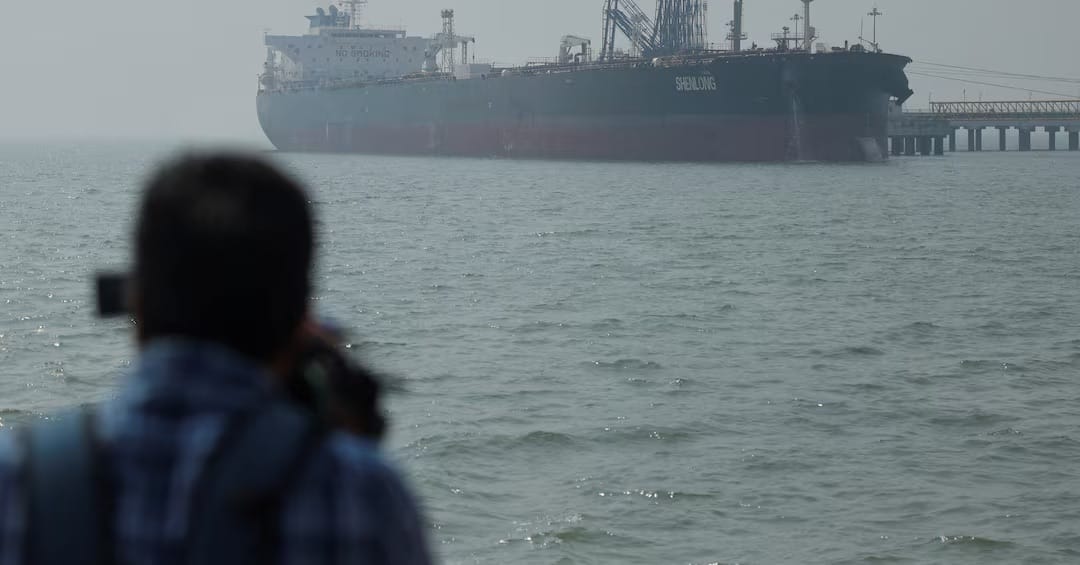
On February 28, 2026, U.S. and Israeli forces launched strikes on Iran. Within days, Iran closed the Strait of Hormuz — the narrow waterway through which roughly one-fifth of the world’s oil supply passes. Brent crude oil, the international benchmark, surged sharply, and even after a ceasefire was announced on April 8, ship traffic through the strait remained far below pre-war levels.
For Argentina, which imports refined fuel even as it exports crude oil from its Vaca Muerta shale fields, the timing was damaging. Economy Minister Luis Caputo acknowledged the connection directly, writing on X that March saw a significant impact from the war in the Middle East, citing increases of 9% in fuel, 24 in domestic airfare, and 22% in intercity transportation.
When fuel gets more expensive, everything that moves or is made with energy gets more expensive too — bus tickets, freight costs, food delivery, and manufacturing inputs. In an economy that was already fighting to bring inflation down, the oil shock arrived at the worst possible moment.
Milei’s Promise — and the Gap
Milei has been characteristically bold in his public forecasts. In a speech in March, Milei said that by August this year, consumer inflation may start with zero. In a separate appearance, he said that by the middle of next year, Argentina’s inflation problem will be over.
When March’s 3.4% number came out, Milei called it “bad” and said inflation “repulses” him — but he promised it would converge to zero by August.
Private economists are not there yet. Full-year 2026 inflation expectations among market analysts have climbed to 29.1% — nearly triple the government’s official 10.1% budget target. Santander Argentina’s chief economist said the bank’s annual inflation estimate has jumped from 16% to 26%, partly because of fuel-price increases tied to the Iran war.
That gap between what the government promises and what the market expects is not unusual in Argentina — governments have been overpromising on inflation for decades. What is different now is that Milei’s economic credibility is one of the few assets underpinning the recovery. If that credibility erodes, so does investor confidence, and with it the peso stability that the entire anti-inflation program depends on.
What the Government Plans to Do
Milei’s approach to inflation has never changed in its fundamentals, regardless of the external shocks. The strategy rests on three pillars.
The first is keeping the government budget in surplus — meaning the government spends less than it collects in taxes. Milei has consistently declared the fiscal surplus non-negotiable, slashing public spending, cutting the number of government ministries by more than half, and laying off tens of thousands of public workers.
The logic is that if the government is not running deficits, it does not need to print pesos to cover them, and less peso printing means less inflation over time.
The second is managing the exchange rate. In January 2026, Milei’s government adopted a new monetary framework, adjusting the peso’s trading bands in line with inflation and building up the Central Bank’s international reserves. Keeping the peso stable is critical — every time the peso weakens significantly, imported goods get more expensive, and inflation accelerates.
The third is betting that the Iran war’s impact on fuel prices is temporary. Economy Minister Caputo said he expects April inflation to decelerate, arguing that as the energy shock from the Middle East conflict passes, the underlying disinflation trend will reassert itself.
The government is essentially asking Argentines to wait out the external shock and trust that the domestic fundamentals are still sound.
Caputo told an audience at the AmCham Summit — alongside executives from Chevron, Cargill, and JPMorgan — that the next 18 months could be Argentina’s best in decades. “The path won’t change,” he vowed.
What it Means for Ordinary Argentines
The macro numbers — GDP growth, fiscal surplus, inflation rate — tell one story. The daily experience of Argentine families tells another.
A family of four needed 1.43 million pesos per month to stay above the poverty line in March 2026. The basic food basket accumulated 11.6 percent in the first quarter alone — rising faster than both general inflation and wages. When the cost of basic food rises faster than what people earn, poverty increases even in an economy that is technically growing.
Unemployment has also shown signs of rising, adding to public frustration over stagnant wages and living costs. A survey found 56% disapproval for Milei, one of the most difficult moments of his presidency in terms of public opinion.
The disconnect between Argentina’s strong macro indicators and the daily financial stress many families still feel is not a contradiction. It is the normal shape of a recovery from a crisis as severe as the one Argentina came through. Inflation at 32% annually is genuinely much better than 211%. It is also still 32% — still eating into wages, still eroding savings, still making it hard to plan for the future.
Milei's bet is that patience will be rewarded. His government has been able to produce remarkable results that no serious economist predicted two years ago. Whether the Iran war’s oil shock is a temporary disruption in a genuine recovery — or the first crack in a fragile construction — is the question Argentina will spend the rest of 2026 answering.
Sociedad Media will continue to monitor Argentina’s economic recovery and the Iran war’s impact on Latin America. Tips and firsthand accounts: info@sociedadmedia.com