

On the same weekend that Washington ordered a Brazilian federal police officer to leave the United States for allegedly using American immigration enforcement as a political weapon against a Bolsonaro opponent, Colombia’s President Gustavo Petro was in Barcelona, warning that this is exactly the kind of behavior that ends empires.
“It is a system like the one the Spanish king had centuries ago,” Petro told the Spanish newspaper El País on the sidelines of the IV Meeting in Defence of Democracy, held on April 18 in Barcelona.
“And what was Latin America’s response? Rebellion. That is what will happen now if the U.S. government is not capable of rethinking its ties to Latin America.”
The remark was the sharpest to emerge from a weekend gathering that brought together an unusually broad coalition of progressive leaders opposed to the current direction of American foreign policy — and it landed, in real time, against a backdrop that gave it an unusual intensity due to the congregation of figures hostile to the administration in Washington.
The Summit
Progressive leaders from across the globe gathered in Barcelona on Saturday for the IV Meeting in Defence of Democracy, hosted by Spanish Prime Minister Pedro Sánchez. Brazilian President Luiz Inácio Lula da Silva, Mexican President Claudia Sheinbaum, South African President Cyril Ramaphosa, Uruguayan President Yamandú Orsi, and Chile’s former President Gabriel Boric were all in attendance.
U.S. Democratic Senator Chris Murphy of Connecticut and Minnesota Governor Tim Walz were also present — a notable detail. The presence of sitting American elected officials at a European summit implicitly framed around emphatic opposition to the U.S. president’s foreign policy is not a diplomatic accident. It was intentional and orchestrated.
Later in the day, a separate but overlapping event — the inaugural Global Progressive Mobilization — drew some 3,000 left-wing elected officials and policy analysts to the same convention center.
Sánchez and Lula both remained for that gathering as well.
The events were explicitly framed as a response to what the assembled leaders described as a global drift toward authoritarianism and the erosion of multilateral institutions. Sánchez told the rally that the populist right “screams and shouts not because they are winning but because they know their time is running out,” adding that their embrace of “climate change denial, xenophobia and sexism” was their greatest error.
Sheinbaum proposed that governments commit to spending the equivalent of 10% of their military budgets on reforestation projects, and said she wanted to put forward a declaration against any military intervention in Cuba — a country Trump has said he believes he will “have the honor” of targeting.
Lula, notably, avoided naming Trump directly, instead calling on U.N. Security Council members to guarantee peace and warning that “the world cannot bear any more wars.”
Petro’s Warning
It was Petro — the most combative voice in the room and the one with the least diplomatic caution — who made the remark that circulated most widely.
In his interview with El País, Petro argued that U.S. pressure on dissenting Latin American leaders could lead to a “rebellion” against Washington’s influence. He said the OFAC sanctions placed on him by the U.S. Treasury were being used as a political instrument to extort “those of us who espouse dissenting politics.”
He pointed specifically to the Trump administration’s January operation against Venezuelan President Nicolás Maduro, which Petro described as an attempt to intimidate regional leaders into compliance. He called Caracas “the first Latin American city to be bombed in its history,” saying it had created “a wound” across the region.
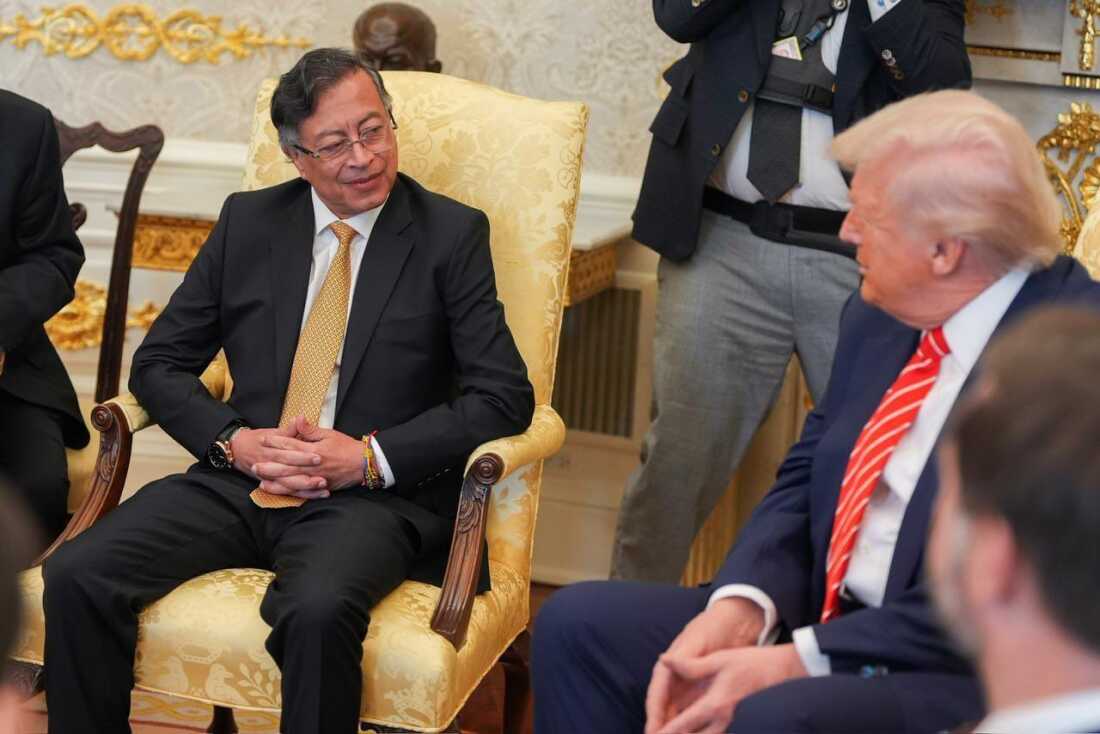
The colonial analogy was deliberate. Petro — a former member of the left-wing M-19 guerrilla movement and Colombia’s first left-wing president — was invoking the independence movements of the early 19th century, when the Spanish crown’s overreach drove the very leaders it sought to control into open revolt.
The implication was that Washington is making the same category of error: using coercive power in ways that unite rather than divide its opponents.
The Contradiction Petro Can’t Escape
The warning carries real weight in the current moment. What it cannot escape is its source.
Petro is set to leave office in August, as the Colombian constitution bars presidents from serving more than a single term. He is making these arguments from the exit. His influence over what comes next in Colombia — let alone across Latin America — is limited and diminishing.
More importantly, the picture he presented in Barcelona was selectively drawn. Petro himself acknowledged that his personal relationship with Trump was good — that the two had spoken twice recently, that they had “shattered false narratives about each other,” and that he had not gone to Washington “to get on his knees to beg” but met Trump as an equal.
A man warning of imminent continental “rebellion” while simultaneously describing a cordial bilateral relationship with the administration he is warning against is not a straightforward messenger.
The broader coalition assembled in Barcelona also has its own contradictions. Lula is managing a delicate relationship with Washington while simultaneously losing the Ramagem battle in U.S. immigration courts.
Sheinbaum leads a country that is hosting the 2026 World Cup alongside the United States — a relationship that creates enormous practical incentives for Mexico to keep tensions managed rather than escalated.
Sánchez is an outspoken Trump critic leading a country that is a NATO ally with deep trade ties to the United States.
Why the Warning Still Matters
The historical analogy Petro reached for has limits — the conditions that produced Latin American independence were decades in the making, rooted in deep structural grievances, and driven by forces far larger than any single leader’s speeches.
A weekend summit in Barcelona is not a rebellion.
But the sentiment driving it is not manufactured. It is a response to a series of real decisions made in Washington that have, in aggregate, signaled to the governments of the region that the old norms of past relationships with previous U.S. administrations are no longer operative — and that the replacement is something they do not fully recognize yet.
What that becomes over the next eighteen months, as Brazil heads toward a presidential election and the World Cup turns the hemisphere’s eyes toward North America, is the central question in U.S.-Latin American relations. Petro is leaving office, but some resentments he raised in Barcelona are not leaving with him.
Sociedad Media will continue to monitor U.S.-Latin America relations. For tips and reporting, contact info@sociedadmedia.com.


