

RIO DE JANEIRO / MIAMI — They had come to watch the sunrise.
Morro Dois Irmãos — the twin-peaked hill above Vidigal and Leblon in Rio de Janeiro’s south zone — is one of the most visited viewpoints in all of Brazil. Tourists hike up before dawn to watch the sun rise over the Atlantic Ocean with Ipanema spread out below. On most mornings, it is exactly what it looks like: extraordinary.
Monday morning, however, was not most mornings.
Shortly after dawn, the Rio de Janeiro Civil Police’s Special Resources Coordination unit launched a major operation in the Vidigal favela, targeting leaders of the Comando Vermelho (CV) — one of Brazil’s most powerful and oldest criminal organizations. Armed members of the faction responded with heavy gunfire. Criminals erected barricades using burning garbage trucks to block the advance of security forces and seal off the road.
The road they sealed off was Avenida Niemeyer — the only ground-level exit from Vidigal, connecting the community to the neighborhoods of São Conrado and Leblon.
With it blocked by burning barricades and live gunfire, approximately 200 people at the top of Morro Dois Irmãos — tourists and local visitors who had arrived for the sunrise canvas — found themselves stranded with no way downhill.
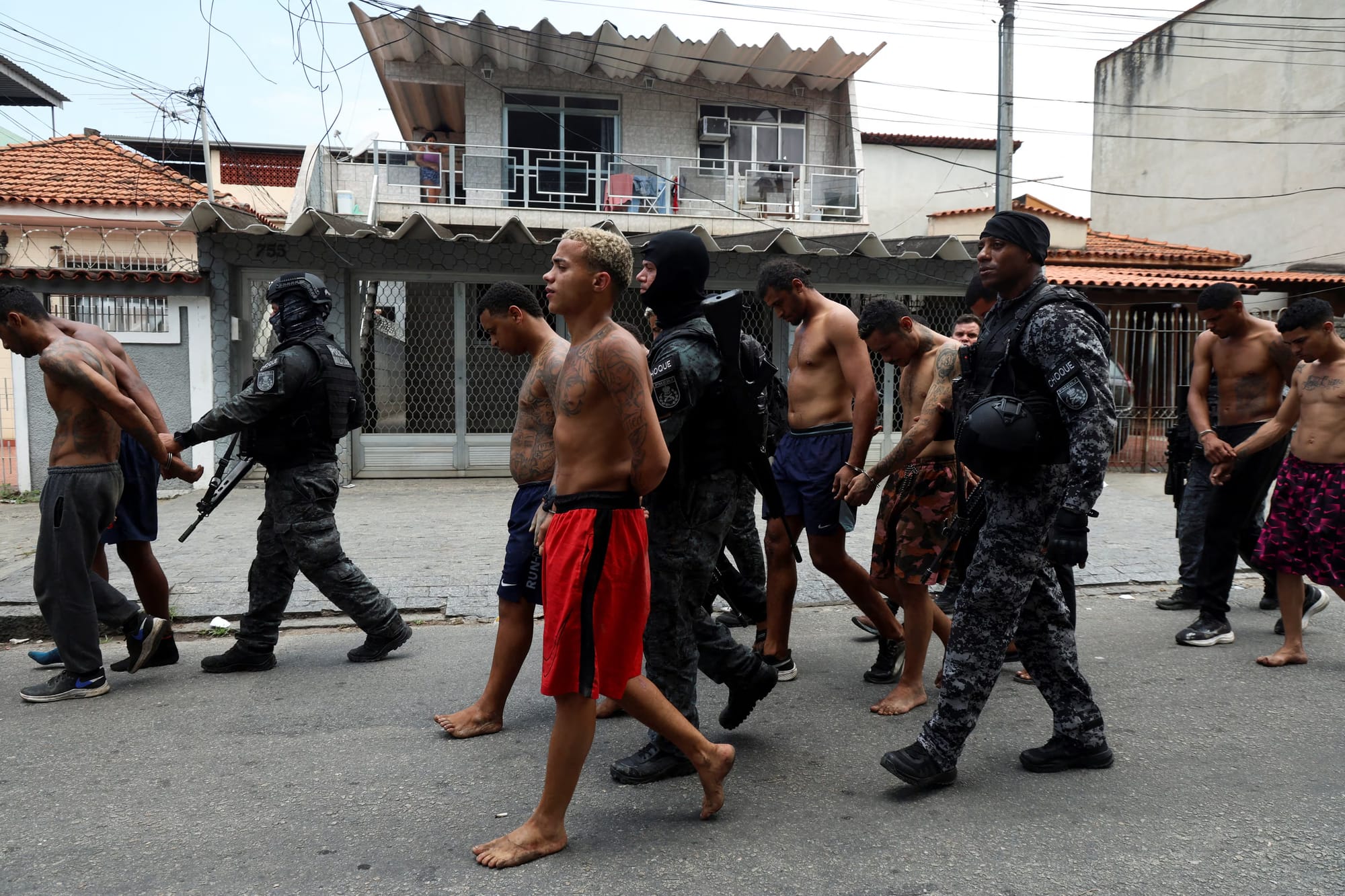
Images captured by tourists show a Civil Police helicopter flying close to the trapped group as they tried to find a safe position on the hillside. Two men were arrested in flagrante, and a woman was detained on a judicial warrant.
All tourists eventually descended without injuries.
Portuguese tourist Matilda Oliveira told reporters the guides asked everyone to sit down when the shooting began. “It’s always frightening, but it was under control as much as possible,” she said.
🚨 OPERAÇÃO PESADA NO VIDIGAL: TURISTAS ILHADOS E MULHER DE CHEFE DO TRÁFICO PRESO!
— COMANDO DAS FAVELAS (@CDFNOTICIA) April 20, 2026
Tiroteio intenso na Zona Sul do Rio nesta segunda-feira (20/4). Durante megaoperação da Polícia Civil no Morro do Vidigal (CV), cerca de 200 turistas ficaram ilhados no Morro Dois Irmãos,… pic.twitter.com/Byd15RYk42
The Comando Vermelho held one of Rio’s most internationally visible tourist destinations hostage for hours on a Monday morning. Nobody was hurt. The operation ended with three arrests. By midday, Avenida Niemeyer had reopened.
But in Washington, the incident landed as something more than a crime story, and may have sealed earlier convictions.
The Designation That is Coming
The Trump administration is moving forward with procedures to classify the Comando Vermelho (CV) and the Primeiro Comando da Capital (CCP) as Foreign Terrorist Organizations (FTOs).
The State Department has completed the technical documentation supporting the designation, and the decision awaits only political approval, according to sources familiar with the U.S. government.
Sociedad Media reported the full dimensions of this standoff on April 8 — the Rubio-Vieira phone call, the sovereignty argument in Brasília, the electoral implications, and the Venezuela parallel that haunts every conversation in the Lula government about Washington’s intentions in the hemisphere.
Monday’s incident in Vidigal does not change the legal or diplomatic calculus. But it does something else: it makes the abstract concrete.
The organization that stranded 200 tourists on a hillside this morning, that set garbage trucks on fire to block a major road in one of Rio’s most international neighborhoods, and forced a police helicopter to circle above a group of visitors trying to find cover — that organization is the one Washington wants to call a terrorist group. And based on current reporting, the signature could come any day.
What the Designation Would Actually Mean
For Sociedad Media readers following this story since March, the legal mechanics are now well established. An FTO designation under U.S. law makes it a federal crime to provide material support to the listed group, triggers asset freezes within the American financial system, and enables immigration restrictions against members and associates. It also — and this is the element that most concerns Brasília — creates legal architecture that the Trump administration has previously used as a precursor to direct action.
The Lula government points explicitly to what it calls the designation-to-action pipeline: in July 2025, the U.S. began naval strikes on Venezuelan drug trafficking vessels after designating the Cartel de los Soles. In January 2026, U.S. special forces captured Maduro in an 18-minute raid. A terrorism-related indictment, followed by designation, followed by military action — that is the sequence Brasília fears being applied to its own territory.
Brazilian Justice Minister Ricardo Lewandowski has argued that “terrorism always involves an ideological element” and that criminal gangs “commit offenses already defined in the Penal Code.”
Former São Paulo prosecutor-general Mario Sarrubbo warned that designating the groups as terrorists would “only make the country vulnerable internationally to economic embargoes and even territorial violations.”
The counterargument from Brazil’s right is equally pointed. São Paulo Governor Tarcísio de Freitas — a leading presidential candidate — called the potential designation “an opportunity,” arguing that once the U.S. views the PCC as a terrorist organization, “it becomes easier to open the way for cooperation, integrate intelligence, access financial resources, and structure an even more effective fight.”
With Brazilian general elections approaching on October 4, 2026, the designation has become a domestic political weapon. Right-wing candidates may embrace it as validation for harder security policies, while the Lula government faces the dilemma of appearing either soft on crime or subservient to Washington. Alternatively, with Lula putting up resistance against the designation, he risks appearing soft-on-crime before his citizens, during an election in which crime is one of the most important issues identified by voters.
The Vidigal Paradox
There is an uncomfortable irony at the center of Monday’s operation that neither the Brazilian government nor the Trump administration has an easy way to resolve.
The operation that stranded 200 tourists was launched jointly by the Rio de Janeiro Civil Police and the Public Ministry of the State of Bahia — targeting CV members from Bahia who were reportedly sheltering in Vidigal. This is exactly the kind of aggressive, cross-state law enforcement operation that Washington says it wants to see more of in Brazil. It produced three arrests. It also produced images of foreign tourists waving to a helicopter from a Rio hillside while a war played out beneath them.
The Comando Vermelho did not choose Monday morning to make a geopolitical point. It responded to a police operation the way it always does — with violence, with gunfire, and with the tools of a criminal organization that has controlled Rio’s favelas for five decades with sheer brutality.
But the timing, and the images, and the international tourists caught in the middle of it — all of it feeds directly into Washington’s argument that Brazil’s most powerful criminal organizations have graduated beyond the category of domestic crime problem.
The designation is not primarily a law enforcement tool in Washington’s hands. It is a signal that the Bolsonaro family’s allies in Washington view Brazil’s gangs the way Brazil’s security-conscious voters already do.
And after Monday morning in Vidigal, it is harder than ever for Brasília to argue that those voters are wrong.
Sociedad Media has been covering the U.S.-Brazil FTO designation standoff since March. Tips and firsthand accounts: info@sociedadmedia.com


