

MIAMI — On Friday night in Phoenix, Arizona, Donald Trump stood before 5,000 supporters at a Turning Point USA rally and said what Miami’s Cuban community has been waiting 70 years to hear from an American president.
“Very soon, this great strength will also bring about a day that has been 70 years in the making. It’s called a new dawn for Cuba,” Trump declared. “We are going to help you with Cuba. We have so many remarkable Cuban-Americans.” He addressed the community directly, describing them as people “brutally treated, whose families were killed and brutalized,” and closed with five words: “And now, watch what happens.”
It was not the first time Trump has said something like this. On March 27 in Miami Beach, he predicted, “Cuba is next.” On March 16, he stated from the White House, “I believe I will have the honor of taking Cuba,” and on April 13, he said, “We might stop in Cuba after finishing with this,” referring to the war with Iran.
But the Phoenix speech landed differently. Because the same week Trump was promising a new dawn from a stage in Arizona, U.S. officials were quietly sitting across a table in Havana — doing something that has not happened since Barack Obama visited the island a decade ago.
The Secret Talks
A senior U.S. State Department official recently met with Raúl Guillermo Rodríguez Castro — the grandson of former Cuban leader Raúl Castro — in Havana, marking a renewed diplomatic push between the two countries. It is the first time a U.S. government plane has touched down in Cuba since Obama visited the island a decade ago.
The talks covered U.S. demands for Cuba to make major changes to its economy and governance, as well as a proposal to provide free internet access to the island through Starlink satellites.
The meeting in Havana came after Secretary of State Marco Rubio had already met with Raúl Guillermo Rodríguez Castro — known as “Raulito” — in February. The U.S. delegation warned that Cuba would not be allowed to become a national security threat in the region.
The Starlink proposal is the most striking new development of the talks. Cuba’s internet is controlled by ETECSA, the state telecommunications monopoly that the government uses as an instrument of censorship — slowing, blocking, or cutting access entirely during protests. Trump’s administration proposed installing Starlink in Cuba in exchange for free elections, the release of political prisoners, and compensation for properties confiscated since 1959.
If accepted, it would give ordinary Cubans unfiltered access to information for the first time — bypassing the regime’s control entirely. The Cuban government has not publicly responded to the Starlink proposal.
When pressed on Capitol Hill about whether negotiations were underway, State Department official Michael Kozak declined to provide details. “If you want to get anywhere with talks of this kind, you don’t do it in public,” he said, suggesting that any potential discussions would remain confidential.
What Miami’s Cuban Community Actually Thinks
The same week the secret talks were being revealed, the Miami Herald published the most comprehensive poll of South Florida’s Cuban community in years — and the results were unambiguous.
The survey, conducted by Bendixen & Amandi International and The Tarrance Group between April 6 and April 10, polled 800 randomly selected Cubans and Cuban Americans across Miami-Dade and South Florida. Seventy-nine percent support U.S. military intervention in Cuba — 36% solely to overthrow the communist government, and 38% responded in favor of an intervention that combines regime change with addressing the humanitarian crisis.
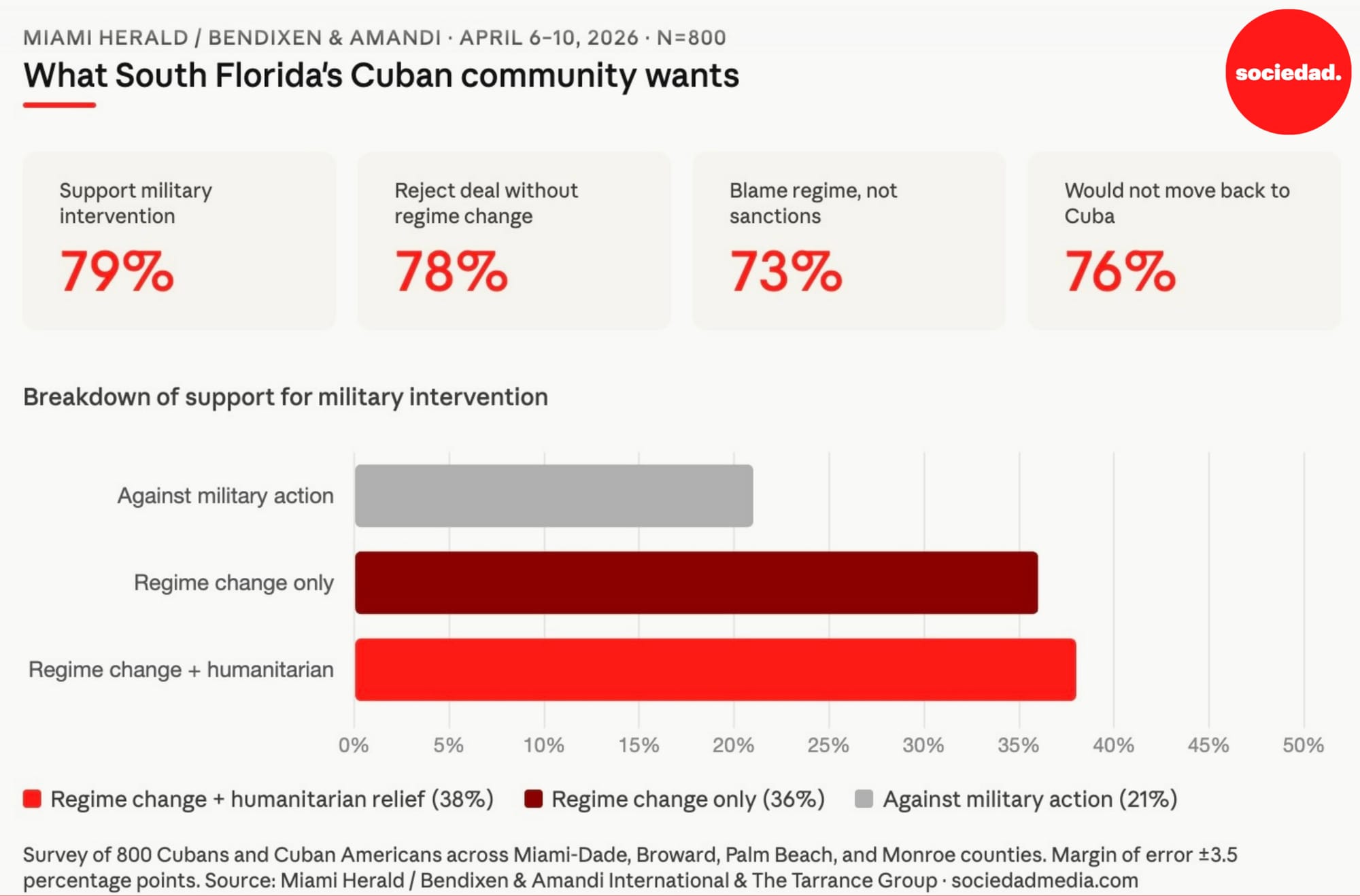
An additional 78% disapprove of any agreement with Cuba that would allow the current government to stay in power in exchange for economic reforms.
Seventy-three percent of respondents also blame the regime — not U.S. sanctions — for the island’s economic and humanitarian crisis
The numbers reflect something Miami’s Cuban community has been saying for months (even decades) — that the Venezuela model is not what they want for Cuba.
“Nothing has actually happened in Venezuela; they are just shuffling ministers around,” said Nelson Emilio Martín, 41, one of the poll respondents who spoke to the Herald. “Let not a single communist remain.”
“Whatever is needed to get the job done,” said another Cuban-American, Javier Yuanis. “My parents are Cuban, my grandparents are Cuban, and we were always told, you know, one day we would love to return to a free Cuba, and they never saw it; a lot of people died.”
At Florida International University, Sebastian Arcos, interim director of Cuban Studies, said the poll confirms what his institution has been arguing for weeks.
“The poll just published by the Herald proves something that we have been saying for over a month now — that there is a Miami consensus on how a transition should take place in Cuba.”
Arcos noted that more recent Cuban arrivals to the U.S. tend to favor a transition that begins with sweeping political changes, including removing members of the Castro family from power.
Cuban American artist Willy Chirino expressed conditional support. “I’d rather have an intervention unless there is another way that we could do it diplomatically,” Chirino said.
The Disconnect Washington Needs to Reckon With
The finding reflects growing unease in the Cuban community with Trump’s Cuba strategy. He has forged a de facto blockade of oil shipments to the island to pressure the communist government — but he appears more interested in striking an economic reform deal than in toppling a repressive regime.
That gap — between what Washington appears to want from Cuba and what Miami’s Cuban community demands — is the central tension in the story right now. The Trump administration is reportedly considering four potential strategies: forging an economic agreement; initiating regime change; launching military intervention; or doing nothing.
Analysts describe the situation as politically volatile with no straightforward solutions.
Representative María Elvira Salazar told a State Department official during a congressional hearing: “We are not going to do business with the Castros. They need to leave and start from scratch.” Congressman Carlos Giménez, the only member of Congress born in Cuba, cautioned that the regime’s intent is to buy time: “All they want is time, time to survive. And they are very skilled at that.”
On the other side, John Kavulich, president of the U.S.-Cuba Trade and Economic Council, suggested: “Nobody should be surprised if Steve Witkoff and Jared Kushner eventually find themselves in Havana negotiating with the Cuban government.”
Cuba’s Response: Defiance Backed by Oxen
The Cuban government has responded to all of it — the Phoenix speech, the secret talks, the Starlink proposal, the polls — with its characteristic combination of revolutionary rhetoric and increasingly visible economic desperation.
On April 16, marking the 65th anniversary of Fidel Castro’s declaration of the socialist character of the Cuban Revolution — and the eve of the Bay of Pigs anniversary — Díaz-Canel struck a defiant tone. “The moment is extremely challenging and calls upon us once again, as on April 16, 1961, to be ready to confront serious threats, including military aggression,” he said.
“Cuba is not a failed state. Cuba is a besieged state,” he declared.
But the defiance has limits that are increasingly visible. Cuba declared 2026 the “Year of Defense Preparation” and launched military exercises. The April 11 exercises in Villa Clara — showcasing anti-aircraft artillery pulled by oxen and mules carrying supplies — revealed the true deterioration of the Cuban armed forces and sparked widespread ridicule on social media.
Cuba’s May 1 labor demonstration has been called under the slogan “The Homeland is Defended” — a distinctly warlike and anti-American tone that reflects the escalating tensions between Havana and Washington. The regime is preparing its people for confrontation. Whether the confrontation comes — and what form it takes — is the question that not even Trump’s five-word warning from a Phoenix stage can answer.
What Miami’s Cuban community has made clear is that they already know which answer they want. The question is whether the administration that promised them a “new dawn” can actually deliver it — or whether Cuba becomes Venezuela: a deal that changes the name at the top and leaves the system intact.
Seventy years is a long time to wait — and Miami’s Cuban community is not inclined to wait much longer.
Sociedad Media covers Cuba & its direct impact on Miami’s Cuban community. For stories and firsthand accounts of experiences on the island, reach out to the outlet: info@sociedadmedia.com


