

In April 1982, the United States faced one of the more uncomfortable foreign policy dilemmas of the Cold War: a close NATO ally and a key hemispheric partner had gone to war over a remote archipelago in the South Atlantic, and Washington had to choose a side. It chose Britain. Secretary of Defense Caspar Weinberger overruled colleagues who wanted to preserve U.S. neutrality and provided the British task force with intelligence, logistics, and materiel support that proved decisive in the 74-day conflict.
Argentina surrendered on June 14, 1982. The Falkland Islands — Las Malvinas to every Argentine — remained British. And the United States’ position on the question of sovereignty, for the four decades that followed, remained what it had effectively been since the war: the islands are administered by the United Kingdom, the islanders have the right to self-determination, and Washington does not challenge British control.
That position is now, for the first time since 1982, explicitly under review.
The Memo That Changed the Conversation
An internal Pentagon email, prepared by Elbridge Colby — the Pentagon’s top policy adviser and one of the most influential foreign policy voices in the Trump administration — outlines a menu of options for punishing NATO allies that refused to grant the United States access, basing, and overflight rights for the Iran war. The memo describes such cooperation as “just the absolute baseline for NATO” and expresses frustration at what it characterizes as a sense of entitlement among European allies.
Among the options outlined: the potential suspension of Spain’s NATO membership for refusing to permit U.S. forces to use Spanish bases to launch attacks on Iran, and a reassessment of U.S. diplomatic support for longstanding European “imperial possessions” — with the Falkland Islands cited explicitly.
The memo is an internal policy document, not a formal statement of U.S. government position. The Pentagon declined to confirm its contents in detail, with press secretary Kingsley Wilson saying only that “the War Department will ensure that the President has credible options to ensure that our allies are no longer a paper tiger.”
The White House has not formally announced any change in U.S. policy on Falklands sovereignty.
But the significance of the memo is not what it formally declares. It is what it signals — that within the highest levels of the Trump administration’s defense establishment, the Falklands question is now on the table as a diplomatic instrument. That is a first.
1982: What Actually Happened & Why the U.S. Role Mattered
To understand why Washington’s position matters so much, you need to understand what it was in 1982 — and why its evolution since then has shaped the dispute’s frozen state.
The Falklands War began on April 2, 1982, when Argentine forces invaded and occupied the Falkland Islands, followed by South Georgia the next day. The British government dispatched a naval task force five days later. The conflict lasted 74 days and ended with an Argentine surrender on June 14.
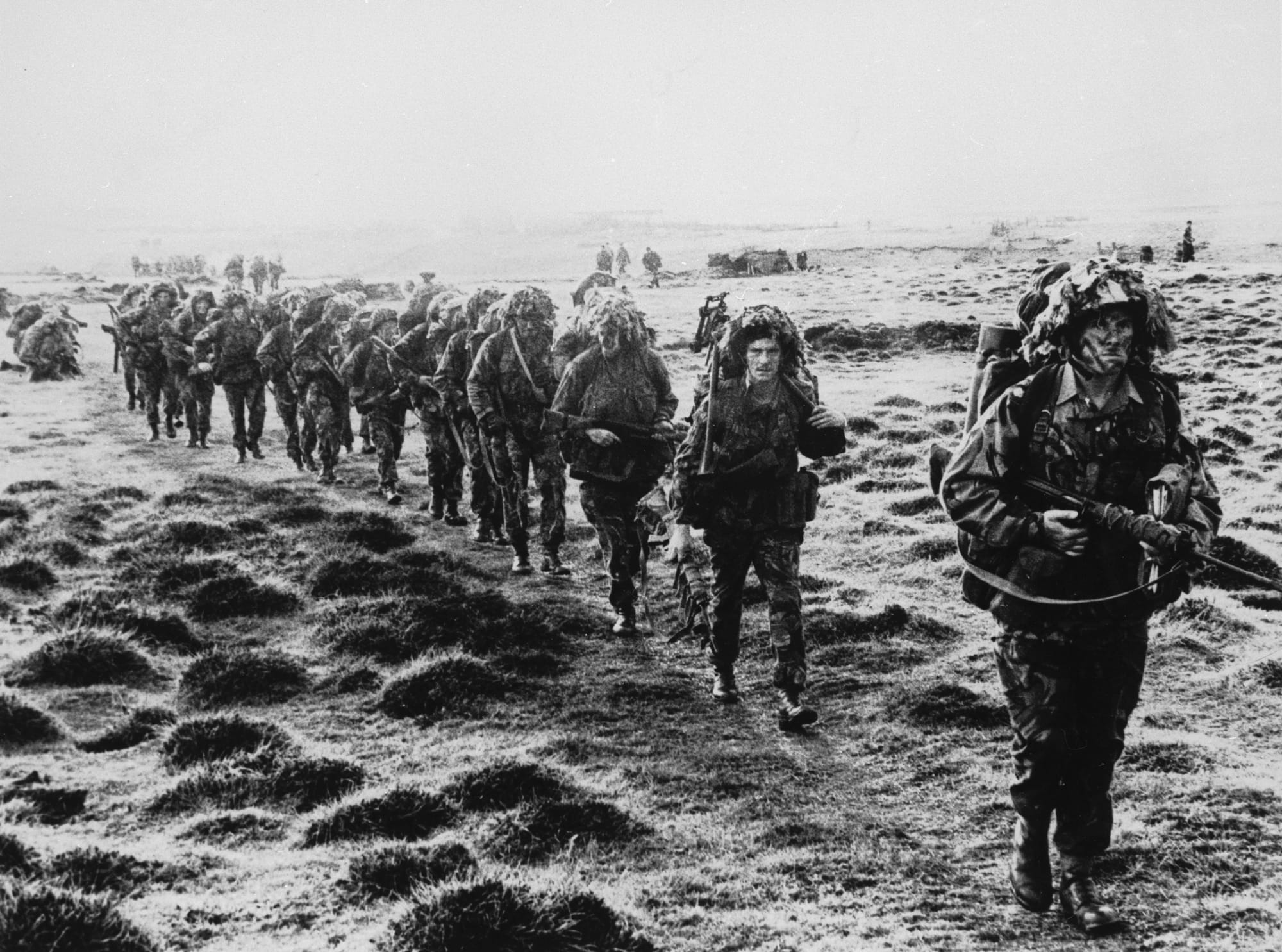
In total, 649 Argentine military personnel, 255 British military personnel, and three Falkland Islanders were killed.
The Reagan administration’s handling of the crisis was far from straightforward.
Ambassador to the United Nations Jeane Kirkpatrick did not want to alienate the Argentines, regarded as key partners in resisting Soviet-directed communist influence in the Western Hemisphere, while Secretary of Defense Weinberger argued strongly for supporting the British.
The clash between their positions reflected a genuine tension: Argentina was a Cold War partner; Britain was Washington’s closest ally.
Weinberger won the internal argument. The support he provided — Sidewinder missiles, satellite intelligence, use of the British territory of Ascension Island as a logistics hub — was not marginal. British officials have said privately and publicly that without American support, the outcome of the war might have been different.
The British claim to sovereignty rests on two pillars: continuous administration of the islands since 1833, with the brief exception of the 1982 occupation, and the principle of self-determination — the right of the islands’ population, which is overwhelmingly of British descent and identity, to determine their own future.
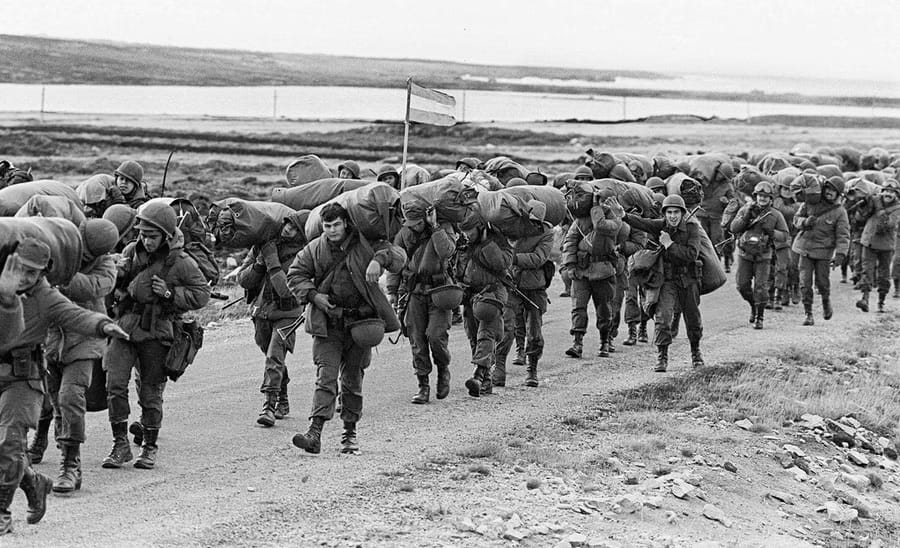
The Falkland Islands have a population of around 3,200 people, situated 300 miles from the southern extremity of Argentina and 8,000 miles from the United Kingdom.
Argentina’s claim rests on different foundations: the argument that the islands were inherited from Spain after Argentine independence in 1816, and the concept of territorial continuity — that the islands are geographically part of the Argentine continental shelf and should be part of the Argentine state. For many Argentines, Las Malvinas are not a foreign policy position. They are a matter of national identity — a wound that the 1982 defeat deepened rather than closed.
The Sovereignty Dispute’s Legal Architecture
The dispute has never been resolved diplomatically, and the legal architecture surrounding it is deliberately ambiguous — maintained in a state of productive vagueness that has allowed both governments to coexist without formally acknowledging their incompatible positions.
The Falkland Islands have been on the United Nations’ list of non-self-governing territories since 1946, and its Special Committee on Decolonisation has been considering the Falklands since 1964. The UN has repeatedly called on Argentina and the United Kingdom to negotiate, but no sovereignty talks have occurred since Argentina invaded in 1982.
Both parties maintain their respective positions.
The U.S. State Department’s website describes the islands as “administered by the United Kingdom, claimed by Argentina” — a formulation that carefully avoids endorsing either sovereignty claim while acknowledging British administrative reality. It is a formula that has served Washington’s interests for four decades: maintaining the alliance with Britain while not formally alienating Argentina.
What the Colby memo proposes is abandoning that studied ambiguity — not as a principled position on the merits of the sovereignty dispute, but as a transactional punishment for NATO non-compliance in a separate conflict.
The Falklands question, in this framing, is not a matter of historical rights or the self-determination of 3,200 islanders. It is a bargaining chip.
Milei, Trump & the Strategic Realignment
The Pentagon memo arrived in the context of a U.S.-Argentina relationship that has been deepening steadily since Javier Milei took office in December 2023 — and that has accelerated dramatically in the months since the Iran war began.
Milei moved immediately when the memo became public. “THE MALVINAS WERE, ARE, AND ALWAYS WILL BE ARGENTINE,” he posted on X in capital letters.
In a radio interview, he said Argentina was doing “everything humanly possible” to bring the islands back under Argentine control — framing the Pentagon memo not as a threat but as progress.
Argentina’s Foreign Minister also moved quickly, writing on X that Argentina was ready to pursue a “peaceful and definitive solution” to the sovereignty dispute and expressing willingness to resume bilateral negotiations with the United Kingdom.
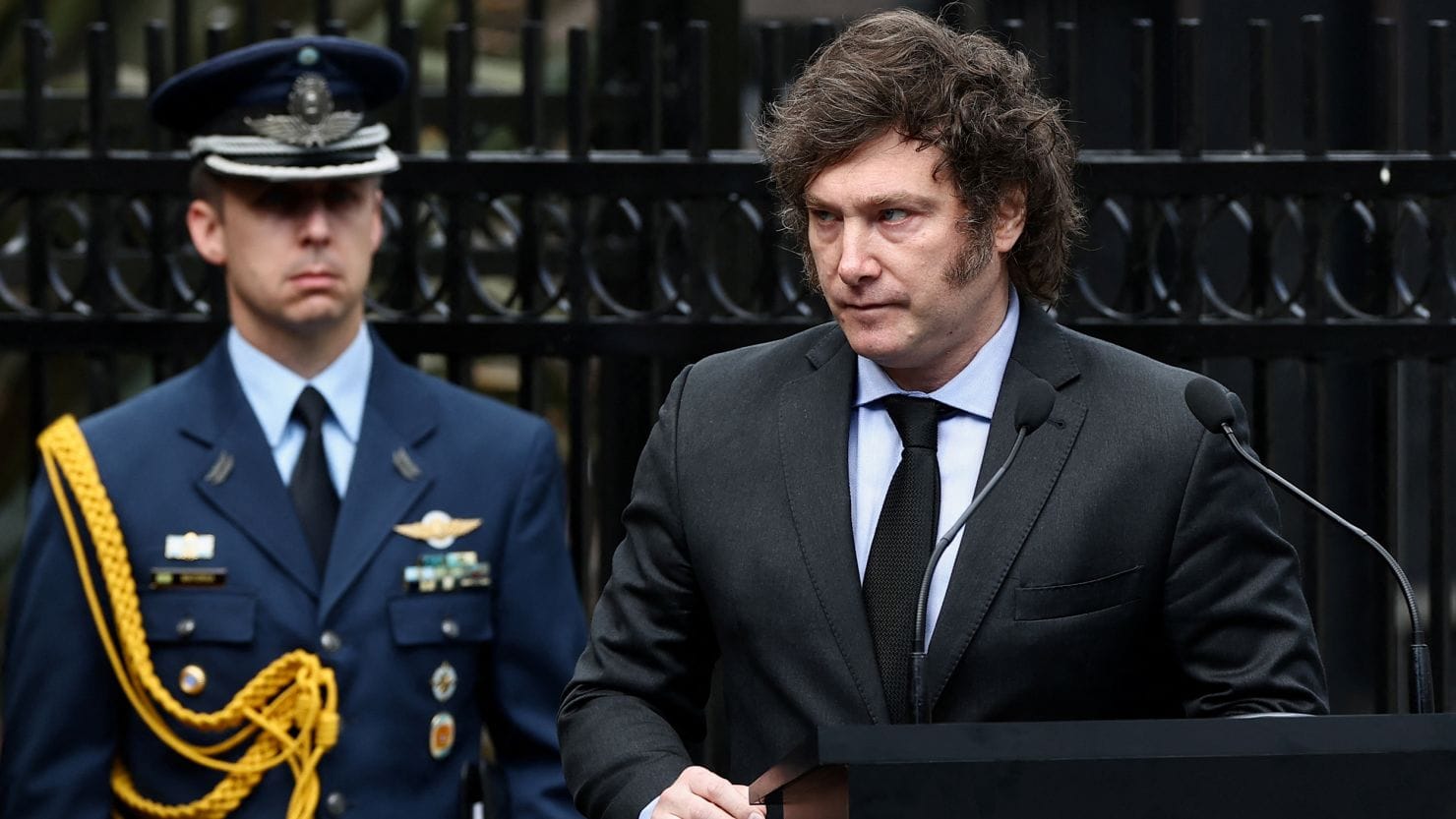
The timing is not incidental. Earlier this week, Sociedad Media reported that Milei signed Decree 264/2026 authorizing U.S. Armed Forces personnel to operate on Argentine soil for Operation Daga Atlántica — joint military exercises running through June 12 — bypassing congressional approval to do so. The USS Nimitz and USS Gridley are conducting naval exercises in Argentina’s Exclusive Economic Zone this week. U.S. C-17 and C-130 transport aircraft have already landed at Argentine military installations.
In that context, the Pentagon memo takes on a different character. Washington is simultaneously conducting joint military exercises on Argentine soil, floating a review of its support for British sovereignty over Argentine-claimed territory, and operating in a bilateral relationship that Milei has explicitly described as one of his administration’s defining strategic priorities.
Whether these developments are coordinated or coincidental, their cumulative effect is the same: Argentina is being positioned as Washington’s most capable and willing security partner in South America at a moment when the U.S.-UK relationship is under strain over the Iran war.
London’s Response — and its Limits
Britain’s response has been firm and predictable — and also revealing in what it cannot say.
Downing Street was unequivocal: “We could not be clearer about the UK’s position on the Falkland Islands. Sovereignty rests with the UK, and the Islands’ right to self-determination is paramount. That’s been our consistent position and will remain the case.”
The political reaction in Britain cut across party lines. Reform UK leader Nigel Farage — who plans to visit Argentina — vowed to raise the matter directly with Milei:
“This is utterly non-negotiable. There is no way we’re even going to have a debate about the sovereignty of the Falkland Islands.”
Conservative leader Kemi Badenoch dismissed the American position as “absolute nonsense,” comparing Trump’s remarks to his previous comments about Greenland. Lord West described the Pentagon’s list of potential punishments as “extraordinary on many levels,” calling any mention of the Falkland Islands “an insult to its autonomous, self-reliant and free people.”
What London cannot say publicly — but what the Foreign Office has been quietly gaming out — is the scenario in which U.S. support for British sovereignty is formally withdrawn or meaningfully downgraded. The potential for a shift in the U.S. position had been considered in the Foreign Office as a “hypothetical scenario.”
Ben Judah, a former special adviser to the foreign secretary, suggested the United Kingdom consider converting the islands from overseas territories to overseas kingdoms represented by MPs elected to Westminster — a constitutional reclassification designed to make them harder to treat as colonial remnants subject to decolonization arguments.
The Falkland Islanders themselves have not yet been heard from publicly in this latest round. In a 2013 referendum, 99.8% of islanders voted to remain a British Overseas Territory. Their position on the sovereignty question is not ambiguous. What is ambiguous — for the first time in four decades — is whether the superpower that helped make their position stick in 1982 still considers it a priority worth defending.
What a U.S. Position Shift Would Actually Mean
The practical consequences of a formal U.S. reassessment of Falklands sovereignty would be significant but not immediate — and the distinction between a formal shift and a rhetorical signal matters enormously.
If the United States were to formally recognize Argentine sovereignty claims — or even to adopt a position of genuine neutrality that it pressed both governments to resolve through negotiation — it would remove the most powerful external stabilizer of the status quo. Britain’s ability to maintain the islands depends not just on military capability, which remains formidable, but on the diplomatic isolation of the Argentine sovereignty claim. A U.S. shift would end that isolation and give Argentina international legitimacy it has never had since 1982.
It would also have implications that extend well beyond the South Atlantic.
NATO’s credibility as a mutual defense framework — already under strain from the Iran war divisions — would face a new question: if the United States can weaponize the sovereign territorial integrity of a NATO member as a bargaining chip in a bilateral dispute, what does collective security mean? The precedent would not be lost on other alliance members watching from Warsaw, Tallinn, and Vilnius.
For Latin America, the implications run in a different direction. A U.S.-Argentina alignment that encompasses both military cooperation and diplomatic support for Argentine territorial claims would represent the most significant shift in hemispheric security architecture since the Cold War. It would signal that Washington’s approach to the region is no longer organized around multilateral institutions and the OAS framework — but around bilateral relationships with aligned leaders, rewarded with strategic dividends that previous U.S. administrations would not have considered on offer.
Whether the Colby memo represents a serious policy direction or a tactical pressure tactic directed at London will become clearer in the weeks ahead. What is already clear is that the Falklands question — frozen since 1982, maintained in diplomatic limbo by mutual exhaustion and American stability — has been unfrozen.
The 3,200 people living on those islands, and the two governments whose flags they have flown under, are watching Washington in a way they have not had to since the spring of 1982.
Sociedad Media is monitoring U.S.-Argentina relations, regional security developments, and the Falklands sovereignty dispute. For tips and reporting, contact info@sociedadmedia.com


