

Sociedad Media is monitoring.
MIAMI — On Wednesday morning, the U.S. Embassy in Caracas posted a brief farewell message on X. It was signed by Laura F. Dogu, the career diplomat who had arrived in Venezuela three weeks after U.S. special forces captured Nicolás Maduro, reopened an embassy that had been shuttered for seven years, and spent the most consequential 100 days in U.S.-Venezuela relations in decades standing beside Delcy Rodríguez at oil signings, military reshuffles, and diplomatic ceremonies that would have been unimaginable a year ago.
“I am deeply grateful to President Trump and Secretary Rubio for entrusting me with the task of leading the implementation of their plan here in Venezuela and representing the U.S. during this historic moment as we build a solid relationship between our two countries,” Dogu said in her statement.
She confirmed she will return to her previous post as Foreign Policy Advisor to the Chairman of the Joint Chiefs of Staff, and that diplomat John Barrett will arrive shortly in Caracas to assume the role of new U.S. Chargé d’Affaires.
The departure had a slightly awkward prelude. On Tuesday, April 14, the U.S. State Department denied reports of a change, confirming to EFE that Dogu remained in her post. Less than 24 hours later, she announced her own departure. The sequence — denial followed by confirmation — reflects the compressed, improvised quality of a diplomatic relationship that has moved faster than the institutional machinery designed to manage it.
Who Was Dogu in Venezuela?
To understand what her departure means, it helps to understand what Dogu represented in Caracas during this period.
Dogu was named Chargé d’Affaires for Venezuela at the end of January 2026 — three weeks after the capture of Nicolás Maduro and two months before Washington announced the reopening of its embassy in Caracas, closed since the rupture of diplomatic relations in 2019.
She was the right person for the specific moment the transition required. A two-time U.S. Ambassador to Honduras and to Nicaragua — with prior postings in Mexico, Turkey, Egypt, and El Salvador — Dogu brought both regional credibility and an unusual combination of civilian diplomatic and national security experience. Her prior role as Deputy Director of the FBI’s Hostage Recovery Fusion Cell and Foreign Policy Advisor to the Chairman of the Joint Chiefs of Staff gave her a profile that was deliberately calibrated to the security-first, stabilization-first nature of the transition’s opening phase.
She was present at every significant moment. She stood beside Rodríguez and Energy Secretary Chris Wright at the Orinoco Belt oil facility in February. She attended Monday’s Chevron signing at Miraflores Palace. She was in the room when U.S. Assistant Secretary of Energy Kyle Haustveit visited Caracas. Her presence at each of these events was not incidental — it was the physical expression of Washington’s operational commitment to a relationship it had chosen to build through her.
Who is Barrett — and What His Profile Signals?
The contrast between Dogu’s background and her successor’s is the most significant element of Wednesday’s announcement.
John Barrett’s professional background highlights experience as an Economic Affairs Counselor in Peru and a consular leader in Recife, Brazil. He holds an MBA from the University of Pennsylvania and brings a more technical and economic profile, aligned with the current phase of political transition Venezuela is navigating in 2026. His agenda is expected to focus on two pillars: migration control and counter-narcotics cooperation.
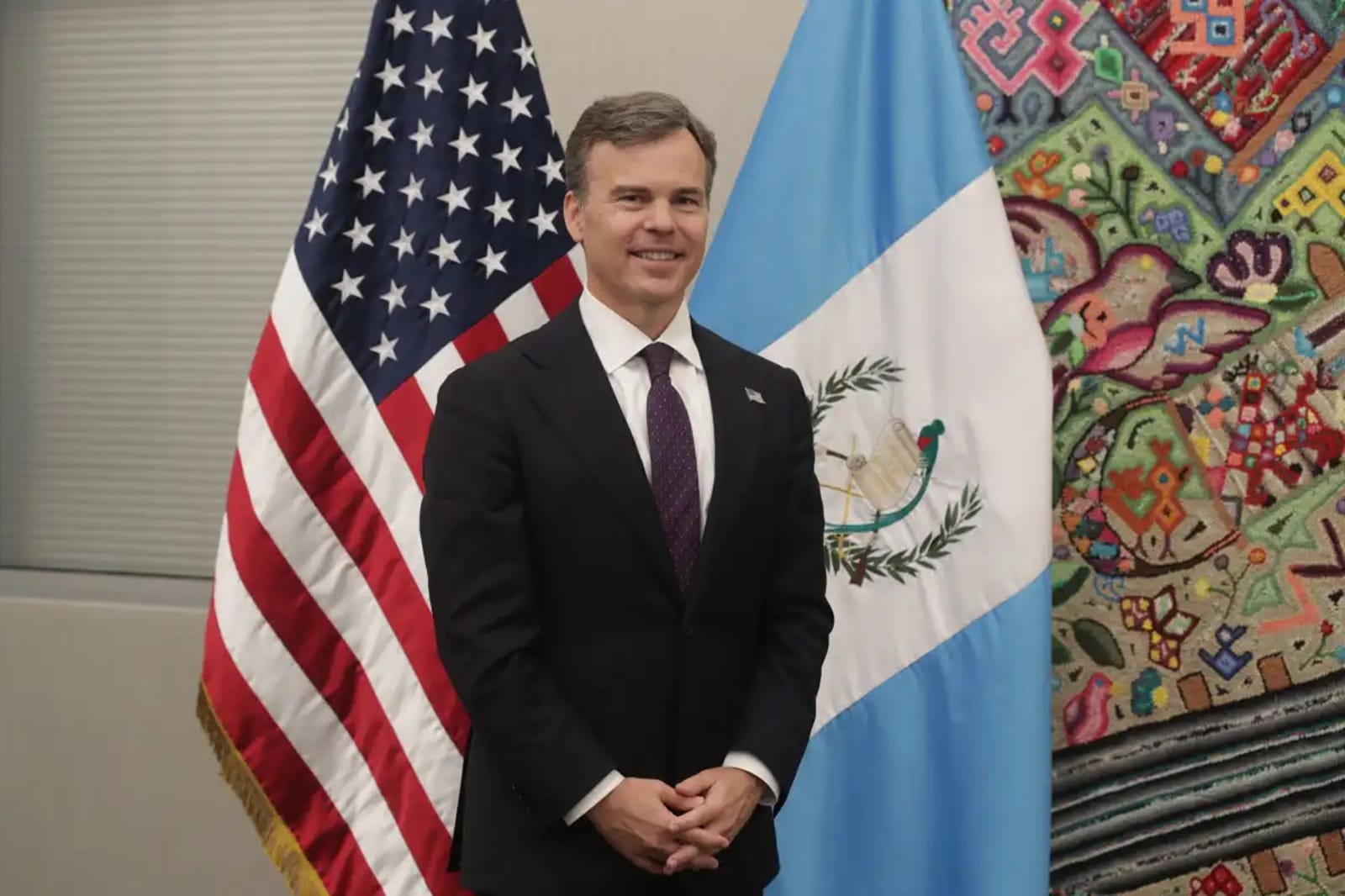
Dogu was a security and political diplomat sent to stabilize a relationship in its most volatile phase. Barrett is an economic diplomat being sent to deepen it. That sequencing is deliberate. The stabilization phase — embassy reopening, diplomatic recognition, oil licensing framework, military reshuffle management — has been completed. The next phase, in Washington’s three-phase framework, is economic recovery. Barrett’s MBA and his experience in the Andean nation of Peru make him the operational expression of that shift.
Barrett’s appointment lands against a backdrop of rapid institutional change in Venezuela’s financial architecture. On April 14 the U.S. Treasury lifted sanctions on Venezuela’s Central Bank. On April 16 the IMF voted to restore formal relations with Venezuela for the first time in seven years. The IMF projects Venezuela's economy will grow 4% in 2026 and 6% in 2027 — projections that would have been unthinkable at the start of the year.
Barrett now inherits not just a diplomatic mission but the operational management of the most ambitious U.S. economic engagement with Venezuela in two decades.
The Three-Phase Framework and Where it Stands
Dogu’s departure comes precisely at the 100-day mark of the transition — a milestone that Venezuelan media, opposition analysts, and Washington’s own officials have used as a measuring stick.
Wright mentioned 18 to 24 months as a reasonable timeline for elections, while others have cited 2030 as a target date for free and fair elections. Secretary of State Marco Rubio has spoken only of the three stages — stabilization, economic recovery and reconciliation, and transition — without specifying what these stages entail or how long they are expected to last.
On the stabilization phase — Phase 1 — the record is concrete. The embassy is open. Diplomatic relations are restored. Oil licenses have been issued. Chevron has expanded its Orinoco stake. Shell is close to signing. Venezuela’s oil production rose from one million to 1.095 million barrels per day between February and March. The amnesty law passed. Some political prisoners were released. The military high command was reshuffled.
On Phases 2 and 3 — economic recovery and democratic transition — the record is thinner. No election date has been announced. No electoral authority has been reformed. The constitutional mandate for a new election expired months ago without resolution. Workers who marched on Miraflores last week, demanding wages above $1 per month, were met with tear gas. María Corina Machado, whose return to Venezuela is imminent according to her party, has not yet landed — and Rodríguez has publicly stated she should “answer to Venezuela” for supporting the U.S. operation that removed Maduro.
What Dogu’s Exit Means for the Opposition
The timing of Dogu’s departure intersects with two other significant developments that together define the political landscape into which Barrett will arrive.
The Prime Minister of the Netherlands met with María Corina Machado on April 15 and promised European pressure for a democratic transition. The meeting — the first confirmed encounter between Machado and a European head of government since her announced return to Venezuela — signals that the European diplomatic track is beginning to activate in parallel with Washington’s operational track. Whether those two tracks produce a unified message to Rodríguez about election timelines remains to be seen.
Meanwhile, in Washington, Trump and his team urged Machado in a March 6 meeting to be patient and to avoid rushing to return to Venezuela to avoid potential problems. That advice — patience, restraint, deference to Washington’s managed timeline — is exactly what Machado’s return to Caracas will test. Her physical presence in Venezuela will force the democratic transition question onto the agenda in a way that no amount of diplomatic patience can prevent.
Barrett arrives in Caracas to manage a relationship that is economically deepening and politically unresolved. The oil deals are real. The Chevron stake has expanded. Shell is signing. The financial architecture is in place. The election date is not.
The problem, as Foreign Policy’s Christopher Sabatini wrote, is that Venezuela watchers have become consumed by which of the country’s two women leaders — Rodríguez and Machado — will define its future. What neither Washington nor Caracas has yet answered is what the process that decides between them actually looks like, and who controls it.
That is the question Barrett inherits. Dogu handed him an embassy, an oil framework, and a transition without a democratic roadmap.
Sociedad Media will continue to monitor U.S.-Venezuela diplomatic developments. For stories, tips, and inquiries, reach out to the outlet: info@sociedadmedia.com


