

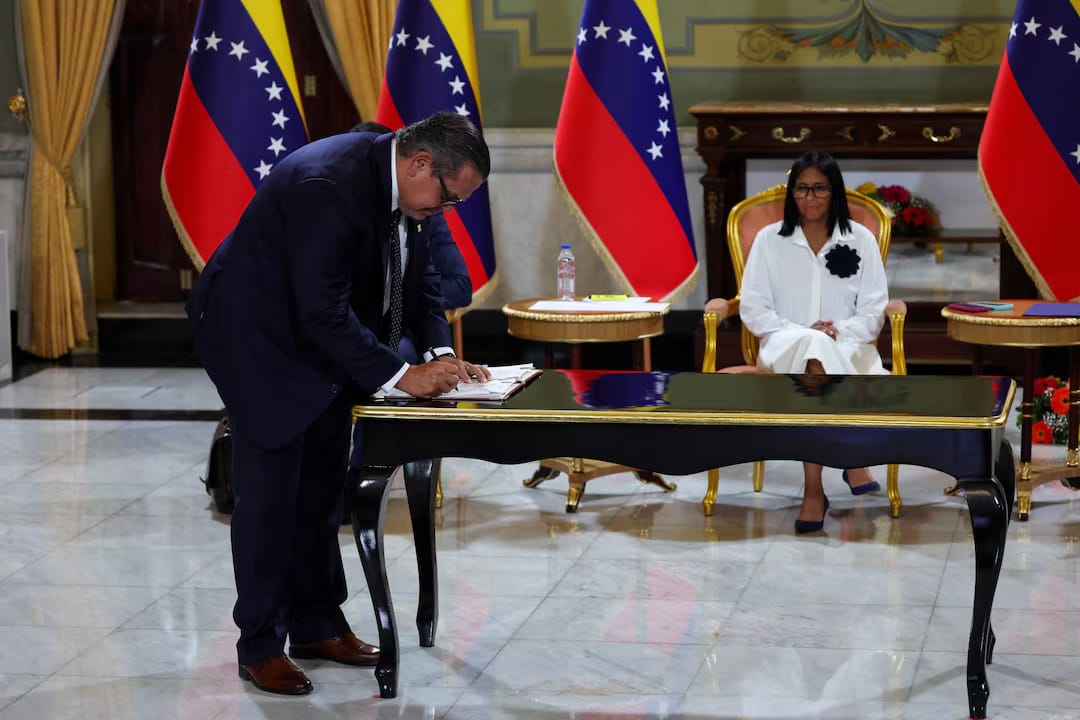
MIAMI — On Monday afternoon, inside the Miraflores presidential palace — the same building where Nicolás Maduro governed Venezuela for a decade before U.S. special forces removed him in January — Delcy Rodríguez stood alongside executives from one of the world’s largest oil companies and signed what her government called a historic agreement.
Chevron signed two agreements to expand operations at Venezuela’s vast Orinoco Belt, including an asset swap adding an extra-heavy crude area to its main project while returning an offshore gas field and a small crude area. The deals were signed by company executives led by Javier La Rosa, head of Chevron’s Base Assets and Emerging Countries, and officials from Venezuela’s state-owned oil conglomerate PDVSA in the presence of acting President Delcy Rodríguez.
The signing ceremony at Miraflores Palace was attended by U.S. Chargé d'Affaires Laura Farnsworth Dogu and Assistant Secretary of Energy Kyle Haustveit, Washington’s most senior energy official present in Caracas since the transition began.
It was, in one image, the state of U.S.-Venezuela relations in April 2026: an American oil major expanding its footprint in the world’s largest proven crude reserves, a U.S. energy official in the room to witness it, and a Venezuelan acting president who spent years as one of Maduro’s most hardline lieutenants presiding over a ceremony that would have been unimaginable more than three months ago.
What Was Signed
The details of Monday’s agreements are specific and significant.
The deals include the increase of Chevron’s stake at one of its joint ventures with PDVSA in the Orinoco belt, Petroindependencia, to 49% from a previous 35.8%. The company also agreed to relinquish two gas blocks that include the coveted Loran offshore field and its stake at a small oil project in western Venezuela, while receiving a new oil area, Ayacucho 8, as part of its existing Petropiar project — also in the Orinoco and Chevron’s largest operation in the country.
In practical terms, Chevron is making a strategic bet on extra-heavy crude — Venezuela’s most abundant and commercially promising resource — while returning gas assets it had not developed.
The deals give Chevron, PDVSA’s main joint venture partner, a strong foothold to expand heavy oil projects in the country amid expected increased competition with foreign companies.
The current Chevron-PDVSA joint ventures produce approximately 260,000 barrels per day, representing roughly one quarter of Venezuela’s total national crude output. U.S. Energy Secretary Chris Wright, who visited the Orinoco Belt in February, projected Chevron could reach 300,000 barrels per day as the expansion takes effect.
Shell is Next
Monday’s Chevron signing is the opening act of a broader reconfiguration of Venezuela’s energy sector that has been building since January’s hydrocarbon law reform.
Shell, which is developing Trinidad’s portion of the Loran-Manatee gas field, expects to send as much Venezuelan gas to Trinidad as possible for processing into liquefied natural gas — a major push for its shared Atlantic LNG project, which has been unable to reach capacity due to insufficient gas supply. Shell executives signed preliminary agreements with Rodríguez’s administration in March to advance the 4.2-trillion-cubic-foot Dragon gas project and the Carito and Pirital onshore crude and gas areas.
A formal signing is expected imminently.
Beyond Chevron and Shell, BP, Eni, and Repsol have received U.S. authorization to resume operations and sign investment agreements in Venezuela. The current regulatory framework favors U.S. and Western companies while maintaining strict restrictions on entities from China, Russia, and Iran. That last clause is not incidental — it is a central feature of Washington’s strategy, designed to displace the Chinese and Russian energy presence that developed under Maduro’s sanctions-era workarounds.
The Sanctions Architecture Behind the Deal
The Miraflores ceremony was made legally possible by a series of U.S. Treasury Office of Foreign Assets Control general licenses issued in rapid succession since January. OFAC issued General License 46 on January 29, authorizing a broad set of activities related to Venezuelan-origin oil exports. Subsequent licenses — GL 47 through GL 51, issued between February and March — authorized the sale of U.S.-origin diluents to Venezuela, the supply of goods and services for oil and gas exploration and production, negotiations of new investment contracts, and activities related to Venezuelan-origin gold.
The framework is deliberately structured to advantage companies operating within Washington’s orbit. Payments flow through mechanisms designed to prevent revenue from reaching sanctioned individuals, including provisions for Foreign Government Deposit Funds established by executive order.
Companies must file detailed reports to the State Department and the Department of Energy. The legal architecture is, in effect, a U.S.-supervised oil economy — Washington does not just approve the deals, it monitors and structures the financial flows from them.
Rodríguez’s Part of the Bargain
At the signing, Rodríguez framed the deal in terms of Venezuelan national interest while simultaneously signaling continued frustration with the sanctions framework. She stated that the agreement came after “days of negotiations” and described it as evidence that “there are legal pathways” for investments to be secure in Venezuela and to have “a prosperous future.” She also added that revenues from increased production would go “directly” to “shared benefit” between both nations.
Rodríguez used the platform to press Washington on the sanctions question directly. The acting president said she always uses these occasions to insist on advancing toward “a Venezuela without sanctions,” expressing to the U.S. embassy representative that removing them would provide greater legal and institutional security for investors — signaling that this is not a one-time investment but a long-term commitment.
The statement reflects the fundamental tension at the heart of the transition. Rodríguez needs sanctions relief to fully unlock Venezuela’s energy potential and deliver the economic improvements her government has promised. Washington is using the prospect of that relief as the primary lever to extract compliance on oil production, political prisoner releases, democratic reforms, and the broader transition framework.
Every deal signed at Miraflores narrows Washington’s leverage slightly. Every sanction that remains gives Washington a card to play.
The Production Picture
Venezuelan oil production rose 7.24% between February and March 2026, climbing from 1,021,000 to 1,095,000 barrels per day. That is meaningful progress from the lows of the Maduro era, but it remains a fraction of Venezuela’s potential.
The country holds the world’s largest proven crude reserves — an estimated 303 billion barrels — yet produces less than one million barrels per day compared to a late-1990s peak of 3.5 million. Chevron executives said in January that the firm could increase output in Venezuela by about 50% in the next two years within its existing footprint.
Monday’s expansion agreements make that projection more credible.
What This Means Beyond the Oil Fields
The Chevron signing at Miraflores is the most concrete expression of what U.S.-Venezuela relations have become since January 3 — a transactional arrangement built on oil access, diplomatic normalization, and managed political compliance, with democracy as an aspirational destination rather than an operational requirement.
Venezuela’s democratic opposition — led by Nobel Peace Prize laureate María Corina Machado, who has announced her imminent return to the country — has watched this energy opening with a mixture of pragmatic acceptance and concern. The concern is specific: every barrel of Venezuelan oil that flows to a U.S. Gulf Coast refinery under a Chevron-PDVSA joint venture reduces Washington’s incentive to press for the elections, electoral reforms, and institutional changes that Machado and the Democratic Unitary Platform have demanded as the price of the legitimate transition.
ExxonMobil and ConocoPhillips directors have insisted that full normalization of operations will depend on a transition toward a representative government model and on the recalibration of conditions for long-term investment.
That conditionality — from the American companies themselves, not just from the opposition — is one of the few remaining levers pushing the transition toward democratic accountability rather than purely economic normalization.
The oil is flowing. The deals are signed. The question Venezuela’s eight million diaspora — a significant portion of whom live within driving distance of Miraflores’ U.S. Gulf Coast refining customers — is asking is whether Washington’s energy agenda and its democracy agenda are still the same thing.
On the evidence of Monday’s ceremony, the answer could be complicated.
Sociedad Media will continue to monitor Venezuela’s energy sector opening and U.S.-Venezuela relations. For stories or general inquiries, contact the outlet: info@sociedadmedia.com


