

BOGOTÁ — In the spring of 1981, somewhere in the middle of the most profitable criminal enterprise in the history of the Western Hemisphere, Pablo Escobar decided he needed hippos. He already had elephants, giraffes, rhinoceroses, zebras, and exotic birds from four continents. He had a private airstrip, a bullring, a personal collection of vintage automobiles, and a ranch so large that it had its own zoo, its own lake, and its own replica of the stone gate from the Medellín neighborhood where he grew up. What Hacienda Nápoles did not have — yet — was hippopotamuses.
Escobar acquired four of them, smuggled from Africa in defiance of international wildlife trafficking laws, and installed them at his estate in the Magdalena River valley. They were the ultimate status symbol for a man whose entire existence was organized around the proposition that the rules applied to everyone else, but not to him.
But in December of 1993, Escobar was shot dead by Colombian security forces.
Forty years after those four animals arrived in Colombia, the Colombian government announced on Monday that it would euthanize up to 80 of their descendants — the largest cull of the so-called “cocaine hippos” in the country’s history, and a decision that has reignited a decades-long debate about ecological responsibility, animal rights, and the extraordinarily durable consequences of Pablo Escobar’s legacy in Colombia.
The Zoo at the End of the World
To know these hippos, you have to understand Hacienda Nápoles — and to understand Hacienda Nápoles, you have to understand what Pablo Escobar was at the height of his power.
By the mid-1980s, the Medellín Cartel that Escobar led was responsible for an estimated 80% of the cocaine traffic entering the United States. At its peak, the cartel was generating revenues of approximately $420 million per week. Escobar himself was listed by Forbes magazine among the world’s wealthiest individuals, with a personal fortune estimated at $30 billion. He owned thousands of properties across Colombia, a fleet of aircraft, and a degree of territorial control over Medellín that made him, in practical terms, a parallel government.
Hacienda Nápoles was the physical expression of that power.
The 7,400-acre estate in the municipality of Puerto Triunfo, Antioquia, functioned simultaneously as Escobar’s personal retreat, his operational headquarters, and his statement of impunity. The private airstrip — a reference to the first plane he used to smuggle cocaine — was marked with the aircraft itself, mounted at the entrance to the property. The bullring seated thousands. The artificial lakes were stocked, and a private zoo that held over 200 animals from across the world.
The zoo was not incidental to Escobar’s identity. It was central to it.
In a country where the political and economic establishment had excluded men like Escobar — a self-made criminal from a poor family who had briefly served in the Colombian Congress before being expelled — the exotic animal collection was a statement of arrival. It was also, for the surrounding communities, a source of genuine local pride. Thousands of ordinary Colombians visited Hacienda Nápoles during the years of Escobar’s dominance, many of them guests of the man himself, who cultivated a Robin Hood image in the poor neighborhoods of Medellín and the rural towns of Antioquia.
The hippos were the crown of the collection. Four animals — one male, three females, imported in defiance of CITES, the international Convention on International Trade in Endangered Species, at a time when the Colombian government lacked either the will or the capacity to enforce wildlife trafficking laws against the most powerful criminal in the country’s history.
After Escobar
When Colombian National Police shot Escobar on a Medellín rooftop on December 2, 1993, the state moved quickly to seize his assets. The properties were confiscated. The accounts were frozen, and the entire empire was dismantled.
The zoo presented a specific problem. Most of Escobar’s exotic animals were transferred to zoos and sanctuaries across Colombia and abroad. The hippos, however, were considered too dangerous and too expensive to relocate. They were left at Hacienda Nápoles — which the government had seized but not yet converted into anything — with minimal oversight and no population management strategy.
Hippos are not native to the Americas. In their African habitat, population growth is constrained by territorial competition, seasonal drought, and natural predators. The Magdalena River valley offered none of those constraints. The climate was warm and wet. The rivers and wetlands were abundant. Food was plentiful. And there were no natural predators capable of threatening an animal that can weigh up to four tonnes.
The four hippos became eight. The eight became sixteen. A study published by Colombia’s National University estimated that around 170 hippos were roaming freely in the country in 2022. Recently, hippos have been spotted in areas more than 100 kilometers north of Escobar’s former ranch. Current estimates put the population between 160 and 200 individuals.
Without intervention, authorities warn the population could surge to as many as 1,000 by 2035.
The Ecological Reckoning
The hippos are not simply an unusual curiosity. They are, by any scientific definition, an invasive species — and one with the body mass, territorial aggression, and reproductive capacity to reshape the ecosystems they inhabit.
Environmental authorities say the hippos pose a direct threat to villagers who have encountered them in farms and rivers, and that they compete for food and space against local species such as river manatees, otters, and turtles. Because they have no natural predators in Colombia, as they would in Africa, the population has grown unchecked and is affecting the local ecosystem. Because they are such large animals, they consume considerable amounts of grassland and produce significant waste, which then contaminates rivers.
The water quality dimension is significant. Hippopotamuses spend most of their time in water and defecate in it heavily — their waste alters the chemical composition of rivers and wetlands, reducing oxygen levels and creating conditions hostile to native fish species.
In Africa, this process is part of a balanced ecosystem where hippo waste feeds aquatic food chains that evolved alongside it. In Colombia’s Magdalena River basin, the same process is an unmitigated ecological disruption.
Authorities warn that hippos represent a direct threat to native species such as manatees and turtles, and also affect water quality in rivers and wetlands. One of the main obstacles to international relocation is the genetic deterioration of the hippos. All current hippos descend from just four individuals, which has caused inbreeding and malformations. “The gene pool is too limited, and individuals with mutations have already been found,” Environment Minister Irene Vélez said.
“There are visible deformities, such as in the snout, and probably other genetic damage.”
That genetic finding is significant beyond its scientific implications. It effectively closes the one exit door that animal welfare advocates had most consistently proposed — return or relocation. Because Colombia’s hippos come from a limited gene pool and could carry diseases, taking them back to their natural habitat in Africa has been considered unfeasible. No African conservation authority would accept genetically compromised animals carrying unknown disease risks into established hippo populations.
Forty Years of Failed Solutions
Monday’s decision did not arrive without an extensive history of attempts to avoid it.
Over the past 12 years, spanning three presidential administrations, Colombia has tried to neuter some of the hippos in a bid to reduce their population. But the initiatives have had limited scope due to the high costs that come with capturing the dangerous animals and performing surgeries on them.
The neutering program was technically effective where it was applied — sterilized animals do not reproduce. But capturing a four-tonne animal in a river requires specialist equipment, veterinary expertise, and significant resources. The cost per hippo can reach up to $14,000, including sedation, the operation, and final disposal through on-site burial. At that cost, sterilizing even a fraction of the population requires a budget that three successive Colombian governments failed to sustain.
International relocation was attempted on a limited scale. Several hippos were transferred to zoos in Mexico and India. But the logistics of moving such large, dangerous animals internationally — combined with the genetic deterioration issue and the reluctance of foreign facilities to absorb Colombia’s problem indefinitely — meant that relocation never scaled beyond individual animals.
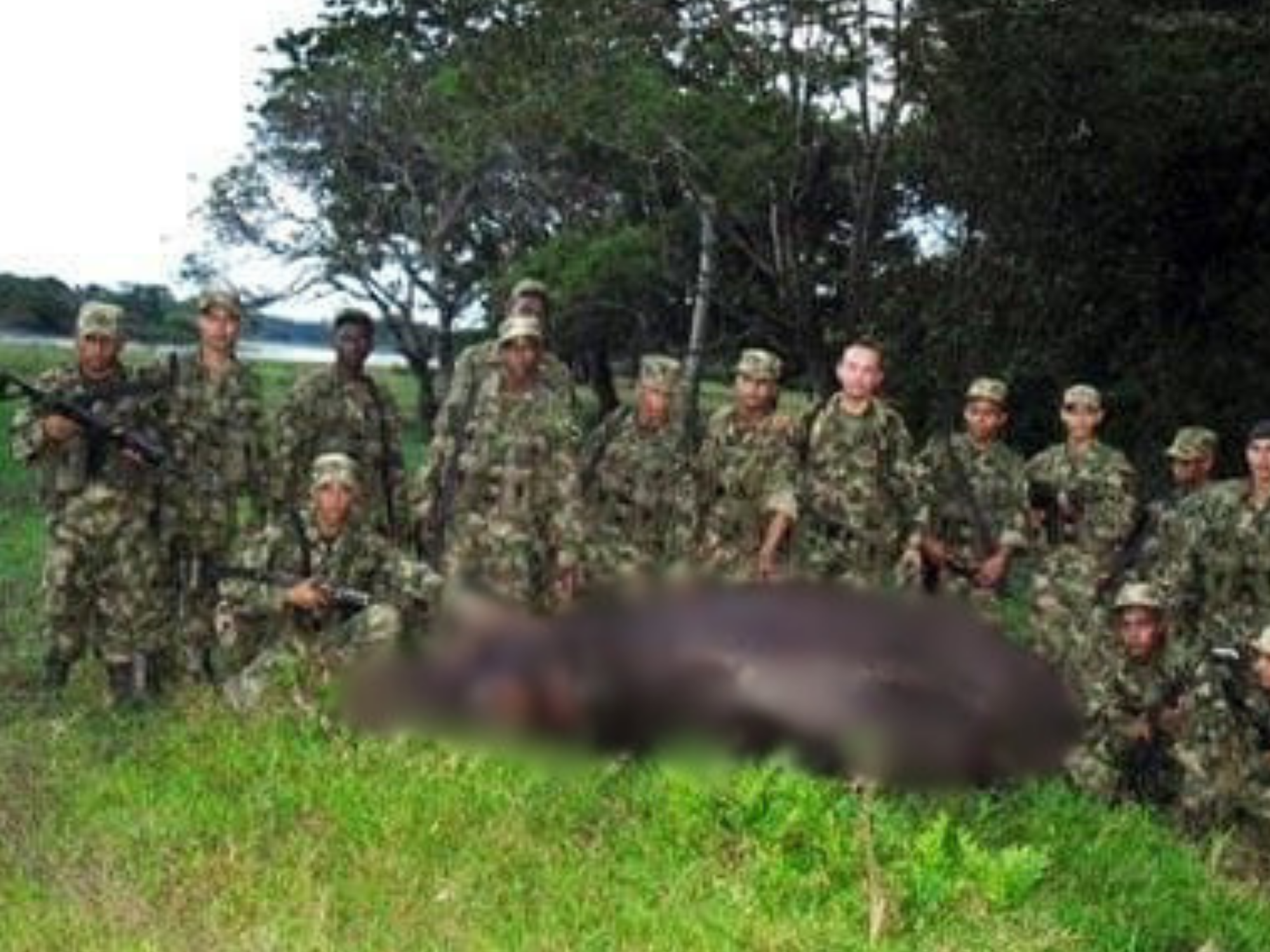
When an aggressive male hippo was killed in 2009, a photo of soldiers posing with the animal’s body sparked outrage and halted efforts to rein in the hippos for years. That single incident — and the public reaction it produced — shaped Colombian policy for over a decade, effectively making any discussion of lethal control politically toxic even as the population grew.
The Decision
Colombian Environment Minister Irene Vélez announced Monday that up to 80 hippos would be affected by the cull, which will begin in the second half of 2026.
She said previous methods to control the population had been expensive and unsuccessful. “If we don’t do this we will not be able to control the population,” Vélez said. “We have to take this action to preserve our ecosystems.”

The program, with a budget equivalent to $1.98 million, will include population control measures such as confinement and relocation alongside euthanasia. The euthanasia component will use both chemical and physical methods under technical standards defined by the Ministry of Environment.
The government frames the decision in explicitly ecological terms. Colombia is a signatory to international biodiversity conventions and has made environmental protection a stated priority under President Gustavo Petro’s administration. The hippos, in that framework, are not exotic pets to be protected — they are an invasive species that is actively damaging ecosystems that Colombia has a legal and moral obligation to preserve.
The Opposition
Not everyone accepts the cull.
Animal welfare activists in Colombia have long opposed proposals to kill the hippos, arguing they deserve to live. Senator Andrea Padilla, an animal rights activist who helped draft a law against bullfights in Colombia, described the plan as a “cruel” decision and accused government officials of trying to take the easy way out. “Killings and massacres will never be acceptable,” Padilla wrote on X.
“These are healthy creatures who are victims of the negligence of government entities.”
The animal rights argument has a specific resonance in the Colombian context that goes beyond generic opposition to culling. Colombia spent five decades in an internal armed conflict that produced mass atrocities, forced displacement, and a collective trauma around violence that has shaped the country’s political culture in lasting ways. The argument that a government decision to kill animals — even invasive ones — “sets a poor example” in a country still processing the memory of political violence is not frivolous.
It reflects a genuine cultural sensibility about the relationship between institutional violence and civic values.
There is also a simpler argument: the hippos did not choose to be here. They are the innocent consequence of one man’s criminality, left behind by a state that failed for decades to manage a problem it created by confiscating the property that housed them without developing a plan for the animals that came with it.
The Tourist Problem
The decision is further complicated by a dimension that has no ecological justification but significant economic weight.
Despite the challenges, the hippos have become a tourist attraction. The Nápoles ranch, confiscated by the Colombian government as it seized Escobar’s properties, now functions as a theme park featuring swimming pools, water slides, and a zoo that includes several other African species. Residents of villages surrounding Hacienda Nápoles offer hippo-spotting tours and sell hippo-themed souvenirs.
The communities around Hacienda Nápoles have built a modest but genuine tourism economy around the cocaine hippos. For the small towns of Puerto Triunfo and Doradal, the hippos are not an environmental catastrophe — they are an economic asset. The decision to cull 80 of them will affect not just the hippo population but the livelihoods of the tour operators, souvenir vendors, and hospitality businesses that have made Escobar’s most bizarre legacy into a sustainable industry.
What Escobar Left Behind
The cocaine hippos are the most visible remnant of Pablo Escobar’s private zoo, but they are not the only ones.
Several of the other African species Escobar imported remain at the Nápoles theme park, now managed by the Colombian state. The property that once served as the operational hub of the world’s most powerful drug cartel is today a functioning tourist attraction visited by Colombian families.
That transformation — from criminal empire to public park — is one of the more surreal acts of institutional reclamation in Latin American history. The hippos are the element that resists reclamation. They cannot be managed from behind a fence. They have colonized the rivers. They have expanded beyond the property’s boundaries. They have, in a very literal sense, escaped Pablo Escobar’s control just as Escobar himself was never fully contained by the institutions of the Colombian state.
There is a certain dark poetry in that parallel. Escobar built an empire on the premise that he was beyond accountability, that the rules that governed ordinary people did not apply to him. The hippos are the living proof that consequences — ecological, as in every other domain — do not respect the intentions of the people who set them in motion.
Colombia is now paying that bill. The cost is $14,000 per hippo, and a political controversy that will outlast the cull itself.
Sociedad Media will continue to monitor Colombia’s hippo management program. For tips and firsthand accounts: info@sociedadmedia.com


