

MIAMI — A man suspected of helping organize the 1994 bombing of a Panamanian commercial airliner arrived in Panama on Monday under heavy security, becoming the first person to face trial in one of the deadliest terrorist attacks in Central American history.
Ali Zaki Hage Jalil, a Colombian-born Venezuelan national of Lebanese descent, arrived at Tocumen International Airport in Panama City and was transferred to judicial authorities for processing. He will be placed in a penitentiary while prosecutors prepare for trial, facing charges in connection with the explosion of Alas Chiricanas Flight 901 in July 1994 that killed all 21 people on board.
The U.S. Embassy in Panama described the extradition as the result of “extraordinary operational coordination and sustained diplomatic engagement” between the United States, Panama, and Venezuela’s interim authorities.
The Attack
Flight 901 was bombed on July 19, 1994, one day after the AMIA attack in Buenos Aires, Argentina. All 21 people on board were killed, including Panamanian Jewish passengers, U.S. citizens, and Israeli nationals.
The small twin-engine Embraer EMB-110 was en route from Colón to Panama City when it exploded midair. Investigators concluded that a suicide bomber detonated explosives concealed inside a portable radio.

According to Panamanian prosecutors, the man who carried the bomb aboard — identified as Ali Hawa Jamal — died in the blast.
Of those murdered, 12 were members of Panama’s Jewish community. Three were U.S. citizens. Four Israeli nationals were also among the dead.
In October 2024, the U.S. Office of the Director of National Intelligence formally concluded that Hezbollah was responsible for the attack. U.S. intelligence assessed the Panama bombing and the AMIA attack as part of a single coordinated operation targeting Jewish communities and Western interests across both countries within 24 hours, carried out by Hezbollah under Iranian direction.
Three Decades of Impunity
The case languished for nearly three decades. Panama did not issue a formal indictment until 2022, and Interpol did not release a Red Notice until 2025.
For years, Jalil had been residing on Venezuela’s Margarita Island under multiple aliases, protected by local networks sympathetic to Hezbollah-linked groups. The case regained momentum after Israeli intelligence shared new evidence with Panama in 2017. President Juan Carlos Varela later confirmed that Prime Minister Benjamin Netanyahu had personally transmitted the material.
In 2024, the U.S. State Department offered a $5 million reward for information leading to those responsible.
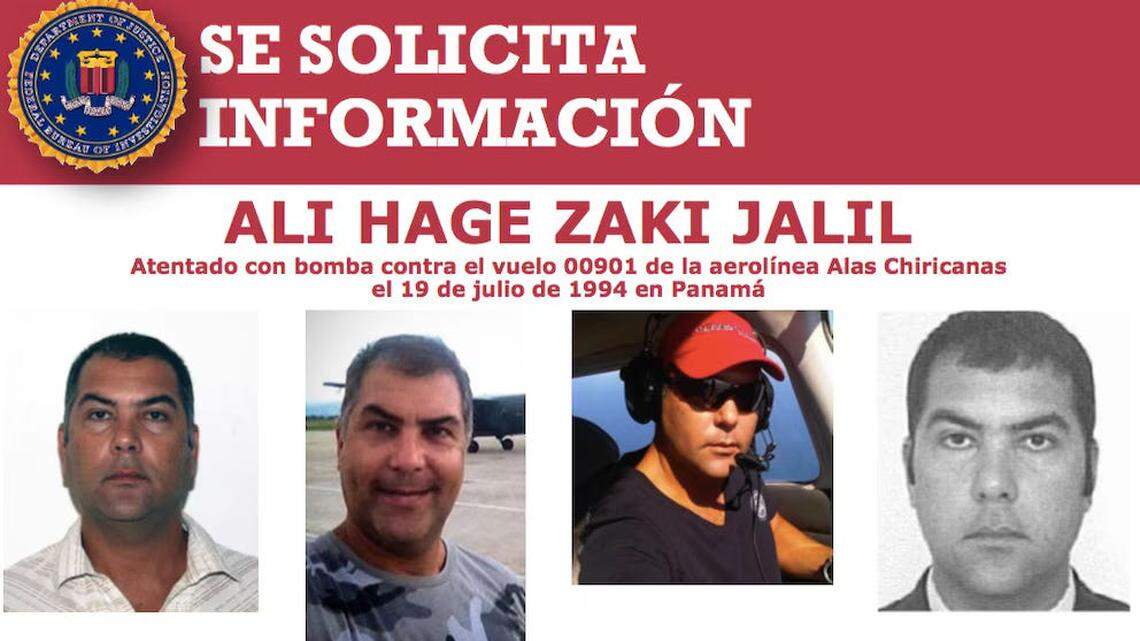
In November 2025, Venezuelan authorities, working with Interpol, arrested Hage Jalil on Margarita Island, where he had lived openly and operated a business for years without interference.
The extradition faced a significant legal obstacle: Jalil holds dual Lebanese and Venezuelan nationality, and Venezuela’s constitution prohibits the extradition of its own nationals. On March 27, 2026, Venezuela’s Sala de Casación Penal issued a ruling authorizing the transfer regardless.
A New Venezuelan Relationship
The extradition carries significance beyond the individual case.
Under the Maduro regime, Venezuela functioned as a permissive environment for Hezbollah-linked actors, Iranian proxies, and transnational criminal networks.
The post-Maduro administration has signaled a reorientation toward cooperation with the United States, and this transfer — executed with U.S. oversight — represents a concrete expression of that shift.
The U.S. Embassy statement quoted U.S. Ambassador to Panama Kevin Cabrera saying the extradition “sends a definitive message: the Trump Administration has a long memory and an even longer reach.” Cabrera also said he hoped the legal process would “bring peace to the families of the victims, who have waited more than 30 years for justice.”
Israeli Foreign Minister Gideon Sa’ar welcomed the extradition, calling the 1994 attack “an open wound” and expressing hope that the proceedings would “shed light on Jalil’s ties to Hezbollah, which also operates to spread terrorism in Latin America and poses a threat not only to Israel, Lebanon, and the Middle East, but to peace throughout the entire world.”
What Comes Next
Once placed under judicial custody, Jalil must appear before the Panamanian Judicial Branch so that a trial date can be set. The proceedings are expected to test evidence gathered across multiple jurisdictions and could take years to resolve.
He faces charges of deliberate homicide and crimes against collective security under Panamanian law as it stood at the time of the attack. He has not been convicted of any crime and is presumed innocent until proven guilty in a court of law.
The families of the 21 victims have waited 32 years.
Hezbollah in Latin America: A Network Three Decades in the Making
The extradition of Ali Zaki Hage Jalil does not close a chapter so much as illuminate one that has been largely hidden from public view for thirty years.
Two geographical hubs have emerged as critical for Hezbollah’s regional presence in Latin America: the Tri-Border Area — where Argentina, Brazil, and Paraguay converge — and Venezuela under the Hugo Chávez and Nicolás Maduro regimes.
Each offers distinct advantages. The Tri-Border Area provides a semi-lawless environment with limited law enforcement oversight — conditions Hezbollah operatives exploited when planning and coordinating logistics for the 1994 Buenos Aires bombing. Venezuela, by contrast, offered explicit state support, including political protection, passport provisioning, and transportation networks through state-owned enterprises.
The fact that Jalil lived openly on Venezuela’s Margarita Island for years — operating a business under false identities without interference — is consistent with that documented pattern. According to a leaked confidential report from Lloyd’s, Hezbollah has been implicated in the smuggling of Venezuelan gold, purchasing it through local intermediaries and reselling it to Iran, which moves it to buyers in Turkey and other Middle Eastern countries to finance terrorist activity.
A 2025 RAND Corporation study also identifies illegal gold mining in Venezuela’s Orinoco River region as a growing Hezbollah revenue source, supported by Iranian and militant networks.
More recently, Hezbollah-linked networks have shifted toward cryptocurrency — particularly the stablecoin Tether (USDT) — exploiting Venezuela’s permissive crypto markets and cash-based parallel economy to move value across borders. In 2023, the U.S. Treasury’s OFAC sanctioned a Venezuelan technology company for being controlled by a known Hezbollah operative.
The network extends well beyond Venezuela. Hezbollah’s Latin American footprint spans Brazil, Colombia, Ecuador, Panama, and Peru, with Ciudad del Este in Paraguay’s Tri-Border Area serving as a primary operational and financial hub, where the Barakat clan has built commercial infrastructure used to launder money and fund militant operations.
In Colombia, the town of Maicao in La Guajira — near the Venezuelan border with a long-standing Lebanese immigrant presence — has emerged as a key operational base, with Hezbollah operatives using religious and commercial institutions to conceal recruitment and financial activity.
In 2025, Colombian investigators linked Hezbollah financiers to a cattle export ring used to traffic cocaine to Europe.
Only five countries in Latin America — Argentina, Colombia, Guatemala, Honduras, and Paraguay — have formally designated Hezbollah as a terrorist organization, leaving the majority of the region without the legal tools needed to prosecute Hezbollah-linked activity domestically.
Washington Escalates Pressure
Jalil’s arrival in Panama comes within a broader and intensifying U.S. campaign against Hezbollah’s financial architecture globally — with Latin America increasingly central to that effort.
In March 2026, the U.S. State Department imposed a new round of sanctions targeting what it described as a global financial network supporting Hezbollah, aimed at disrupting fundraising and money laundering operations conducted on the group’s behalf across the Middle East, Europe, and North America.
In February 2026, the U.S. Treasury imposed additional sanctions targeting a gold exchange firm and several individuals and shipping companies it said were generating revenue for Hezbollah. Treasury Secretary Scott Bessent stated that Washington would work to “cut these terrorists off from the global financial system.”
In March 2025, U.S. senators introduced the “No Hezbollah In Our Hemisphere Act”, which specifically identified Venezuela as having “essentially become Iran’s forward operating base in Latin America” and called on the State Department to pursue aggressive efforts against Iranian proxy networks throughout the Western Hemisphere.
The post-Maduro government’s decision to extradite Jalil — overcoming Venezuela’s own constitutional prohibition on extraditing nationals — is the most concrete sign yet that Caracas is prepared to act on the reorientation it has signaled toward Washington. Whether it signals a durable policy shift or a one-time gesture will be tested in the cases that follow.
Sociedad Media is monitoring proceedings in the Alas Chiricanas case, along with any other major security concerns in the region. For tips and reporting, contact info@sociedadmedia.com


