

MIAMI — The United States military is deploying artificial intelligence as a central weapon in its campaign against drug cartels in Latin America — integrating autonomous systems, AI-driven targeting, and a new counternarcotics doctrine modeled on post-9/11 counterterrorism operations into what Washington is calling a generational shift in how it fights organized crime in the hemisphere.
The scope of that shift, still coming into focus across a series of Pentagon strategy documents, new task force structures, and operational strikes, represents the most significant expansion of U.S. military activity in Latin America in decades — and one that is unfolding faster than most governments in the region have been able to respond to.
The Doctrine
The foundation was laid in January 2026, when the Pentagon — now officially renamed the Department of War under Secretary Pete Hegseth — released its Artificial Intelligence Strategy, declaring that 2026 would be “the year we emphatically raise the bar for Military AI Dominance.”
The strategy calls for AI-enabled battle management and decision support from campaign planning through strike execution, with AI agent networks capable of autonomous coordination of robotic systems with what officials describe as “minimal operator intervention.”
That framework is not being applied solely to peer adversaries. It is being applied to cartels.
CIA Director John Ratcliffe has significantly expanded the agency’s operations in Mexico, shifting counterterrorism authorities and resources toward counter-cartel work along the U.S.-Mexico border and inside Mexico itself. The CIA began covertly flying MQ-9 Reaper drones over Mexico to spy on drug cartels, and the agency undertook a review of its authorities to use lethal force against cartel targets in the country.
Ratcliffe described the approach in explicit terms:
“We have built a finely tuned machine at the CIA over the past 20 years since 9/11 to find, fix, and finish terrorist targets, and now we are going to be taking that machine and turning it to the cartels.”
The phrase “find, fix, finish” is standard U.S. military targeting language.
The Task Forces
The operational architecture being constructed is layered and expanding.
In October 2025, SOUTHCOM created Joint Task Force Southern Spear under the II Marine Expeditionary Force, tasked with crushing drug cartels operating in the region using a fleet with robotics and autonomous systems. The operation formally launched in November 2025 and has since conducted more than twenty lethal strikes on alleged drug trafficking vessels in the Caribbean and Eastern Pacific.
As recently as April 11, Joint Task Force Southern Spear conducted two lethal kinetic strikes on vessels operated by Designated Terrorist Organizations in the Eastern Pacific, killing five people.
SOUTHCOM described the operation as “applying total systemic friction on the cartels.”
Separately, on January 15, 2026, a second task force — the Joint Interagency Task Force-Counter Cartel (JIATF-CC) — was established under U.S. Northern Command, based in Tucson, Arizona. It integrates analysts from the military, FBI, CIA, NSA, DEA, and ICE to map cartel networks, funding channels, logistics, leadership hierarchies, and the locations of drug production facilities.
On the technology side, Joint Interagency Task Force 401 — established under a Hegseth directive to accelerate counter-drone capabilities — has already awarded contracts for AI-driven DroneHunter interceptor systems that use artificial intelligence and radar to detect, track, and neutralize unmanned aerial threats.
AI on the Battlefield Against Cartels
The integration of AI into cartel targeting is not theoretical. It is operational.
Operation Southern Spear has, from the outset, relied on a hybrid fleet combining manned vessels with robotic and autonomous systems to increase presence in and awareness of strategic maritime corridors in the Caribbean and Eastern Pacific. Intelligence feeds from surveillance drones, satellite imagery, and signals intelligence are being processed through AI systems to identify trafficking vessels and generate targeting decisions.
The Pentagon’s drone swarm program — currently in a “crucible” testing phase — is developing AI agents capable of autonomously coordinating the role assignments of robotic systems in what officials call “inter-agent collaboration,” with automatic target recognition and machine learning capabilities designed to adapt to environmental conditions.
Those systems are intended for warfighting broadly, but their architecture maps directly onto the counter-cartel mission.
CSIS analysts note that the Trump administration has declared the current counter-cartel campaign a “non-international armed conflict,” a legal classification that — under international law — permits the United States to use lethal force against cartel members even when they do not present an immediate threat.
During a congressional briefing, Pentagon officials reportedly said they do not need to positively identify individuals on targeted vessels as specific cartel members to carry out lethal strikes. However, a number of lawmakers on Capitol Hill have been critical of the administration’s targeted campaign against suspected narco-traffickers in the region.
Miami Conference
The political framework for the regional expansion of this doctrine was made explicit in March.
On March 5, Defense Secretary Hegseth hosted the first Americas Counter Cartel Conference at SOUTHCOM headquarters in Miami, with defense officials from more than a dozen conservative governments aligned with the Trump administration. White House Homeland Security Adviser Stephen Miller told the assembled military leaders that drug cartels can only be defeated with military force.
“We have learned after decades of effort that there is not a criminal justice solution to the cartel problem,” Miller said. “The reason why this is a conference with military leadership and not a conference of lawyers is because these organizations can only be defeated with military power,” Miller said to Latin American delegates.
Colombia, Brazil, and Mexico did not send delegations to the conference. Their absence was noted.
Hegseth told the assembled allies that “America is prepared to take on these threats and go on the offense alone if necessary” — a warning directed as much at reluctant regional partners as at the cartels themselves.
The Risks Analysts Are Raising
The deployment of AI-driven targeting systems against cartel networks raises questions that the Pentagon has not publicly addressed.
Analysts at the Global Initiative Against Transnational Organized Crime note that criminal organizations in Latin America are themselves increasingly deploying drones, artificial intelligence for cyberattacks and human trafficking, and social media for recruitment — creating an arms race dynamic in which U.S. military escalation may accelerate cartel technological adaptation rather than degrade it.
The decapitation strategy that underpins much of the current U.S. approach has a documented limitation: for every cartel leader who falls, others are available to replace him. The death of CJNG leader El Mencho in February sparked violent retaliation across Mexico, killing 60 people and triggering a power struggle that complicated — rather than resolved — the security situation.
CSIS analysts also flag the definitional problem at the heart of the campaign: in any “war” on drugs, the definition of winning matters enormously. The task force’s job is to define what it means to manage — and ultimately reduce to as close to zero as possible — the flow of drugs into the United States, and that is a goal no military technology has yet achieved.
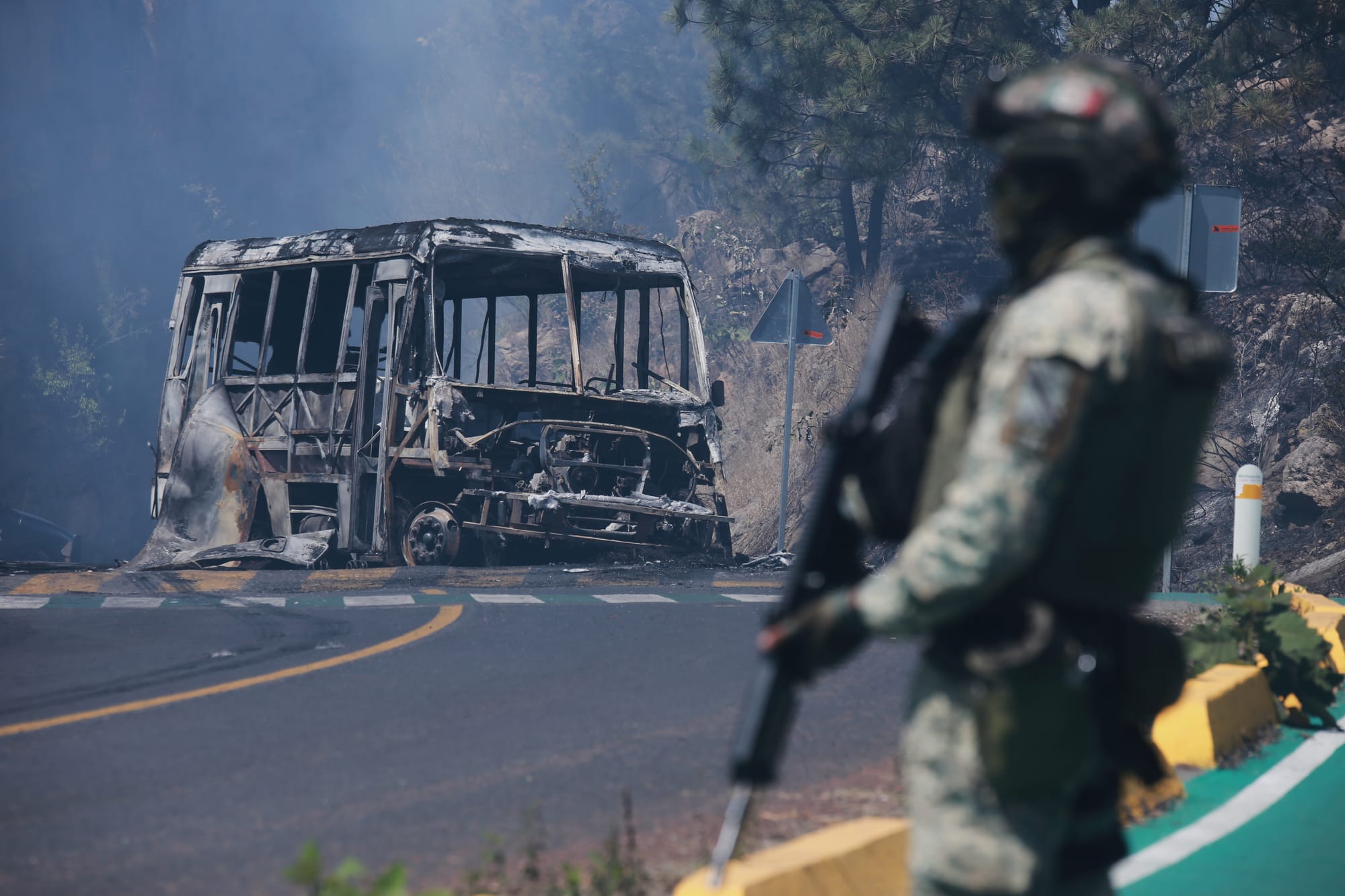
For Latin American governments watching Washington build this architecture, the question is not whether the United States is serious about deploying it. The deaths of two CIA officers in a Chihuahua ravine last Sunday answered that.
The question is what it means for sovereignty, for bilateral relationships, and for the 2026 World Cup this summer, when millions of visitors will be moving through the same countries where this war is being waged.
Sociedad Media is monitoring U.S. military operations in Latin America. For tips and reporting, contact info@sociedadmedia.com


