

DORAL, MIAMI – President Donald Trump gathered a dozen of Latin America’s most conservative leaders at his Trump National Doral resort on Saturday morning in Miami, kicking off a major Hemispheric alliance to line up against the region’s adversaries.
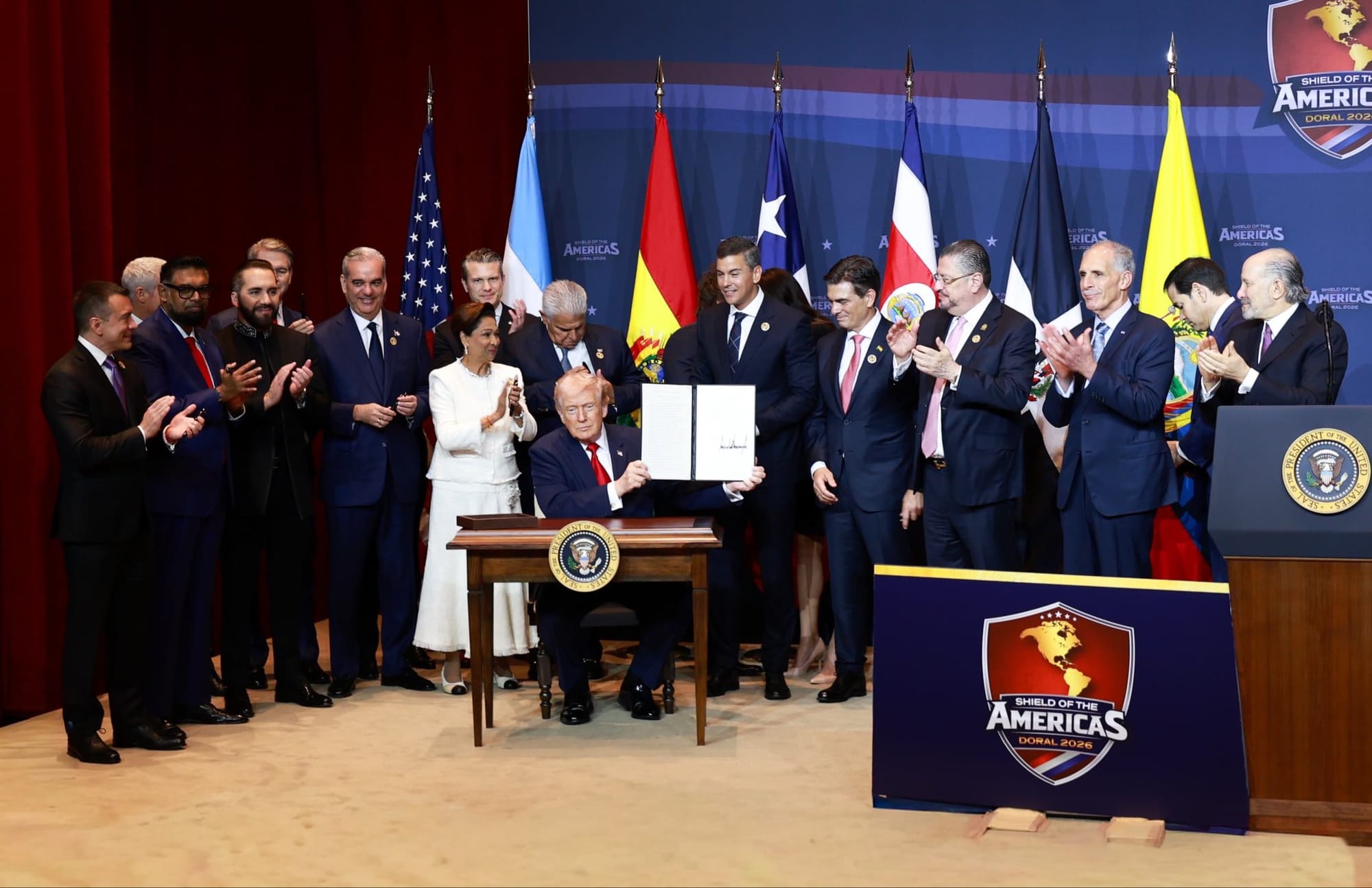
The inaugural ‘Shield of the Americas Summit’—billed by the White House as a historic coalition to push back against drug cartels, Chinese influence, and illegal migration across the Western Hemisphere—produced three concrete outcomes before noon: a signed presidential proclamation committing the United States and its regional allies to confronting cartel criminal activity; the formal launch of a multilateral security framework built on what the Trump administration calls the “Donroe Doctrine”; and Trump’s public announcement of his formal U.S. recognition of Venezuela’s acting government under Delcy Rodríguez.
“She’s Doing a Great Job Because She’s Working With Us”
The Venezuela announcement was the most diplomatically significant moment of the summit. Speaking to assembled leaders, Trump addressed the U.S. military’s removal of Nicolás Maduro in January, describing the operation as “18 minutes of pure violence,” and praised Rodríguez for cooperating with Washington.
“I mean, she’s doing a great job because she’s working with us,” Trump said. “If she wasn’t working with us, I would not say she’s doing a great job. In fact, if she wasn’t working with us, I'd say she's doing a very poor job. Unacceptable.”
Trump announced at the summit that his administration had decided to formally recognize the government headed by Rodríguez, telling the assembled leaders that Venezuela is in better shape and that the United States has developed a better relationship with the country.
🚨🇻🇪🇺🇸 | MASIVO/U.S.-VENEZUELA: U.S. President Donald Trump announces the formal recognition of the Venezuelan interim government of Delcy Rodríguez at the inaugural conference of the ‘Shield of the Americas’ in Doral, Miami, Florida.
— Sociedad Media (@sociedadmedia) March 7, 2026
The move will provide a smoother runway for… pic.twitter.com/tTTI6GjYCJ
The announcement came just two days after the State Department confirmed the restoration of full diplomatic relations between Washington and Caracas—and one day after the U.S. Treasury licensed Venezuelan gold exports to American refineries.
Trump told the room that U.S. companies are already taking out tremendous amounts of oil from Venezuela—a confirmation that the commercial terms of the post-Maduro arrangement are already fully operational.
“We Cannot and Will Not Tolerate the Lawlessness”
In his opening remarks, Trump told the assembled leaders they are united in the conviction that they cannot and will not tolerate the lawlessness in their hemisphere any longer. The U.S. president encouraged Latin American leaders to band together to combat violent cartels, and focused a significant portion of his remarks on Mexico, describing it as the epicenter of cartel violence.
Trump was joined at the summit by Secretary of State Marco Rubio, War Secretary Pete Hegseth, former Homeland Security Secretary Kristi Noem—newly appointed as Special Envoy for the ‘Shield of the Americas’—Treasury Secretary Scott Bessent, Commerce Secretary Howard Lutnick, and U.S. Trade Representative Jamieson Greer.
The attending leaders represented Argentina’s Javier Milei, Bolivia’s Rodrigo Paz, Ecuador’s Daniel Noboa, El Salvador’s Nayib Bukele, the Dominican Republic’s Luis Abinader, Panama’s José Raúl Mulino, Paraguay’s Santiago Peña, Honduras’s Tito Asfura, Costa Rica’s Rodrigo Chaves, and Guyana’s Mohamed Irfaan Ali, along with Trinidad and Tobago’s Prime Minister Kamla Persad-Bissessar and Chile’s president-elect José Antonio Kast, who travels to the summit before taking office on March 11.
The Doral Charter and the China Problem
The summit’s most durable product may be the Doral Charter—a multilateral document that participants are expected to sign affirming a hemispheric alliance to confront foreign interference, with China as the primary unnamed target.
The CSIS recommended that the administration use the summit to establish a Hemispheric Security Network that goes beyond fighting drugs and human trafficking, specifically designed to box out China’s Global Security Initiative from the region and its so-called “safe cities” programs—a surveillance infrastructure that Beijing has exported to multiple Latin American governments.
Trump has made countering Chinese influence in the hemisphere a top priority since returning to the White House in January 2025. His national security strategy promotes the Trump Corollary to the Monroe Doctrine, targeting Chinese infrastructure projects, military cooperation, and investment in the region's resource industries.
The capture of Maduro—Beijing’s closest Latin American ally—and the subsequent redirection of Venezuelan oil away from China toward U.S. refineries is the administration’s most concrete action yet on that front.
But even leaders closely aligned with Trump have been reluctant to fully sever ties with China, according to Evan Ellis of CSIS, who noted that for many countries, China’s trade-focused diplomacy fills a critical financial void in a region with major development challenges.
Trump, by contrast, has been cutting foreign assistance to the region while rewarding countries aligned with his immigration crackdown.
Who Was Not in the Room
The summit’s guest list was as notable for its absences as its attendees. Mexico, Brazil, Colombia, and Peru—four of Latin America’s largest economies—were not represented.
Neither Rodríguez nor Cuba’s Miguel Díaz-Canel attended, despite both countries being central to Trump’s most visible regional foreign policy objectives in recent weeks.
Richard Feinberg, who helped plan the first Summit of the Americas in 1994 during the Clinton administration, noted the contrast starkly: “The first Summit of the Americas, with 34 nations and a carefully negotiated comprehensive agenda for regional competitiveness, projected inclusion, consensus and optimism,” he said. “The hastily convened ‘Shield of the Americas’ mini-summit conjures a crouched defensiveness, with only a dozen or so attendees huddled around a single dominant figure.”
Trump left the summit early—flying to Dover Air Force Base in Delaware to receive the dignified transfer of six U.S. troops killed in a drone strike on a command center in Kuwait, one week after the U.S. and Israel launched their military campaign against Iran.
For Miami’s Latin American community—the largest and most politically engaged in the United States—Saturday’s summit was not a distant diplomatic event. It happened in their backyard where the president of the United States signed a cartel proclamation, recognized Venezuela’s new government, and declared that the hemisphere’s era of lawlessness is over.
Whether the dozen leaders who signed the Doral Charter have the institutional capacity, political will, and domestic support to make that declaration real is the question that will define the ‘Shield of the Americas’ long after the cameras leave Doral.


