

MIAMI — On January 9, 2024, a gunman walked into a live television studio in Guayaquil and pointed a weapon at a news anchor on air. The broadcast went out across Ecuador in real time. Within hours, President Daniel Noboa had declared an internal armed conflict against 22 criminal organizations and ordered the military to neutralize them.
15 months later, the war is still very much on — and the results are more complicated than either side of the debate wants to admit.
How Ecuador Got Here
Ecuador’s descent into violence is one of the most dramatic security collapses in recent Latin American history. Ecuador’s national homicide rate climbed from approximately 6 per 100,000 inhabitants in 2018 to a recorded 44.5 per 100,000 in 2023 — the highest in Latin America and among the highest globally — representing a more than sevenfold increase in five years.
The roots of the crisis run deeper than any single policy failure. Local criminal groups were absorbed into a transnational grid, acting as subcontractors for international drug traffickers, managing logistics, protecting shipments, and exerting territorial control. Mexican cartels played a decisive role — in late 2020, the Jalisco New Generation Cartel — CJNG — moved to challenge the Sinaloa Cartel’s dominance in the region’s drug markets by investing in strengthening Los Lobos, fueling a war between that group and Los Choneros.
Albanian mafias with direct links to Colombian cocaine suppliers and deep influence at the port of Guayaquil added another layer to a criminal ecosystem that overwhelmed a state already hollowed out by austerity and institutional decay.
In 2017, when former President Rafael Correa left power, Ecuador had a murder rate of six homicides per 100,000 inhabitants — one of the lowest in Latin America. The combination of institutional weakening, economic stagnation, and shifts in international drug trafficking dynamics transformed that landscape within a decade.
The moment that forced Noboa’s hand came on January 8, 2024: two notorious gang leaders — José Adolfo Macías Salazar, alias “Fito,” of Los Choneros, and Fabricio Colón Pico of Los Lobos — escaped from prison. The escapes were accompanied by prison riots, car bombings, kidnappings, and criminal attacks on a television channel and a university in Guayaquil.
Things were out of control, and so Noboa declared an internal armed conflict the following day.
What the Military Approach Has Delivered
The results since January 2024 are genuinely mixed — and deserve to be read that way.
Noboa’s declaration of internal armed conflict and the subsequent militarization of public security initially curbed violence, especially in prisons. However, gangs soon revived their violent competition, and higher government pressure on their leaders helped fuel intra-gang disputes. The initial lull was reversed, and violence reached unprecedented levels in early 2025.
Ecuador closed 2025 as the most violent year in its history, recording 9,216 intentional homicides — a 32% increase over 2024 — producing a rate of 50.9 per 100,000 inhabitants. Six Ecuadorian cities ranked among the world’s 50 most violent.
Noboa’s administration successfully captured the leaders of the country’s most powerful organized crime groups — the Lobos, Choneros, Tiguerones, and Chone Killers. But the arrests produced power struggles that pushed the homicide rate to a record 50 per 100,000 residents in 2025. Decapitating criminal organizations without dismantling their underlying structure does not reduce violence — it redistributes it.
The most recent government data, however, shows a genuine shift. In March 2026, the Noboa government announced that intentional homicides had decreased by 28% compared to the same month the previous year. Interior Minister John Reimberg said 4,300 people had been arrested nationwide as part of the recent crackdown, with 2,200 search warrants executed. In border conflict zones specifically, government data show a nearly 35% year-on-year decline in violent crime during Q1 2026 — a reversal that Noboa attributed to joint operations with the United States.
Whether those numbers represent a durable turning point or a temporary dip is the central question.
The U.S. Enters the Picture
The most significant development of 2026 is not the homicide statistics. It is the presence of the United States military on Ecuadorian soil, and what that precedent means.
On March 3, Noboa and Trump launched a joint military operation in Ecuador. The U.S. has largely provided intelligence and logistics to support the campaign, which has been carried out on the ground by Ecuadorian forces.
The operation falls within the broader framework of Operation Southern Spear. The September 2025 designation of Los Choneros and Los Lobos as Foreign Terrorist Organizations provided the formal legal trigger for expanded U.S. involvement, announced during Secretary of State Marco Rubio’s visit to Quito with Noboa’s explicit concurrence.
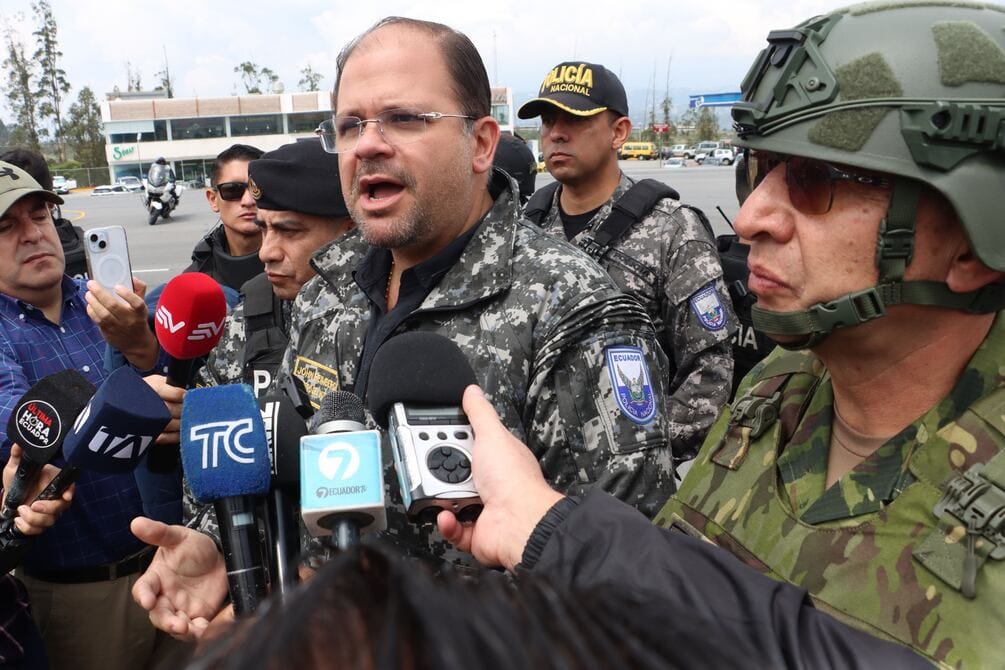
Noboa has not been subtle about where he wants this partnership to go. He told Bloomberg he would welcome U.S. troop deployment this year to help fight narco-trafficking gangs, provided they operate under Ecuadorian military command — the most explicit invitation for American military presence in the country since Washington’s departure from the Manta air base in 2009.
That invitation carries a political complication Noboa has not fully resolved. In November 2025, Ecuadorian voters rejected a constitutional reform package that included a provision to allow the return of foreign military bases — a referendum Noboa himself promoted. The current U.S. military presence operates under temporary cooperation agreements that avoid the need for a formal basing arrangement — a legal distinction that may satisfy constitutional requirements but does not resolve the democratic one.
The operations have also produced at least one serious allegation. When Ecuador claimed to have bombed a camp used by Border Command leader Johnathan Alfredy Tole Collazos near the Colombian border in Sucumbíos province, locals speaking to the New York Times said the military struck a dairy farm.
The incident drew no formal international investigation but is emblematic of the accountability gap that human rights organizations have been raising since the conflict began.
The Human Rights Question
The military approach has delivered measurable results on some metrics, and documented progress in the war on the gangs has been recognized by the Ecuadorian public. However, it has also produced documented abuses that the Noboa government has not meaningfully addressed.
Human Rights Watch documented at least one apparent extrajudicial killing and multiple cases of arbitrary arrests and ill-treatment since the internal armed conflict declaration. The organization found that extortions and kidnappings have risen even as overall homicides temporarily decreased — suggesting the violence has shifted rather than disappeared.
Reports of arbitrary arrests, extrajudicial killings, enforced disappearances, torture of detainees, including beatings, electric shocks, sexual violence, and tear gas misuse, as well as deaths in custody, have sparked the alarm of third-party international organizations.
The Noboa government has consistently denied systematic abuse while acknowledging isolated incidents.
The broader structural concern is institutional. Organized crime has become deeply entrenched in Ecuador’s political and legal systems, weakening democratic governance and widespread public corruption. The iron-fist measures have seriously damaged the rule of law in a country where democratic institutions — the judiciary, the courts, the civil service — are already weak and compromised.
What the War Means for the Region
Ecuador is not an isolated case. It is a preview.
The country has become, in the Trump administration’s framing, the model for the hemisphere: a willing partner that invites U.S. military involvement, designates its own gangs as terrorist organizations, imposes states of emergency, and deploys the armed forces as the primary instrument of domestic security. Noboa has embraced the “mano dura” security policies of El Salvador’s Nayib Bukele, and was among the right-wing Latin American leaders at the Mar-a-Lago security summit in early March.
But the Ecuador model contains a tension that the hemisphere’s security architects have not resolved: the iron-fist approach that produced a 17% homicide reduction in 2024 also generated the gang fragmentation that produced a 32% increase in 2025. Unless an organized crime group manages to establish hegemony or the government takes control of prisons and the street and establishes a more permanent presence in gang-ridden communities, violence is likely to continue rising and spread to other provinces.
For the governments of Colombia, Peru, Brazil, and Mexico — each watching the Ecuador experiment from different distances and with different stakes — the question is not whether the military approach produces results in the short term. It demonstrably does, sometimes. The question is what it leaves behind.
Experts warn that the counter-terrorism framing may prioritize lethal kinetic actions over the dismantling of complex corruption networks — the invisible infrastructure that allows criminal organizations to survive the loss of their leaders and rebuild.
Ecuador declared war 469 days ago. The gangs are still there. So is the U.S. military. And the rest of the region is watching closely.
Sociedad Media is monitoring Ecuador’s security situation & U.S. military operations in Latin America. For tips and reporting, contact info@sociedadmedia.com


