
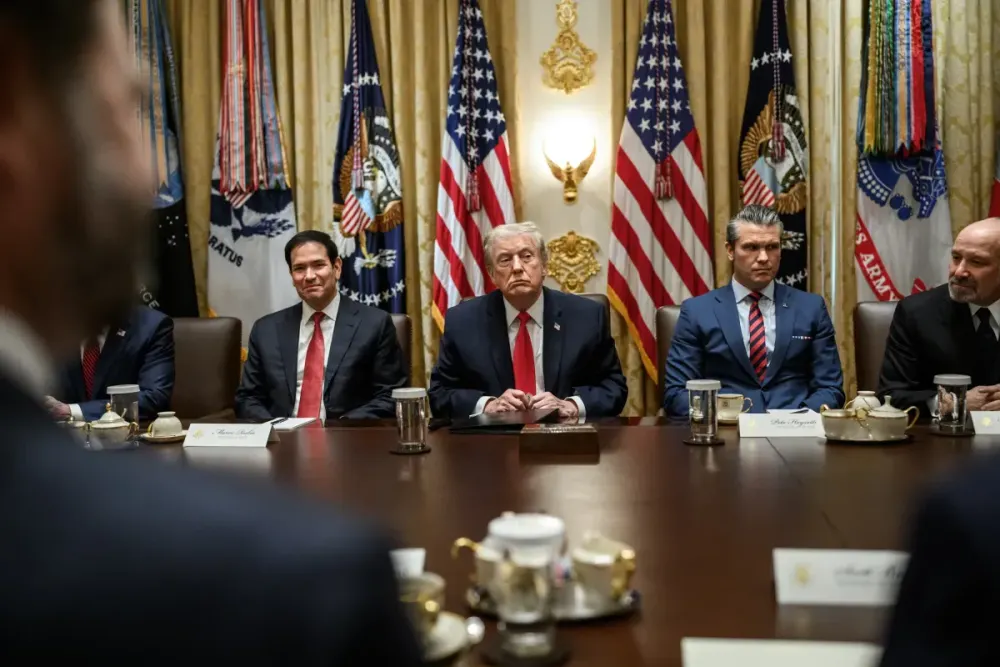
MIAMI — On January 3, U.S. special forces captured Venezuelan President Nicolás Maduro at his Caracas compound. Within hours, President Trump declared that “American dominance in the Western Hemisphere will never be questioned again.” Five months later, Washington is still leaving its most recent mark across the region.
The Trump administration has given the Western Hemisphere more attention in its first months than most past administrations since the Cold War, with a return of hard power, the elimination of soft power, and the use of economic coercion. The results are uneven — significant in some areas, stalled in others, and in several cases producing consequences that were not part of the original plan.
What Has Been Achieved
The Venezuela operation is the clearest success by Washington’s own metrics. Maduro is in U.S. custody in Manhattan awaiting trial on narcoterrorism charges. Interim President Delcy Rodríguez has released political prisoners, opened the oil pipelines to U.S. and international investment, deported political malefactors like Alex Saab to face money laundering charges in Miami, and permitted U.S. Marines to conduct exercises at the Caracas embassy. Read more here →
Venezuela’s economy is now projected to grow 12% in 2026 — its strongest performance in years.
Latin American markets have responded positively to the broader regional posture. Brazil’s benchmark BVSP index has gained 21.7% since the start of the year. Chile’s S&P IPSA is up 8.2%, while Colombia, Peru, and Mexico’s benchmark indexes have posted year-to-date jumps of 10.6%, 18.8%, and 9% respectively. Investors, at least, have not been deterred by the administration’s aggressive posture.
On counter-narcotics, the administration points to a claimed 90% reduction in maritime drug smuggling following U.S. strikes on suspected trafficking vessels in Caribbean waters — a figure it has not independently verified but that has formed the basis of its public case for the maritime campaign.
The capture of CJNG power broker “El Jardinero” in Mexico in late April, conducted with acknowledged U.S. intelligence assistance, represents another major cartel leadership takedown of the year.
In electoral terms, Trump’s influence has produced some of the outcomes Washington sought. In Argentina, explicit U.S. backing and a $20 billion financial package helped Milei’s coalition win the October 2025 midterms. In Costa Rica, a pro-Trump conservative won the presidency in February 2026. Honduras under Asfura and Ecuador under Noboa have both aligned closely with Washington’s security framework, joining the Americas Counter Cartel Coalition and accepting U.S. military cooperation on terms their predecessors would not have considered.
Bumpy Roads
Venezuela’s transition has delivered economic results but not democratic ones.
The Venezuelan constitution requires a presidential election within 30 days of Maduro’s forced absence. That window closed months ago without a vote. María Corina Machado — who won Venezuela’s opposition primary with 92.4% of the vote and holds a 72% approval rating in independent polling — announced from Panama on Saturday that she intends to run for president and return to Venezuela before year’s end.
The constitutional framework that Washington cited to justify the January 3 operation has not been applied to the question of elections.
Cuba, on the other hand, has not followed Venezuela’s trajectory. Despite 240 sanctions, an oil blockade, the indictment of Raúl Castro, CIA Director Ratcliffe’s visit to Havana, and the USS Nimitz carrier strike group operating in the Caribbean, the Díaz-Canel government has held together — organizing street rallies against U.S. pressure, invoking sovereignty, and demonstrating that the Venezuela playbook does not transfer directly to an island with a different power structure and no obvious transition interlocutor.
The Pentagon is updating contingency plans. NBC News has reported that Trump is losing patience. Neither fact constitutes a resolution.
Mexico
Mexico presents the sharpest bilateral tension of the five-month period. The unauthorized presence of CIA agents in Chihuahua, the federal indictment of Sinaloa Governor Rocha Moya and nine other officials, and the deaths of two U.S. agents in a drug lab raid have produced a formal Mexican diplomatic protest and public sovereignty declarations from President Sheinbaum — even as Mexico has continued to cooperate on deportation flights, counter-fentanyl operations, and intelligence sharing.
The relationship is simultaneously more productive and more strained than at any point in recent memory.
Brazil
In Brazil, Trump’s pressure campaign to protect Jair Bolsonaro from prosecution largely strengthened Lula politically. The October 4 Brazilian election is now a statistical tie, but the Banco Master scandal — which has touched figures across Brazil’s political spectrum including those with Washington connections — has complicated any simple alignment between U.S. preferences and electoral outcomes.
The China Question
Washington has also disrupted, but not stopped China’s advancement in Latin America. The Chinese presence in the region relates to gargantuan infrastructure investments — the Chancay megaport in Peru, energy infrastructure in Argentina, telecommunications across the continent. Threatening tariffs, visa bans, and other sanctions without offering economic projects at Chinese rates does not straightforwardly enhance the U.S. position.
The administration has poured more than $1 billion into critical minerals investments across Latin America since January 2025, signaling a more assertive effort to secure lithium, copper, and rare earths. But China’s head start — measured in decades of investment and processing infrastructure — is not closed by a single year of U.S. engagement, however intensive.
The Regional Alignment Picture
Trump’s approach has produced a clear ideological sorting across the hemisphere. Argentina under Milei, Honduras under Asfura, Ecuador under Noboa, and Chile under Kast represent the pro-Washington bloc. Brazil under Lula, Mexico under Sheinbaum, and Colombia — whose next president will be determined in six days — represent governments that have maintained working relationships with Washington while resisting explicit alignment.
Nicaragua under Ortega, Cuba under Díaz-Canel, and whatever remains of Venezuela’s Chavista power structure represent the targets of ongoing U.S. pressure.
What the sorting has not produced is a unified hemispheric consensus behind Washington’s approach. The UN Secretary-General has described U.S. Cuba sanctions as violations of international law. The OAS has raised concerns about the Venezuela transition’s democratic deficit. Brazil and Mexico have both filed cases at international human rights bodies over U.S. immigration enforcement.
The bilateral deals are real. The multilateral legitimacy is contested.
Five Months: An Honest Assessment
The Trump administration has moved more decisively in Latin America in five months than any administration in a generation. It removed a sitting president that it viewed as a hostile actor towards U.S. interests in the region. It indicted two former heads of state. It sanctioned hundreds of individuals across Cuba, Venezuela, and Nicaragua. And it activated a counterterrorism doctrine that explicitly reserves the right to act unilaterally anywhere in the hemisphere.
Whether those actions have produced durable progress toward Washington’s long-term goals — democratic transitions in Venezuela and Cuba, a reliable counter-narcotics partner in Mexico, reduced Chinese influence across the region — is a question five months is too short a timeframe to answer definitively.
What the available evidence does show is that the hard power approach has produced tangible results in Venezuela and measurable progress on narcotics interdiction, while generating diplomatic friction with key partners, falling short of its Cuba objectives, and leaving the democratic accountability question in Venezuela unresolved. The short-term gains are real. The long-term risks — of backlash, of institutional erosion, of filling power vacuums with outcomes that were not planned for — are also real if not handled carefully.
The next six days will add another government to the allies column for Washington if either of the two conservative candidates can pull of a victory in Bogotá.
Colombia’s May 31 election will produce a government that either aligns with Washington’s hemispheric strategy or complicates it. Five months in, the hemisphere is watching.