

Colombia’s president-elect Abelardo de la Espriella has been consistent on one point throughout his campaign and since his June 21 victory: Although deeper U.S.-Colombia security ties will be established, Colombia will not accept a U.S.-led incursion on its soil. “I have spoken out forcefully about preserving Colombia’s sovereignty,” he has said repeatedly.
He has also advocated for opening U.S. military bases in Colombia, carrying out joint operations to fumigate coca crops with glyphosate, and bombing narco-trafficking groups alongside American forces.
The gap between those two positions is not a contradiction. It is a description of where U.S.-Colombia security policy is actually going to be made in the months between now and August 7 — and in the years that follow.
What De la Espriella Has Committed To
The policy commitments de la Espriella made during the campaign are specific. He advocated for opening U.S. military bases in Colombia and carrying out joint operations to fumigate coca crops and bomb narco-trafficking groups. He pledged to join Trump’s Shield of the Americas — the international security framework launched in March that coordinates an aggressive crackdown on transnational cartels.
De la Espriella also committed to full reactivation of the intelligence-sharing and operational cooperation frameworks that President Petro suspended, pledging to unleash the Colombian military against armed groups with a force he described as “the wrath of God never seen before.”
None of that constitutes an “incursion” in the formal sense. An incursion implies uninvited foreign military forces operating unilaterally on Colombian soil. What de la Espriella is proposing is something different — the restoration and expansion of the bilateral security architecture that existed under Plan Colombia and its successors, in which U.S. personnel, equipment, intelligence, and financing operate on Colombian soil with the full invitation and cooperation of the Colombian government.
This distinction matters legally and diplomatically. It does not change what happens on the ground.
The Plan Colombia Blueprint
Colombia has been here before. Plan Colombia, launched at the turn of the millennium, channeled over $6 billion in U.S. military assistance into the country, making Colombia one of the largest recipients of U.S. security aid outside the Middle East.
At its height, U.S. military cooperation extended across a network of Colombian installations. U.S. advisers, intelligence analysts, and special operations personnel operated alongside Colombian forces in what was, by any practical measure, a joint counterinsurgency campaign — without ever being characterized as an incursion.
A right-leaning executive would reopen the door to U.S. national security agencies to reenter the country with a more permanent presence on Colombian soil, reversing the partial withdrawal of the Petro years. What would follow is familiar: the expansion of basing rights, the reactivation of joint counternarcotics operations, and the progressive securitization of social conflict.
De la Espriella’s agenda is not a radical departure from that history. It is a return to it — accelerated by the Trump administration’s broader hemispheric militarization agenda and enabled by a Colombian security apparatus that is, by regional standards, exceptionally capable.
What Colombia’s Military Actually Has
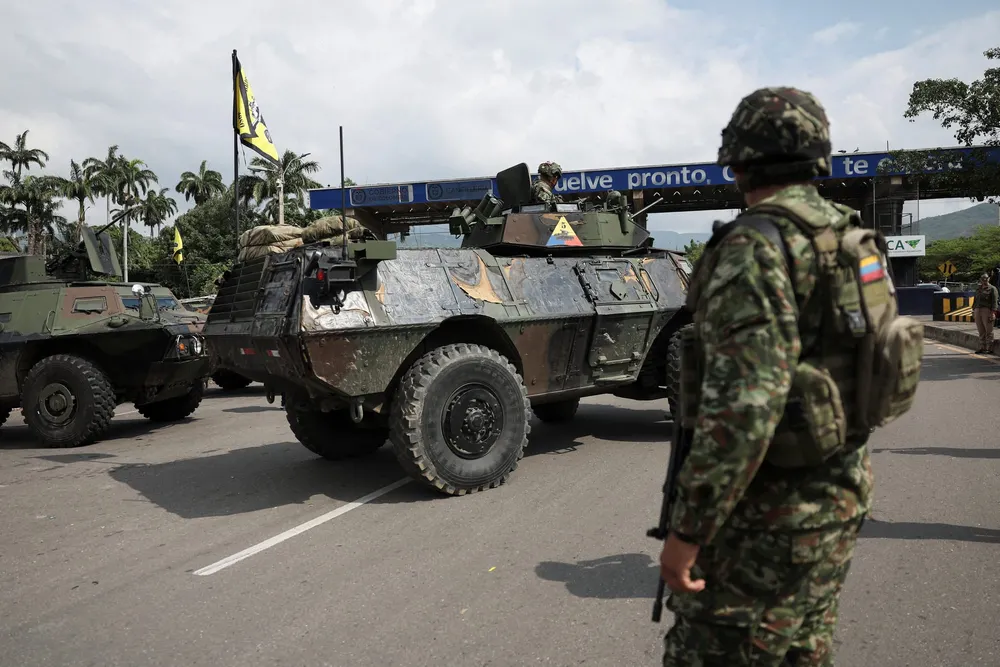
The comparison that keeps being made — between de la Espriella’s Colombia and Noboa’s Ecuador — misses something fundamental. Colombia's security forces are amongst the most capable in the Americas, perhaps the most capable in Latin America and the Caribbean. The Colombian military establishment possesses decades of experience in counterinsurgency, jungle warfare against armed rebel groups, all arms combined operations, intelligence fusion, special ops, air mobility, and joint operations in a variety of forms with different U.S. agencies.
Ecuador’s has nothing like that kind of experience or capacity. And while it’s still relatively early days for Noboa, his strategy so far seems to have fragmented some of the bigger Ecuadorian crime groups but done nothing to reduce violence, nor does it seem to really dent drug trafficking through the country.
Colombia is not a blank canvas for U.S. security policy. It is a country with 60 years of continuous armed conflict, six different active illegal armed groups, the world’s largest cocaine production, and a military that has been fighting this war — with U.S. help — since before most of its current soldiers were born. The question is not whether de la Espriella’s iron-fist approach will be more aggressive than Petro’s total peace strategy. It clearly will be. The question is whether it will work.
The Congressional Complication
The U.S. side has its own complications. Representatives Sylvia Garcia, Greg Casar, Maxwell Frost, and nine other members of Congress sent a letter calling on the Trump administration to carefully review and reassess U.S. security assistance to Colombia under de la Espriella, citing his history as a lawyer for AUC — Colombia’s right-wing paramilitary organization — and his maintained close ties to its former leaders.
The letter invokes “sense of Congress” provisions stating that U.S. security assistance “should be carefully reviewed and reassessed” if directed at governments whose prominent officials are credibly linked to individuals or paramilitary forces associated with the AUC — the United Self-Defense Forces of Colombia — (Autodefensas Unidas de Colombia). The congressional pushback will not stop the bilateral security relationship from deepening — but it could complicate specific military assistance packages and create oversight pressure that constrains the most aggressive proposals.
The Venezuela Dimension
There is a strategic dimension to the U.S.-Colombia security relationship that extends beyond counternarcotics. Colombia sits at the centre of U.S. operations against Venezuela. The United States cannot carry out sustained operations in Venezuela without the Colombian border, Colombian airspace, and Colombian military cooperation. Under Petro, that cooperation was withheld — Colombia had restored diplomatic relations with Caracas and positioned itself as a mediator rather than a participant in Washington’s Venezuela strategy.
Under de la Espriella, Colombia’s 2,000-kilometer border with Venezuela becomes an active asset in the U.S. hemispheric security architecture rather than a neutral corridor. The restoration of Colombian military cooperation — intelligence sharing, basing access, airspace — changes the operational geography of U.S. engagement with Venezuela’s post-Maduro transition in ways that are significant regardless of whether any formal military action is ever taken.
What Comes After August 7
The success of the relationship between Colombia and the United States may hinge on the relationship between the two presidents. Trump is mercurial. De la Espriella is a sovereignty hawk who has spent the campaign insisting Colombia will not be Washington’s instrument.
The tension between those two postures will define the bilateral relationship’s limits.
Some analysts argue that military cooperation may be secondary to expanding economic ties. The U.S. is Colombia’s largest trading partner and source of foreign direct investment, but FDI has been declining. De la Espriella’s fossil fuel agenda — fracking, new oil and gas contracts, expanded exploration — may ultimately matter more to Washington than basing rights.
What is clear is that the Colombian security relationship Washington wanted — and did not have under Petro — begins on August 7. Whether de la Espriella can deliver its substance while defending its form as something other than an incursion will be the defining diplomatic performance of his first year.
For questions or general inquiries, contact the outlet at info@sociedadmedia.com.
Sociedad Media is a Miami-based independent digital news publication covering Latin American politics, U.S.-LATAM relations, security issues and more. Our reporting follows strict impartiality standards.