

CARACAS — A video circulating widely on social media since Sunday shows Venezuela’s Interior Minister Diosdado Cabello physically blocking members of a U.S. rescue delegation from entering a disaster site in La Guaira — the coastal state hardest hit by Wednesday’s twin earthquakes, where more than 1,400 buildings have collapsed and tens of thousands of people remain missing.
In the video, a U.S. rescuer is heard asking rhetorically: “Don’t you want me to go and help the person who’s there?” The question went unanswered on camera. The video has been viewed millions of times and has drawn condemnation from Venezuelan opposition figures, exile communities in Miami, and U.S. political observers, calling for an execution of arrest of Cabello — who remains listed as wanted by U.S. authorities with a $25 million bounty.
What Happened & Where
The Venezuelan government restricted access to La Guaira on the night of June 26, only giving access to authorized personnel. Justice and Peace Minister Diosdado Cabello defended the restriction to clear roadways for ambulances and for health reasons but did not elaborate on the latter.
Rescue efforts in La Guaira had been hampered by a rush of civilian vehicles carrying relief supplies and volunteers that jammed the lone highway into the region, leaving many aid workers stranded in traffic. Officials attempted to limit access to the state to government vehicles and other authorized personnel. But large groups of civilians — many expressing anger at the authorities’ disaster response — still crowded the roads on Saturday to bring food, water, and medical aid.
The access restriction was applied broadly — not exclusively to U.S. teams. Civilian convoys, independent aid workers, and journalists all reported being blocked at checkpoints along the Caracas-La Guaira highway. The government’s stated rationale was logistics: the single road into La Guaira was so congested with civilian vehicles that ambulances carrying injured survivors were unable to get through, according to Venezuelan government officials.
Whether the restriction was also applied selectively to U.S. personnel — and whether Cabello’s personal intervention in the video constitutes deliberate obstruction of an authorized American rescue delegation or a confrontation at a general access checkpoint — has not been independently confirmed.
The Venezuelan government has not addressed the video directly as of Sunday afternoon.
Who Cabello Is — and Why It Matters
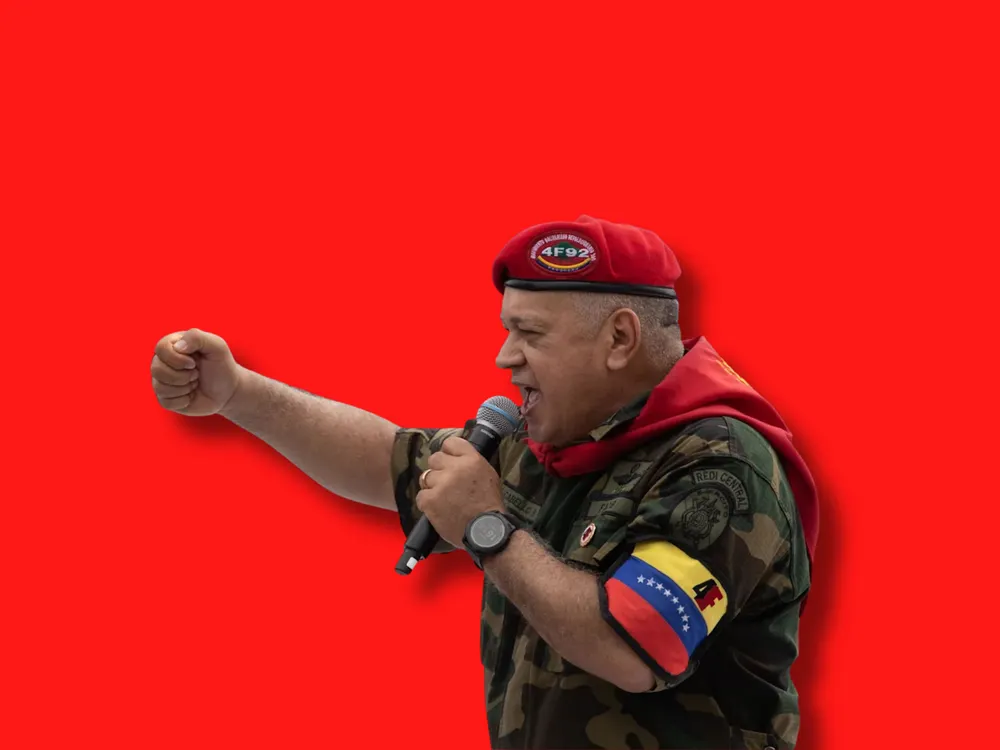
Diosdado Cabello is not a minor figure in Venezuelan politics. A former military officer, longtime Chavista loyalist, and one of the most powerful members of the Maduro-era inner circle, Cabello has served as Interior Minister under the Rodríguez interim government — a position that puts him in direct command of Venezuela’s security apparatus and, by extension, the access control regime in the earthquake disaster zone.
His presence in the disaster response has itself been a source of controversy.
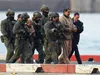
Diosdado Cebello’s encounter with U.S. emergency workers captured on Sunday, June 28, 2026 in La Guaira. Credit: X
Cabello, appearing on state television VTV from La Guaira on Thursday, asked citizens to “trust the government” in its response. “We have the people of La Guaira organized so far, and that is one of the things we ask of them most: that the people organize themselves, that they trust their government,” he said.
“We understand that some people may be desperate, but we are acting according to protocols to activate aid and rescue efforts to help those who need it most,” Cabello said.
Critics of the Venezuelan government have argued that the regime’s logic is insufficient, claiming that the very government itself has survived for 30 years by convincing the population that “U.S. imperialists” in Washington are their hegemonic adversary and implacable in their oppression of the Venezuelan people.
If U.S. rescuers were suddenly permitted to deploy throughout various parts of Venezuela hardest hit by last week’s earthquakes and contribute in emergency aid efforts, the Venezuelan people would see for themselves that what their government had been preaching to them for three decades — is a farce.
For Venezuela’s diaspora in Miami and for U.S. officials who have spent years documenting Cabello’s role in the Maduro government’s human rights abuses and narcotrafficking networks — he was indicted by U.S. federal prosecutors on drug trafficking charges in 2020 — his presence as the face of disaster access control in La Guaira carries a weight that goes far beyond logistics management.
The Broader Pattern
The Cabello video did not emerge in isolation. It is the sharpest crystallization of a pattern that has been building since the first hours after the earthquake.
Almost 24 hours after the earthquakes, residents of La Guaira dug through rubble with their hands as the city faced a shortage of heavy equipment and machinery, with very limited government assistance. Many Venezuelans, frustrated, claimed the government's response was limited and insufficient. At one rubble site, government officials took selfies before leaving without participating in the recovery effort.
Against that backdrop, the sight of a senior government minister physically blocking rescuers — at a moment when the 72-hour golden window for finding survivors alive was closing — has produced fury that extends well beyond the diaspora and into the population of La Guaira itself.
Rescue workers from Fairfax County, Virginia, were working Sunday at the rubble of a multi-story building in La Guaira, listening intently for signs of life. They heard two distinct taps — what they believe is the sound of someone trapped under the structure. Nobody nearby dared speak. Time was running out. Those teams are operating. The U.S. response — $150 million in aid, the USS Fort Lauderdale, urban search and rescue teams, military transport — has proceeded.
Three Americans have died from the earthquakes and 12 remain missing, the U.S. government confirmed on Sunday. Acting President Rodríguez has publicly thanked Washington and said U.S. cooperation has been constructive.
What It Means
The Cabello video sits at the intersection of two realities that are both true simultaneously.
The first: Venezuela’s disaster response has been genuinely chaotic, and access control along the lone highway into La Guaira has been a real logistical problem that has delayed aid from multiple sources — not only from the United States.
The second: Diosdado Cabello, one of the most sanctioned and indicted figures in the Maduro-era government, is exercising authority over who enters the disaster zone — and a video of him doing so in a manner that appears to block U.S. rescuers, at a moment when people are dying under rubble, cannot be dismissed as routine logistics management.
The Venezuelan government has welcomed U.S. aid at the level of acting President Rodríguez and the National Assembly. At the operational level in La Guaira, the picture is more contested — and the Cabello video is evidence of that contest.
What it means for the fragile U.S.-Venezuela rapprochement that the earthquake appeared to be accelerating is a question that will be answered in the days ahead — in the State Department’s public statements, in Rubio’s phone calls with Rodríguez, and in whether U.S. rescue teams operating in La Guaira find their access improving or further restricted as the search for survivors continues.
Sociedad Media extends its deepest condolences to the people of Venezuela and to all families who have lost loved ones in this devastating tragedy. If you have information, eyewitness accounts, or tips from the ground, please contact us at info@sociedadmedia.com.
This looks like a big problem. https://t.co/Oyv8xe5Z3a
— Sociedad Media (@sociedadmedia) June 29, 2026