

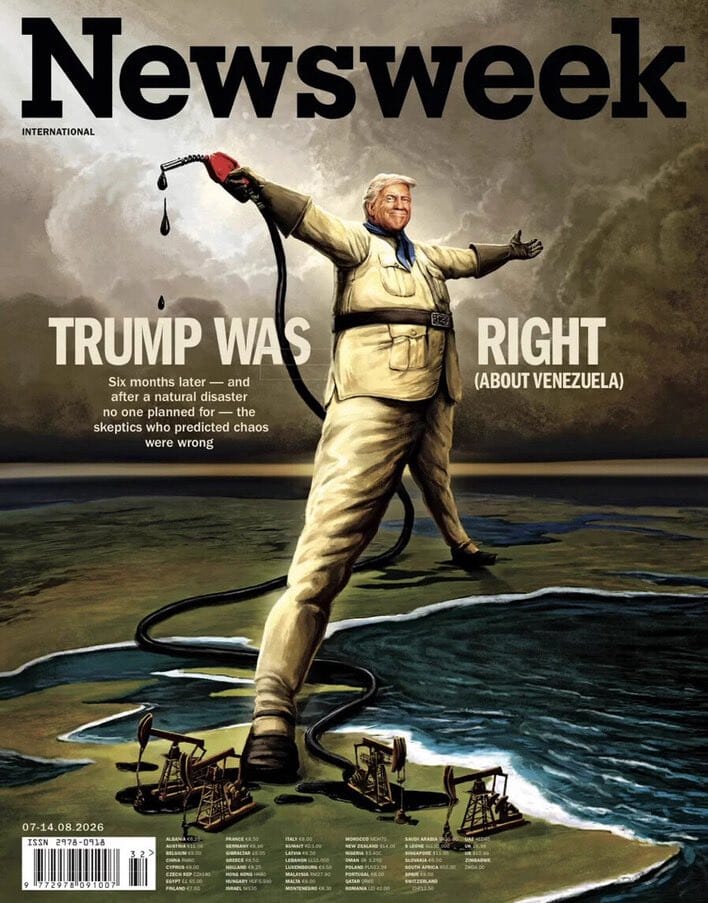
MIAMI — Newsweek’s August 7-14 international cover delivers a blunt verdict on one of the most consequential foreign policy gambles of President Trump’s second term: “TRUMP WAS RIGHT (ABOUT VENEZUELA).” The cover shows a giant, safari-clad caricature of Trump straddling North and South America, fuel pump in hand, oil flowing down to pump-jacks below.
Trump reposted the cover himself; the White House followed with its own share captioned “TRUST IN TRUMP.”
The Case the Cover Makes
The subhead states it plainly: “Six months later — and after a natural disaster no one planned for — the skeptics who predicted chaos were wrong.” Trump reinforced the message in a video statement circulated alongside the cover: “Trump was right about Venezuela. They’ve gotten stability and America has gotten oil and safety. It’s a win and a win and a win.”
What the Skeptics Predicted
When Trump ordered the January 3 raid that captured Nicolás Maduro and ended his presidency, warnings of chaos came from a wide range of voices, not a single source, and the “chaos” framing was explicit and widespread from day one.
House Armed Services Committee ranking Democrat Adam Smith warned that U.S. military intervention “always ends badly,” pointing directly to Iraq and Libya — two cases where removing a strongman by force triggered years of civil war, insurgency, and state collapse. Representative Jim Himes, ranking Democrat on the House Intelligence Committee, drew an equally pointed comparison to the fall of the Taliban in 2002, when early optimism about Afghanistan gave way to two decades of instability.
Although these warnings were only specific forecasts of potentially looming chaos, breakdown, and prolonged violence following the removal of Venezuela’s leader, a host of commentators and analysts were more certain in their forbodings.
Outside of Congress, the warnings were, if anything, more direct. A former Biden administration official who had led Venezuela policy predicted that power struggles inside the country could result in outright “chaos” requiring further U.S. intervention, according to a Congressional Research Service brief. CBS News also ran a segment built around a diplomacy expert’s blunt warning: “A power vacuum creates chaos.”
Andrei Serbin Pont, a military analyst and head of the Buenos Aires-based think tank CRIES, told the Financial Times that Venezuela’s armed groups had “the power to sabotage any type of transition just by the conditions of instability that they can create.”
Fox News reported at the time that guerrilla groups and cartels were already exploiting the power vacuum along Venezuela’s border with Colombia. Security analysts also warned explicitly of “street and jungle firefights between U.S. and foreign-supported proxies, political assassinations, and human rights abuses” as real possibilities in the weeks ahead. Stratfor’s RANE service, too, warned the capture “creates a leadership vacuum that risks leading to potentially violent instability and unrest in the coming weeks.”
These were not vague, hedged predictions — across government, media, and independent analysis alike, the forecast was specific: chaos, breakdown, and prolonged violence following the removal of Venezuela’s leader was inevitable.
Six Months Later, That Chaos Never Came
By Newsweek’s account, none of it happened. There was no civil war. No insurgency. No prolonged security vacuum of the kind Iraq or Libya experienced.
Venezuela’s institutions continued functioning under acting President Delcy Rodríguez, and the transition proceeded without the breakdown critics had forecast — even when the country absorbed a genuine, unplanned shock in the form of the devastating June 24 earthquakes.
That the post-Maduro period withstood a natural disaster of that scale without spiraling into the disorder skeptics anticipated is central to the cover’s argument: not merely that things went acceptably, but that the very scenario critics warned about failed to materialize at all.
The Numbers Behind the Headline
Venezuelan oil, once propping up a government hostile to American interests, is now reaching international markets at levels unseen in years. Oil exports hit a seven-year high, with Venezuela’s central bank reporting $5.5 billion in oil export revenue in the first quarter of 2026 alone, up 21% from the same period in 2025.
A State Department spokesperson confirmed to Newsweek that oil production has reached its highest level in seven years, and that inflation has fallen to single digits for the first time in over a year — a striking turnaround for a country long defined by economic collapse.
Secretary of State Marco Rubio, describing the administration’s approach in a May Fox News interview, framed the shift directly: “We’re trying to normalize that place. For the first time in over a decade, the wealth of the country is actually benefiting the people of Venezuela, but there’s more work to be done.”
The administration organized its strategy around three sequential phases — stabilization, economic recovery, and democratic transition — and the absence of chaos Newsweek documents suggests the first phase held.
Repression Has Eased, Opposition Figures Say
Perhaps the most notable acknowledgment comes from inside Venezuela’s own opposition, not from the administration itself. Gaby Arellano, a Venezuelan opposition leader, told Newsweek: “The most tangible change for Venezuelans is that repression has diminished. It has not disappeared, but it has decreased.”
American humanitarian aid, meanwhile, is now flowing into the country daily through channels the prior Chavista government spent years deliberately blocking — a concrete, on-the-ground shift in daily life for ordinary Venezuelans, delivered without the wider unraveling critics feared.
A Disaster That Didn’t Derail the Recovery
The June 24 earthquakes offered an unplanned stress test of the transition, and by Newsweek’s account, the recovery held. Ecoanalítica adjusted its 2026 growth forecast down to 5.8% from a pre-quake estimate near 8% — a real but measured revision, not a collapse. That Venezuela’s stabilization continued through a natural disaster of that scale is, per the cover’s own framing, further evidence that the doomsday scenarios laid out in January simply didn’t play out.
The Verdict
Six months on, the specific chaos Adam Smith, Jim Himes, and other skeptics warned about when Trump ordered Maduro’s capture — the Iraq-and-Libya scenario, the Afghanistan-style unraveling — has not occurred. Oil is flowing, exports are up, inflation has eased, and even Venezuela’s own opposition describes a real, if incomplete, decrease in repression.
Newsweek’s cover captures that outcome in a single, blunt sentence: the skeptics who predicted chaos were wrong.
Sociedad Media will continue to monitor developments in Venezuela, and remain focused on the challenging strides for a more complete democratic transition in Caracas


