

CARACAS — Venezuela was observing a public holiday when the ground moved. At 6:04 in the evening on June 24 — the feast day of San Juan Bautista, a national celebration that had kept millions of Venezuelans at home — a magnitude 7.2 earthquake struck near San Felipe, in the country’s northwest. Thirty-nine seconds later, a magnitude 7.5 mainshock followed near Yumare.
It was the most powerful earthquake to strike Venezuela in more than 125 years.
At least 164 people have been killed and 971 injured after Venezuela’s most powerful earthquake in more than a century, according to the country’s acting President Delcy Rodríguez. “Dozens of buildings have collapsed, and we are currently carrying out very intense rescue efforts to save as many lives as God allows us to save,” Rodríguez said in an appearance on state television.
The USGS warned the death toll is likely to rise significantly. The USGS Prompt Assessment of Global Earthquakes for Response service estimated a 44% probability of deaths between 10,000 and 100,000, and a 30 percent probability of deaths exceeding 100,000. Economic losses could reach between $10 billion and $100 billion — potentially equivalent to 20% of Venezuela’s GDP.
The Destruction
Venezuelan Interior Minister Diosdado Cabello said the Los Palos Grandes and Altamira municipalities were the worst-affected parts of Caracas. In an unspecified area in southeastern Caracas, almost all high-rise buildings were heavily damaged or destroyed, with many collapsing entirely. Six aftershocks were felt in Caracas within two hours of the mainshock.
Buildings also collapsed in Trujillo, Carabobo, Aragua, Miranda, and La Guaira.
Simón Bolívar International Airport was damaged and all flights were canceled. Metro and railway services remain suspended in Caracas. A tsunami threat was issued for Puerto Rico and the Virgin Islands following the quake.
A resident who survived a quake that hit Caracas in 1967 said the disaster was unlike anything he had experienced. Another resident who escaped a damaged building said “the scene was like a horror movie.”
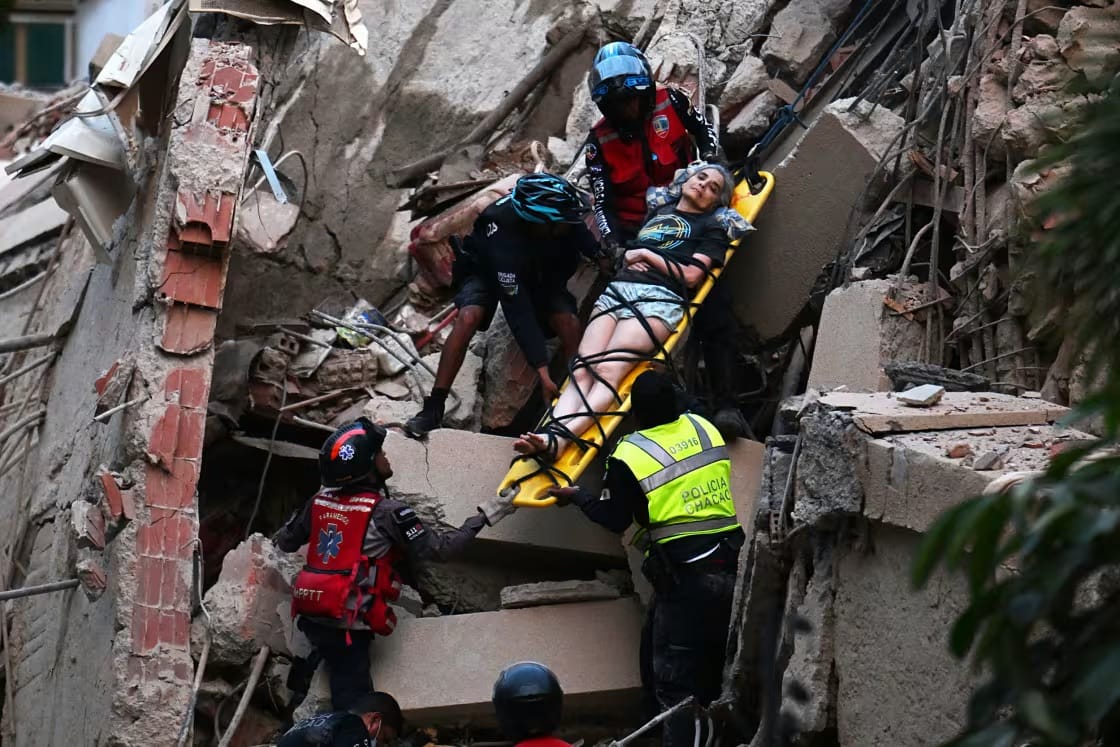
The destruction is compounded by Venezuela’s pre-existing vulnerability. About 80% of the population in Venezuela lives in quake-prone areas, and many live in houses not built to withstand strong earthquakes.
In the hard-hit area of Altamira in Caracas, many of the buildings that collapsed are built on sediments, which makes them much more vulnerable to seismic waves. There is also extensive informal housing across several areas that is not prepared to sustain very strong earthquakes.
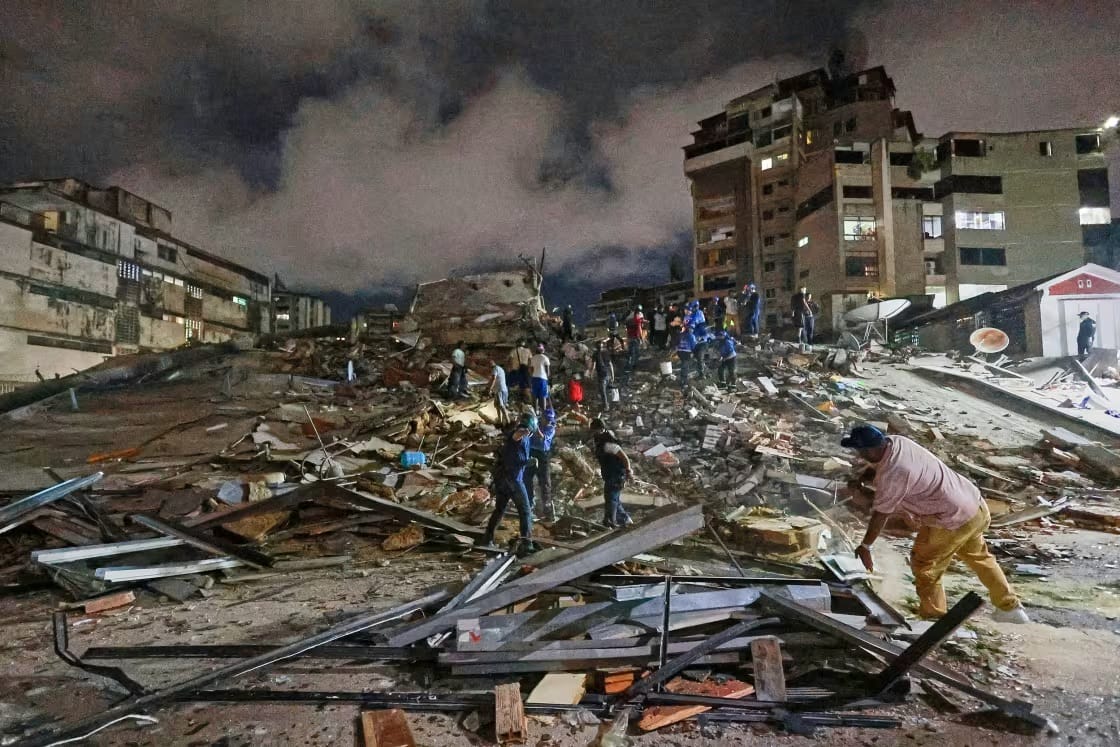
Caracas sits in a deep sedimentary basin that amplifies seismic waves — a geographic reality that has made its urban core catastrophically vulnerable to exactly the kind of strike-slip fault rupture that struck Wednesday evening.
Washington’s Response
The U.S. government moved faster than at almost any comparable moment in recent U.S.-Venezuela relations.
Secretary of State Marco Rubio said he has been in direct contact with acting Venezuelan President Delcy Rodríguez and that the U.S. has already deployed search and rescue teams. “We’re already deploying search and rescue teams from Fairfax County, Virginia, and Los Angeles. There’ll be some others we’ll add,” Rubio told reporters. “That’s their most immediate need right now — search and rescue efforts.”
With Venezuela’s airport badly damaged, the U.S. Defense Department will deploy assets there. Rubio said the U.S. government will also provide overhead imagery to assess damage, particularly in coastal areas. “We have a whole of government response,” Rubio said. “It’ll be big. It’ll be fast and it’ll be effective.”
🎥 Watch video capturing the destruction in La Guaira, Venezuela ⬇⬇
Aftermath of 7.2 magnitude earthquake in La Guaira, Venezuela, on June 24, 2026. Source: X
The speed and scale of Washington’s response is notable given the state of U.S.-Venezuela relations before Wednesday evening. The two countries have been in a state of sustained adversarial tension — U.S. sanctions, the military capture of Maduro, the installation of the Rodríguez interim government, and ongoing disputes over the democratic transition timeline. The earthquake has, at least temporarily, superseded all of it.
What the U.S. Could Do
The immediate U.S. response — search and rescue teams, airport assets, overhead imagery — addresses the acute emergency. But the scale of the disaster, and Venezuela’s pre-existing humanitarian and infrastructure crisis, suggests the window for a more consequential U.S. role is opening.
Several concrete steps Washington could take in the days and weeks ahead:
Humanitarian aid corridor. Venezuela’s airport damage creates an immediate logistical bottleneck. The U.S. military’s deployment of assets to Simón Bolívar International Airport positions Washington to establish the primary humanitarian supply corridor into the country — a role that would simultaneously serve the relief mission and deepen the operational relationship with the Rodríguez government.
Sanctions relief. The U.S. fuel blockade — in place since January 2026 — has already been cited by the UN as contributing to medicine shortages and power failures across Venezuela. In a post-earthquake environment where generators, rescue equipment, and medical facilities all require fuel, a temporary humanitarian suspension of the fuel blockade would dramatically expand Venezuela’s capacity to respond to its own disaster — and would send an unmistakable diplomatic signal about Washington’s intentions.
Engineering and structural assessment. USAID’s Office of U.S. Foreign Disaster Assistance has deep expertise in post-earthquake structural assessment — identifying which buildings are safe to reoccupy, which must be demolished, and which require reinforcement. Deploying OFDA teams to Caracas would address one of the most immediate post-disaster governance challenges: the millions of Venezuelans living near damaged buildings who cannot return home until the risk is assessed.
Geopolitics Always...
Natural disasters have historically created openings in adversarial relationships that political negotiations could not produce. The 2010 Haiti earthquake prompted a temporary suspension of U.S.-Cuba tensions to allow coordinated relief. The 2004 Indian Ocean tsunami created a humanitarian cooperation framework between the U.S. and Indonesia that outlasted the immediate crisis.
Venezuela’s earthquake arrives at a moment when the post-Maduro transition is already at an inflection point — Machado pushing for elections, Washington backing Rodríguez without a defined timeline, and the Cuban sanctions escalation consuming diplomatic bandwidth. A significant, sustained, and visible U.S. humanitarian role in Venezuela's earthquake response would not resolve any of those structural tensions. But it would create a foundation of operational trust between Washington and Caracas that purely political negotiations have so far failed to build.
How Washington uses the next 72 hours in Venezuela may shape the bilateral relationship more than any policy statement of the past six months.
Sociedad Media extends its deepest condolences to the people of Venezuela and to all families who have lost loved ones in yesterday’s devastating earthquakes.
Our thoughts are with the communities of Caracas, Altamira, La Guaira, and every region affected by this tragedy. If you have information, eyewitness accounts, or tips from the ground, please contact us at info@sociedadmedia.com


