

MIAMI —Abelardo de la Espriella is sworn in on Friday as Colombia’s 43rd president, in a ceremony breaking with decades of tradition — and one that South Florida’s large Colombian community, and the Miami-area congressional delegation representing it, has been anticipating since his narrow June runoff victory.
An Inauguration Unlike Recent Memory
De la Espriella’s inauguration takes place at 3:00 p.m. on Friday at the Arena USC, the university coliseum at Universidad Santiago de Cali — the first time in decades that Colombia’s presidential transfer-of-command ceremony has been held outside of the capital city of Bogotá.
De la Espriella has framed the choice as a deliberate political and symbolic gesture toward Colombia’s Pacific region, which his incoming government has flagged as strategic to its early agenda. He has also emphasized the ceremony’s modest cost, describing it as under half the price of the previous inauguration four years ago.
Security for the event is substantial: more than 11,000 military and police personnel are deployed across Cali and the surrounding municipalities of Palmira, Candelaria, Jamundí, Yumbo, and Pradera, under a unified command post.
Authorities have restricted drone use, imposed controls on fuel transport, and enacted an alcohol sales ban (“ley seca”) beginning the day before the ceremony.
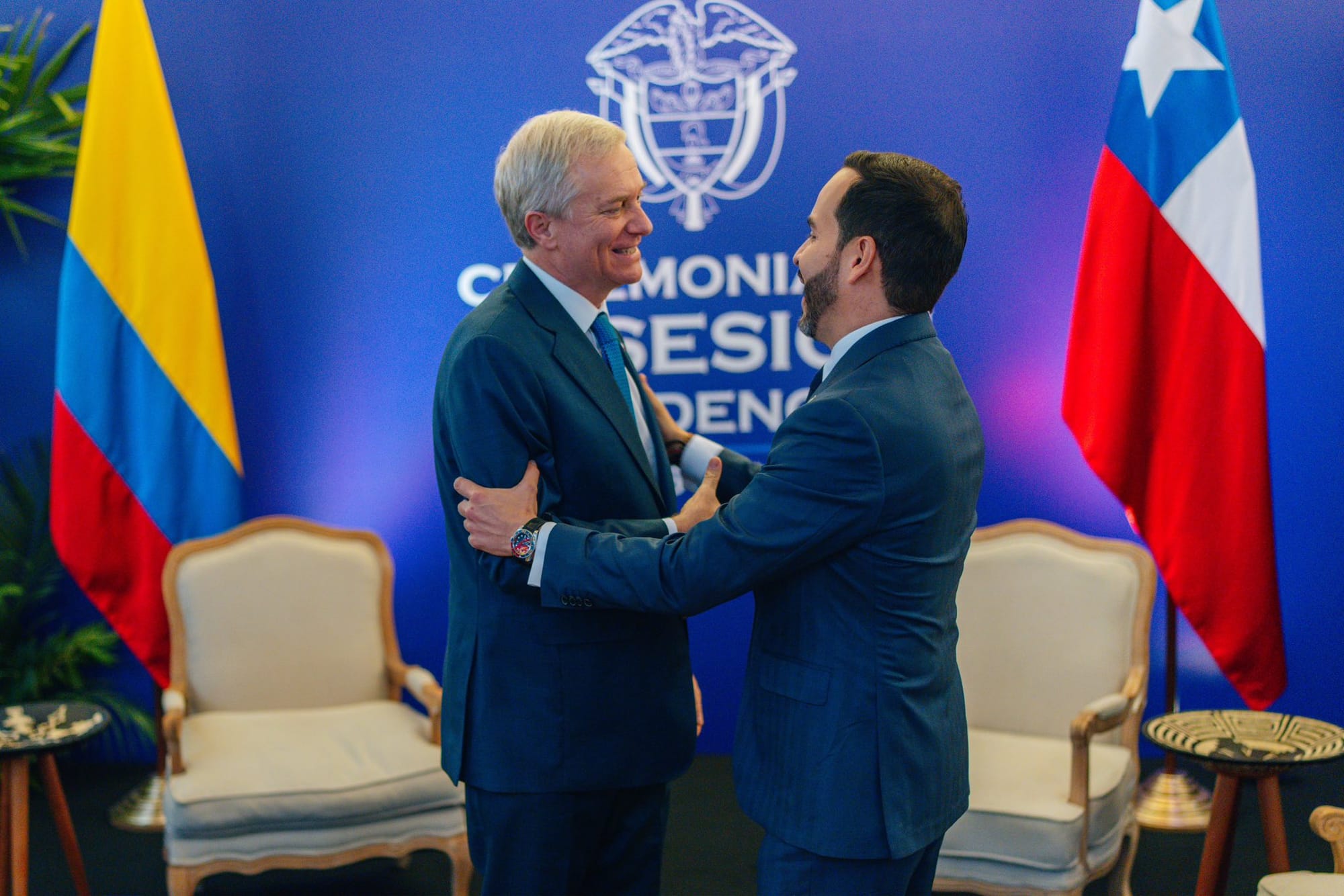
Roughly 6,000 visitors are expected in the city for the event. International attendance includes Spain’s King Felipe VI, Argentina’s Javier Milei, Paraguay’s Santiago Peña, Ecuador’s Daniel Noboa, Chile’s José Antonio Kast, Bolivia’s Rodrigo Paz, and special representative of President Donald Trump, Acting Attorney General of the United States Todd Blanche — a guest list reflecting the same bloc of right-leaning regional governments de la Espriella has aligned Colombia with since his election.
Outgoing President Petro Won’t Attend
Gustavo Petro will not be present at the ceremony; his role as outgoing president instead takes place separately at Casa de Nariño, in a farewell and welcome act with the incoming president held after the swearing-in.
Petro has continued to publicly question the legitimacy of de la Espriella’s win — a margin of less than one percentage point — repeating unsubstantiated fraud claims and, in one notable jab, suggesting the inauguration be held in Miami instead of Cali, accusing de la Espriella of avoiding Bogotá’s Plaza de Bolívar out of guilt over the legacy of Simón Bolívar.
The remark, whatever its intent, inadvertently underscored just how closely de la Espriella’s political rise has been tied to South Florida’s Colombian diaspora from the start.
Miami’s Colombian Community Was Engaged Early
South Florida is home to one of the largest Colombian populations outside Colombia itself, and that community’s engagement with this election was direct and visible well before Friday’s ceremony. Miami-area Republican Representative Mario Díaz-Balart personally accompanied Colombian voters during early voting at the University of Miami, framing the stakes in hemispheric terms: Colombia’s future, he said at the time, was equivalent to the future of the hemisphere itself.
Days before the runoff, Díaz-Balart joined fellow Florida Republicans María Elvira Salazar and Carlos Giménez, along with Representatives Christopher Smith and Bill Huizenga, in sending a letter to Secretary of State Marco Rubio defending then-candidate de la Espriella against criticism from a group of Democratic lawmakers.
Salazar, a member of the House Foreign Affairs Committee, traveled to Colombia and stood with de la Espriella at his campaign headquarters as results came in, later posting: “Today Colombia won its most important match. Congratulations to the president-elect, Abelardo de la Espriella.”
Giménez, who served as an international election observer, congratulated “the tiger Abelardo de la Espriella” from the floor of Congress and announced plans to invite Colombian officials to brief lawmakers on the electoral process.
President Trump, who had publicly backed de la Espriella during the campaign, offered the most prominent reaction of all from Washington.
A Presidency That Begins With Real Obstacles
Despite the celebratory reception in Washington and Miami, de la Espriella’s presidency opens from a position weaker than his international backing might suggest.
In a political confrontation just weeks before his inauguration, former President Álvaro Uribe’s preferred candidate, Honorio Henríquez, won the presidency of Colombia’s Senate — with the backing of Petro’s own Pacto Histórico coalition, an unusual alignment that handed de la Espriella an early legislative setback.
Having run his campaign largely outside Colombia’s traditional party structures, de la Espriella enters office without a large or cohesive congressional bloc of his own, a structural challenge that will likely shape how much of his stated agenda — including the security overhaul, foreign policy reversal, and fiscal austerity program covered extensively in the lead-up to Friday — he can actually convert into governing power.
Future Visions
De la Espriella has pledged a very hardline military approach to Colombia’s security crisis, stating flatly that “in my government, there will be no peace processes,” a direct break from Petro’s approach to negotiations with guerrilla and criminal groups.
For Miami’s Colombian community, many of whom fled precisely the kind of violence and instability such peace processes were designed to resolve, that pledge — alongside de la Espriella’s broader realignment toward Washington — has been a central part of his appeal since the campaign’s earliest days.
Whether a president entering office with a narrow mandate and a weak legislative position can deliver on it is likely to become one of the more closely watched storylines of his term, both in Bogotá and among the diaspora community that championed him from South Florida.
🚨🇨🇴 | NOW/COLOMBIA: Residents at midnight in Medellín celebrate the transfer of power to incoming president Abelardo de la Espriella 🎆
— Sociedad Media (@sociedadmedia) August 7, 2026
Miami’s Colombia community is watching 🇨🇴🌴 pic.twitter.com/0AEPbfDqKM


