

BOGOTÁ — Abelardo de la Espriella — the criminal defense lawyer from Barranquilla who called himself “El Tigre,” is now Colombia’s president-elect.
With 99.96% of ballots counted, the right-wing de la Espriella won with 12,955,911 votes compared with 12,706,523 for left-wing Senator Iván Cepeda — a margin of fewer than 250,000 votes, the narrowest in Colombia’s recent electoral history. With 12.9 million votes, de la Espriella became the most voted presidential candidate in Colombian history.
Turnout was high, at around 63% of the electorate. More than 41.4 million Colombians were eligible to vote.
The result is preliminary. Cepeda announced it would not go uncontested.
The Night in Barranquilla
De la Espriella and his vice-presidential running mate José Manuel Restrepo rode in a bulletproof booth toward a celebration rally after election results showed him leading in Barranquilla. The Tiger — as his supporters affectionately refer to him — had gone to the polls in his hometown, addressed supporters throughout the day, and watched the results come in from a campaign headquarters that had spent weeks preparing for exactly this moment.
U.S. Secretary of State Marco Rubio was among the first to congratulate him, posting on social media that “Colombia’s best days are ahead.” Trump’s Truth Social post — the one that called de la Espriella a man who would fight for Colombia’s greatness and urged Colombians to vote for law and order — had proved prescient in ways that even Washington had not fully anticipated.
The Cepeda Challenge
The left did not concede cleanly, however. Cepeda acknowledged the preliminary count showing his rival as the winner, but said the results are not final and announced that his party will challenge the results from 33,000 polling stations across the country.
Outgoing President Gustavo Petro called for a thorough counting of the votes following the preliminary results. Petro issued a statement on social media accusing the State of Israel of hacking election software in order to cast fraudulent ballots in favor of de la Espriella — an extraordinary claim for which no evidence was presented.
The challenge to 33,000 polling stations echoes Petro’s unsubstantiated fraud allegations from the first round — a pattern the left has deployed throughout this electoral cycle. International observers, who deemed the May 31 first round orderly and transparent, were present across the country on Sunday.
Their preliminary assessment of the runoff is expected in the coming hours.
Who De la Espriella Is
A dual Colombian-U.S. citizen, de la Espriella espouses an “iron fist” security-first approach to crime and corruption. He has spoken favorably of Trump’s policies and vowed to build mega prisons for Colombia’s criminal leaders, similar to El Salvador's President Nayib Bukele. His campaign has also advocated for a free-market economic agenda, casting a smaller government, lower taxes, and resource extraction as the route to restoring order and growth.
De la Espriella is a millionaire businessman and criminal defense attorney who has nicknamed himself “El Tigre.” A political newcomer endorsed by President Donald Trump, he has pledged to pursue a tougher, more hardline approach to security issues in a country racked by recent violence from left-wing insurgent groups and FARC dissidents.
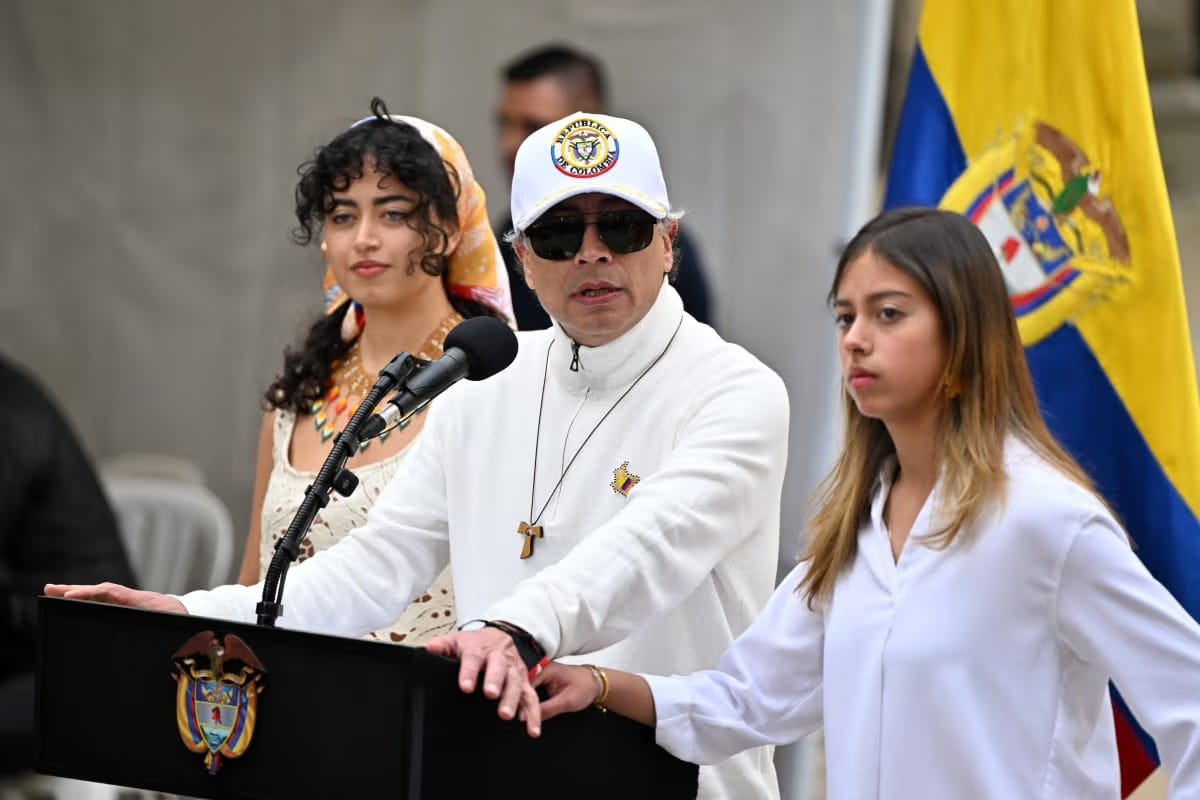
On his first day in office he has promised a sweeping military offensive against guerrilla groups, stating he would “bomb all of the camps holding narco-terrorists.” He has also said he would intensify attacks on drug-smuggling aircraft and boats, and build ten mega prisons.
The 47-year-old has never held elected office and qualified for the ballot through citizen signatures rather than a major party. De la Espriella has run on a culture war platform, casting himself as a defender of the “traditional family,” while his campaign has opposed abortion, adoption by same-sex couples, and “gender ideology.”
He has also said he would govern through emergency decrees to move quickly against crime.
Just spoke to Colombian President-Elect @ABDELAESPRIELLA to congratulate him on his electoral victory.
— Secretary Marco Rubio (@SecRubio) June 22, 2026
The Trump Administration looks forward to working closely with your incoming administration to advance regional security cooperation, end illegal immigration to the United…
Before entering politics, he was a high-profile criminal defense lawyer who built his career defending several controversial clients, including Alex Saab, an alleged financier and close ally of Venezuela’s former leader Nicolás Maduro. That history — defended by his supporters as legal representation, criticized by opponents as evidence of deeper entanglements — will follow him into the presidential palace.
What He Inherits
De la Espriella takes office on August 7 — Colombia’s Independence Day — and inherits a country whose contradictions are as stark as his margin of victory.
His predecessor, Gustavo Petro’s policy of “Total Peace,” aimed at demobilizing all armed groups and definitively ending Colombian conflict, is generally regarded as a failure. FARC dissidents bombed police stations in Cauca in the final weeks of the campaign. The ELN was accused of pressuring rural voters. Drug lord threats were directed at “warmongering sectors.” The security architecture of the country de la Espriella is inheriting is not the one he described on the campaign trail — it is more fractured, more entrenched, and more resistant to the kind of military-first solutions he has promised.
The economy presents its own challenge. Colombia’s relationship with Washington deteriorated to the point of visa revocations and Treasury sanctions under Petro.
De la Espriella pledged to open up the countryside to fracking and reverse Petro’s moratorium on new hydrocarbon and mining contracts — a posture that will define his relationship with the private sector and with international investors watching from Miami to Bogotá.
What It Means for the Region
The result completes the most significant single-cycle rightward shift in Latin American history. This should not be seen as a surprise: Colombians have grown weary of establishment politics for decades and de la Espriella has taken full advantage of that.
With Colombia now joining Argentina, Chile, Ecuador, and Peru in electing right-wing governments, the three largest economies in South America — Argentina, Brazil, and Colombia — are simultaneously governed by the right for the first time in over two decades.
Brazil’s October 2 election, in which Flávio Bolsonaro and Lula are running in a statistical dead heat, is the last major domino.
The president will not be sworn in until the Battle of Boyacá memorial on August 7, 2026, giving him over a month to organize a cabinet and work out the fine details of how to put his plan de gobierno into practice. The official escrutinio — Colombia’s formal vote validation process — will take several weeks.
Cepeda’s challenge to 33,000 polling stations will play out within that process.
🚨🇨🇴 | ALERTA/SUDAMÉRICA: Si De La Espriella resulta victorioso el 21 de junio, la región lucirá así. Algo que no se ha visto desde la revolución de la Marea Rosa de principios de los 2000 — una mayoría política unificada en Sudamérica.#Colombia #Brasil #elecciones2026… pic.twitter.com/FkPk50hJYk
— Sociedad Media (@sociedadmedia) June 1, 2026
Have a tip or story lead? Contact us at info@sociedadmedia.com
Sociedad Media is an independent digital publication covering Latin American politics, business, and security.
Our reporting follows strict impartiality standards.


