

LIMA, PERU — Keiko Sofía Fujimori Higuchi was sworn in on Tuesday as the newest President of Peru, becoming the country’s 132nd head of state and the first woman elected to the office by popular vote — a milestone that arrived on the same date, and even the same birthday, as her father Alberto Fujimori’s own inauguration 36 years earlier.
The Ceremony
The day began with a solemn Te Deum Mass at Lima’s cathedral, attended by outgoing interim President José María Balcázar alongside the diplomatic corps.
Shortly before noon, a congressional delegation traveled to the Torre Tagle Palace, the Foreign Ministry’s headquarters, to formally notify Fujimori that Congress was ready to receive her. At 12:15 p.m. Lima-time, before the bicameral legislature’s full assembly, Congress President Miguel Torres of Fuerza Popular — Fujimori’s own party — administered her oath of office and placed the presidential sash on her shoulders as the national anthem played. She then swore in her two vice presidents before delivering her inaugural address to lawmakers and international dignitaries, followed by the swearing-in of her 19-member cabinet at the Government Palace.
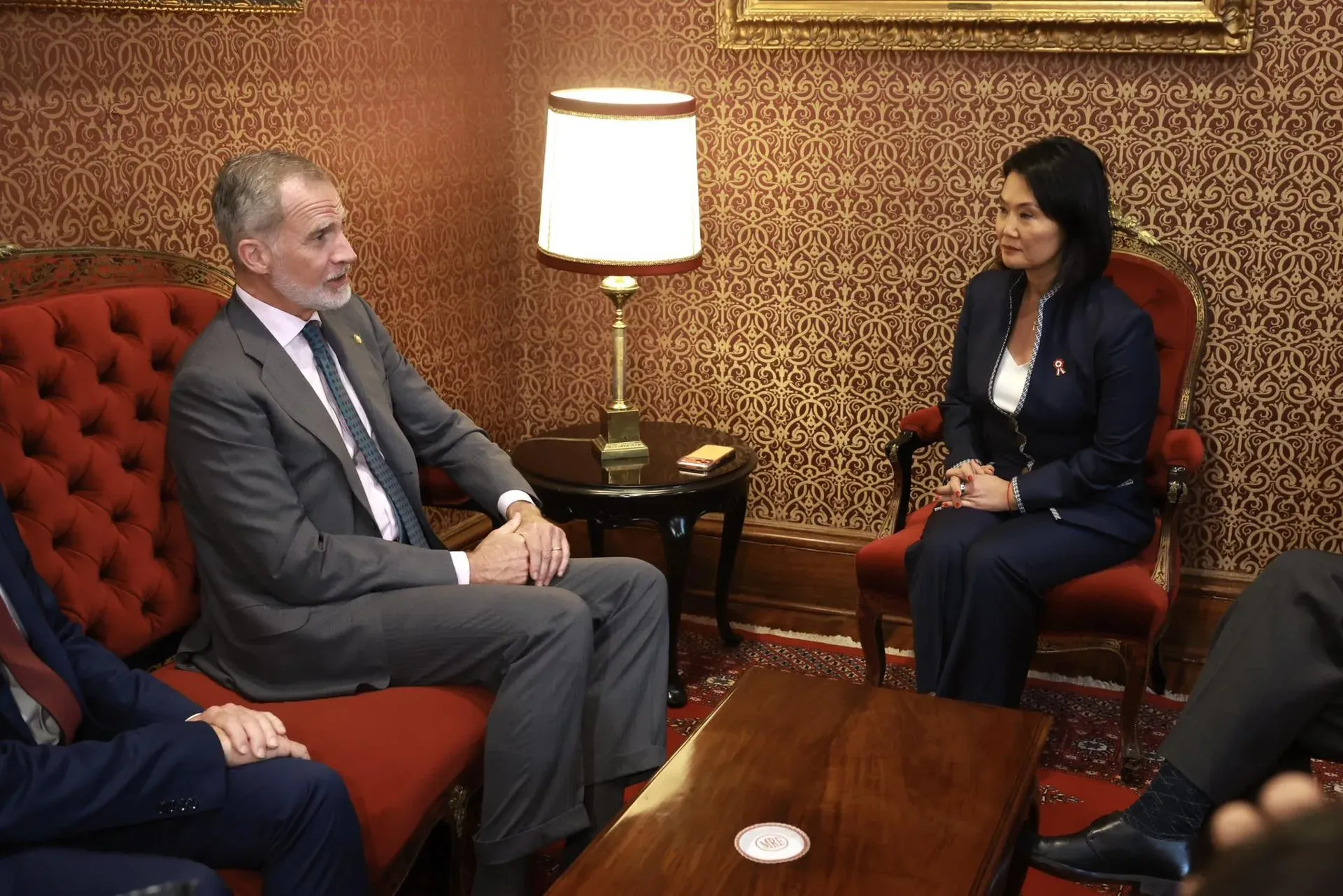
Heads of state and government from across the region attended, including Ecuador’s Daniel Noboa, Argentina’s Javier Milei, Chile’s José Antonio Kast, and Spain’s King Felipe VI — attendance widely read as reflecting Fujimori’s alignment with the hemisphere’s growing bloc of right-leaning governments.
Security was extensive throughout Lima, with checkpoints restricting vehicle access around Congress and Armed Forces and National Police personnel deployed for the ceremony.
A Personal & Political Symbol
The date carried deep personal significance for Fujimori beyond the presidency itself: July 28 is also her late father’s birthday, and the same day he was first inaugurated as president in 1990.
Alberto Fujimori governed Peru until 2000 and later served 16 years in prison for human rights abuses and corruption tied to his government’s fight against the Maoist Shining Path insurgency, before his death in September 2024. Keiko Fujimori dedicated a message to her father shortly before taking office, and her ascension marks fujimorismo’s return to Peru’s presidency roughly 26 years after he left it.
Her path to the office was not quick. The 51-year-old business administrator has spent nearly two decades in Peruvian politics and lost three consecutive presidential runoffs before finally winning in June, defeating leftist candidate Roberto Sánchez by fewer than 50,000 votes.
The Challenges Ahead
Fujimori inherits a country grappling with a serious public-security crisis, years of political instability, and an economy performing below its potential. She has pledged a firm, “mano dura” approach to combating organized crime and extortion, an issue underscored just weeks before her inauguration when the outgoing government declared a second state of emergency this year in Pisco province over homicides and extortion.
Separately, meteorologists are forecasting what could be the most severe El Niño weather pattern in decades, threatening the infrastructure and agricultural disruptions the phenomenon has already begun causing this year.
On the economic front, Fujimori will govern with some institutional continuity: she confirmed Julio Velarde will remain at the helm of Peru’s Central Reserve Bank, a decision that drew support from business sectors given Velarde’s long-standing role anchoring the country’s monetary stability. Her government also faces the task of unlocking stalled mining investment to capitalize on record gold and copper prices — a commodity boom that, as economists have noted, has yet to translate into significant new mining output despite Peru’s position as the world’s second-largest copper producer.
A Divided Reception
Fujimori’s inauguration lands amid open division within Peruvian society over what her family’s political legacy represents. Supporters point to her promise of firmness and order after a decade that saw eight presidents cycle through office amid impeachments and political crises.
Critics, including a sustained anti-fujimorista movement, point to her father’s human rights record and argue she has not adequately reckoned with or apologized for it, while expressing concern that her alignment with other right-leaning governments in the region — several of whose leaders attended Tuesday’s ceremony — could presage a harder-edged governing style.
During the ceremony, Cardinal Carlos Castillo specifically named victims of state violence, including those killed during the 2022-2023 protests under former President Dina Boluarte, a pointed reminder of the unresolved grievances still shadowing Peruvian politics as Fujimori begins her term.
What Comes Next
Fujimori now governs for a five-year term running through 2031, inheriting a security crisis, a pending climate emergency, and an economy that international observers still consider one of the region’s soundest on paper, but that has struggled to convert record commodity prices into broader growth.
How Peru’s newest president balances her hardline security pledges against a country still divided over her family’s legacy is likely to shape both her presidency and Peru’s broader political trajectory in the years ahead.


