

BOGOTÁ — Less than a month before Abelardo de la Espriella is scheduled to be sworn in as Colombia’s next president, the man he is replacing is using every institutional lever available to him to make the handover as difficult as possible.
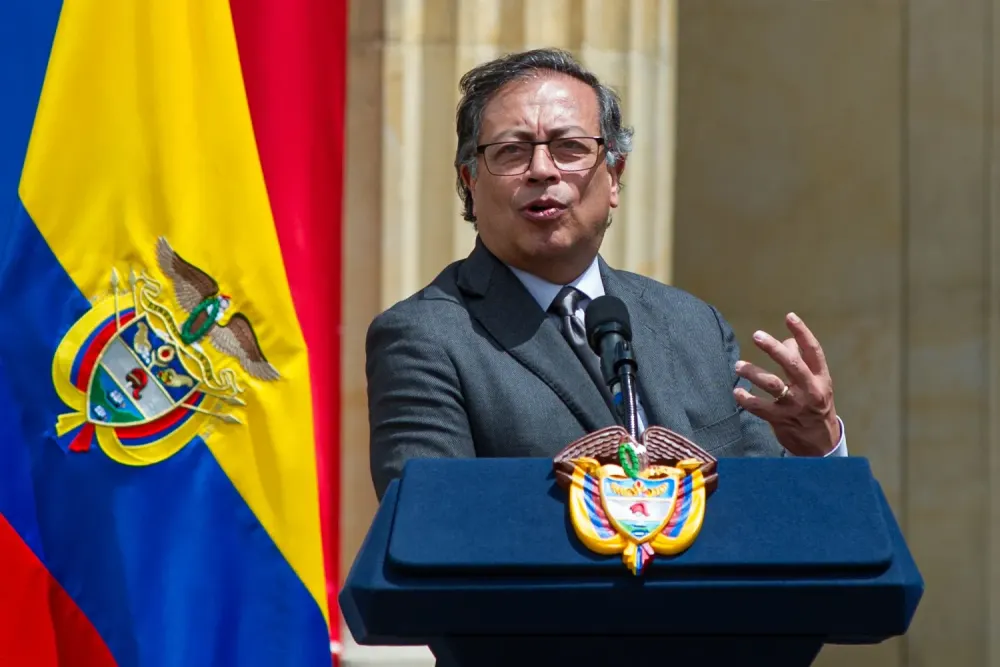
On July 13, outgoing President Gustavo Petro barred de la Espriella from holding his inauguration ceremony at a military base — the first of what the incoming government had planned as a series of symbolic gestures designed to signal a decisive break from the Petro era.
The venue fight is the latest episode in a transition breakdown that has been building since election night and that now encompasses a frozen handover process, an annulment lawsuit before the Council of State, and a former president who has called the election stolen, compared de la Espriella to “Hitler,” and accused Israel of hacking the vote count.
August 7 is still the date. The path there has rarely looked this fraught.
The Inauguration Venue Fight
De la Espriella’s team had planned to hold the swearing-in ceremony at a military base — a deliberate choice designed to open his government with a visual message about security, military alliance, and the reversal of Petro’s adversarial relationship with Colombia’s armed forces.
The ceremony would have placed Colombia’s new president, physically, among the soldiers he has promised to unleash against guerrilla groups and narcotrafficking organizations. Petro vetoed it.
Citing his authority as commander-in-chief of the armed forces until August 7, the outgoing president blocked the plan and insisted the inauguration take place before Congress, as prescribed by law.
“Military and police barracks are under my command until the new president is sworn in and, therefore, until that moment I am the supreme commander of the military forces,” Petro wrote on X.
According to local media, de la Espriella’s push to hold the congressional session outside the National Capitol also tests his strength against the legislative branch. Because his party will not hold an absolute majority in the new Congress, which takes office July 20, Petro’s veto highlights the early institutional challenges and opposition the incoming government is likely to face.
The legal position is Petro’s to make — he is constitutionally correct that the armed forces remain under his command until the moment of the handover. What he is doing with that position is something else: using the last institutional authority available to him to deny the incoming president a symbolic moment he had publicly committed to.
The Transition Breakdown
The venue fight is the most visible symptom of a transition that had already broken down entirely by July 7. De la Espriella had suspended the formal transition process — the empalme — after Petro, on July 7, publicly announced he would not recognize de la Espriella’s victory in the June 21 presidential runoff, alleging fraud without providing evidence.
De la Espriella said in a video posted on social media that Petro and Cepeda had launched a plan to “cling to power at all costs” through “a coup d’état” by refusing to recognize his victory.
“As president-elect, I call on Colombia’s armed forces to honor their oath to protect the constitution and democracy and to disobey any orders from Petro to the contrary,” de la Espriella said.
Colombia’s finance minister and Petro’s transition coordinator responded by ordering his own team to suspend the handover process. Both sides walked away from the table simultaneously — the incoming government citing Petro’s refusal to recognize the result, and the outgoing government citing de la Espriella’s suspension of the empalme.
The result is a transition process that has effectively halted with less than a month until inauguration.
Germán Ávila, Colombia’s finance minister and the Petro administration’s transition coordinator, ordered his team to suspend the handover process in response to de la Espriella’s suspension. Vice President-elect Restrepo’s team has continued its financial audits of the Colombian state independently — but the structured institutional handover through which an incoming government normally learns the detailed operational state of every ministry it is about to inherit has stopped.
The Annulment Lawsuit
Hovering over all of it is a pending lawsuit before Colombia’s Council of State — the country’s highest administrative tribunal — seeking to annul the June 21 runoff result and block the August 7 inauguration entirely.
The far-left Historic Pact coalition announced it would file a lawsuit demanding the annulment of the 2026 presidential runoff, alleging “irregularities” during the vote count. Petro has said he will present evidence that de la Espriella “was elected from abroad, with nonexistent votes” — repeating his unsubstantiated allegation that Israeli companies manipulated the vote count algorithmically.
Colombia’s Attorney General Gregorio Eljach has already stated that “there is no evidence of fraud.” The National Electoral Council certified de la Espriella as president-elect on June 24. International observers from the OAS, the EU, and the UN found no evidence of systematic fraud.
The Council of State has not yet ruled. The legal path looks narrow, though. Annulling a certified presidential result weeks before inauguration would be an extraordinary step, and most analysts see it as a long shot rather than a likely outcome.
What Petro Is Actually Doing
Taken together — the fraud allegations, the transition suspension, the annulment lawsuit, and today’s inauguration venue veto — Petro’s conduct since June 21 follows a recognizable pattern. Each individual action has a legal or procedural basis. Each is being deployed in a manner designed not to succeed on its legal merits but to delegitimize, delay, and complicate a transfer of power that the country’s electoral institutions have formally completed.
The fraud allegations have been rejected by the attorney general and by international observers. The Council of State is unlikely to annul a certified presidential result without evidence of the systematic manipulation Petro alleges.
The inauguration will almost certainly take place before Congress, as the law requires, rather than at a military base, as de la Espriella preferred. But Petro is not trying to win these fights. He is trying to make the point — to his supporters, to history, and to the institutions that will govern Colombia after he leaves — that the transfer of power he is overseeing is illegitimate.
The venue fight is not about where de la Espriella takes his oath. It is about whether Petro will leave office having conceded that his successor was legitimately chosen. Petro said he would leave empty chairs at the handover table, insisting the transfer of power is owed to the public and would proceed by law until his term ends in August.
August 7 is 25 days away. Colombia’s institutions have weathered this kind of pressure before. The question is not whether the inauguration will happen — it will. The question is what shape Colombia’s democratic institutions are in when it does.