

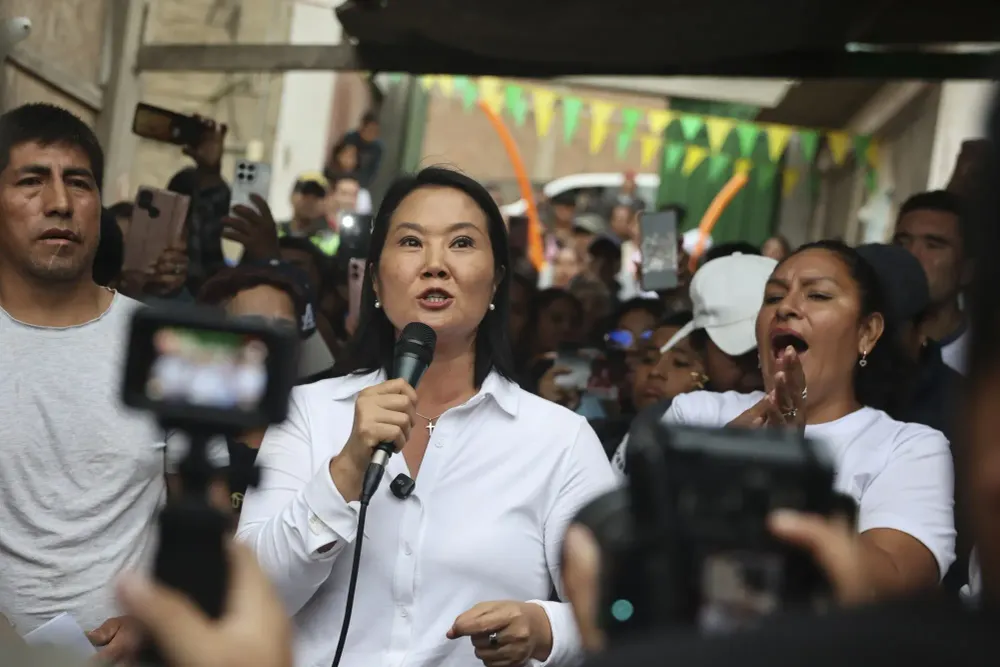
LIMA — Fifteen days before Keiko Fujimori takes office as Peru’s president, the country’s Constitutional Court provided her a political gift — and handed Congress a rebuke that Lima’s political class is still absorbing.
In a ruling issued last week, Peru’s Constitutional Court reversed its own 2022 decision and stripped Congress of its spending initiative — the power to introduce legislation that increases public expenditure. The court had granted that power to the Fujimorist-dominated Congress in 2022. It has now taken it back, returning budgetary initiative exclusively to the executive branch, ahead of a new president taking office on July 28.
The reversal shapes the institutional landscape that Fujimori inherits in a country that has cycled through ten presidents in a decade — and it does so in a way that strengthens the executive at Congress’s expense, at the precise moment a new executive aligned with the court’s current composition is about to arrive.
What the 2022 Ruling Did — and Why This One Matters
To understand the significance of last week’s reversal, it is necessary to understand what the 2022 decision actually did. In May 2022, six of seven members of the Constitutional Court were replaced by Congress. The newly constituted court then granted Congress the power to initiate spending legislation — an expansion of legislative authority that critics said concentrated power dangerously in a legislature already accused of undermining judicial independence, capturing regulatory agencies, and weakening the executive.
The 2022 ruling was widely seen as an institutional coup in slow motion. Congress obtained nearly absolute control of Peru’s government when the Constitutional Court, whose members were directly chosen by Congress, removed judicial oversight of the legislative body. Former minister Pedro Francke was blunt about the reversal’s implications: “The rule is not institutional — it’s about putting power where Keiko is.”
That critique cuts both ways now. The same Constitutional Court that gave Congress spending power in 2022 — when a Fujimorist majority controlled the legislature — has now taken it back as a Fujimorist is about to control the executive. Critics argue the institutional architecture is being adjusted to suit whoever holds power, not to protect democratic principle. That pattern — courts moving in step with political power rather than constraining it — is precisely the dynamic that has made Peru’s democratic institutions so fragile across a decade of political crisis.
What It Means for Fujimori
For the incoming president, the ruling is practically significant. Under the previous arrangement, legislators preferred weak presidents who can absorb public anger while they control the budget and patronage. The restoration of executive spending initiative reverses that equation — giving Fujimori’s government the constitutional authority to set the budgetary agenda without Congress being able to introduce competing spending proposals.
Peru’s new bicameral legislature — reinstated by constitutional reform in 2024, returning to the two-chamber system abolished by Alberto Fujimori in 1992 — adds additional complexity. The new senate will share budgetary and oversight authority with the lower house, effectively multiplying veto powers. Fujimori will need to navigate a legislature in which no party holds a majority, across two chambers, while also managing the institutional inheritance of a Constitutional Court whose independence is questioned by virtually every major democratic monitoring organization.
The Economic Dilemma
The ruling arrives as Peru’s economy is absorbing a sharper hit from falling copper prices than neighboring Chile.
Copper — Peru’s largest export — has declined significantly from its recent highs, cutting into fiscal revenue projections and complicating the budget arithmetic for an incoming government that has promised security spending and economic stabilization simultaneously.
Lima’s political class is still absorbing the Constitutional Court’s ruling stripping Congress of its own spending power, a decision that reshapes who controls the purse strings just as the country’s copper-dependent economy takes a sharper hit from falling prices than neighbouring Chile.
The fiscal implications of the ruling are real — budgetary initiative in Peru’s system is not merely symbolic. It determines who proposes how public money is spent, which ministries receive funding increases, and which constituencies are prioritized in annual budget negotiations. Returning that power to the executive means Fujimori — not the legislative blocs that have dominated Peruvian governance since 2016 — will set the terms of the spending debate heading into her first year in office.
The Institutional Warning
Whatever the practical benefits for the incoming president, the pattern the ruling reveals deserves scrutiny that the political commentary in Lima has largely avoided.
“No hay ningún pudor; los mismos integrantes del TC que permitieron la iniciativa de gasto del congreso ahora aprueban lo contrario. Dudo que podamos llamar a eso Democracia,” — “There is no shame. The same members of the Constitutional Court who allowed Congress’s spending initiative now approve the opposite. I doubt we can call that democracy,” said former minister Pedro Francke.
Peru’s Constitutional Court was established in the 1993 Constitution — Alberto Fujimori’s constitution — and its members are nominated by Congress; these nominations sometimes lack transparency and are based on political favors that nominees can provide to legislators.
A court whose composition is determined by the legislature it is supposed to constrain cannot, by definition, provide a reliable check on legislative overreach.
The 2022 ruling proved that when Congress controlled the nominations, the court expanded congressional power. The 2026 ruling suggests that as the political alignment shifts toward the executive, the court shifts with it.
That is not institutional independence. It is institutional flexibility in service of political power — and it is the defining characteristic of Peruvian democratic governance that Fujimori, whatever her intentions, is about to inherit.
July 28 Arrives in Two Weeks
Fujimori takes office on July 28 — Peru’s Independence Day — as the country’s tenth president in a decade.
She arrives with a mandate from the narrowest electoral margin in the country’s recent history, a legislature where no party holds a majority, a Constitutional Court whose independence is contested, a copper-dependent economy absorbing commodity price headwinds, and an opposition that refused to accept the result for weeks before eventually conceding.
The spending power ruling gives her government a stronger institutional starting position than the outgoing arrangement allowed. Whether she uses it to build durable governance or to consolidate the same pattern of institutional manipulation that has defined Peruvian politics since 2016 is the question her first hundred days will begin to answer.
Have a tip or story lead? Contact us at info@sociedadmedia.com
Sociedad Media is an independent digital publication covering Latin American politics, business, and security. Our reporting follows strict impartiality standards.