

BOGOTÁ — Colombia’s armed conflict enters its next chapter this week not through a peace accord, but through its explicit abandonment. As Abelardo de la Espriella was sworn in on Friday as the country’s 43rd president, his government carried out one of its very first acts of state on the same day: the immediate transfer of 117 high-profile inmates — many of them linked to the “Total Peace” negotiating framework of outgoing President Gustavo Petro — to maximum-security prisons across the country.
The message was unmistakable, and it landed on a security landscape already deteriorating for more than a year.
A Landscape That Has Gotten Worse, Not Better
By the numbers alone, Colombia’s illegal armed groups are in the strongest position they’ve held in over a decade as Petro’s dialogue efforts for peace have been largely viewed by the public as a failure.
According to the Fundación Ideas para la Paz (FIP), combined membership across the country’s armed organizations — combatants and support networks together — surpassed 27,000 people at the start of 2026, a 23.5% increase in a single year, with more than 5,000 new recruits joining these structures over that period. That growth occurred despite an intensified military campaign in the second half of Petro’s term, which included ground operations, special forces actions, and 25 separate bombing raids against FARC dissident, ELN, and Clan del Golfo encampments — none of which succeeded in killing or capturing any of the groups’ principal commanders.
Those commanders remain squarely in the state’s crosshairs: alias “Iván Mordisco,” head of the Estado Mayor Central (EMC), the largest FARC dissident umbrella; alias “Pablito” and the ELN’s central command; alias “Chiquito Malo,” top commander of the Clan del Golfo; and alias “Calarcá,” who leads a rival EMC faction’s bloc structure. All remain at large.
Catatumbo: From Non-Aggression Pact to Renewed War
Nowhere illustrates the volatility of Colombia’s armed landscape better than Catatumbo, the border region in Norte de Santander that has become the country’s most closely watched conflict zone.
The ELN launched a major offensive there in January 2025 aiming to expel the 33rd Front of FARC dissidents and seize a strategic corridor along the Venezuelan border.
What followed was a genuine anomaly in Colombia’s conflict: the ELN and the 33rd Front, rather than fighting to exhaustion, reached a non-aggression pact — an unusual truce between rival armed groups that held for roughly a year before collapsing entirely in January 2026.
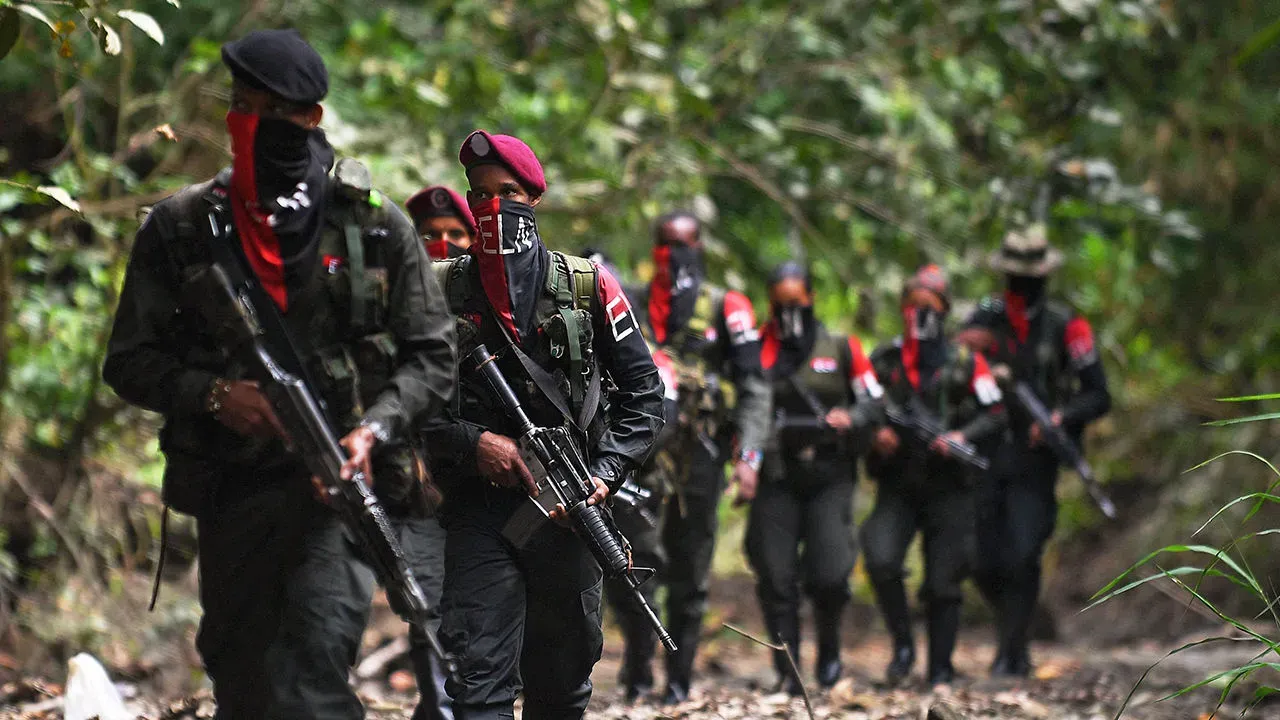
Its breakdown triggered a severe humanitarian crisis and left the ELN as the dominant armed actor in the region, a position it has used to deepen ties with sympathetic elements inside Venezuela, where the group has built relationships with segments of state security forces and exploited smuggling and illegal mining economies along the binational border with what Insight Crime describes as a historically permissive stance from Venezuelan authorities.
Fighting in Catatumbo has continued in waves throughout 2026, repeatedly displacing residents of Tibú and neighboring municipalities and drawing recurring military offensives that have yet to durably shift the balance of control.
Cauca: A Bombing, a Bounty, and a Fractured EMC
Southwest of Catatumbo, Cauca department has emerged this year as another flashpoint, anchored around the Estado Mayor Central, the main FARC dissident faction.
A 2026 bombing attack in the department — following an earlier attack on a military base in Cali that killed one person and opened a broader wave of violence across the region — prompted Colombia's Defense Ministry to offer a 5 billion peso (roughly $1.4 million) reward for a suspect identified as Iván Jacob Idrobo Arredondo, alias “Marlon,” underscoring how seriously the state has come to treat the EMC’s Cauca-based structures as a distinct and dangerous threat, separate from the broader dissident movement.
A Death Toll Measured in Social Leaders
Beyond direct combat, Colombia’s armed groups have sustained a campaign of targeted killings against social leaders and human rights defenders that has continued largely unabated into 2026.
Colombia’s Human Rights Ombudsman’s Office (Defensoría del Pueblo) confirmed 177 killings of human rights defenders and social leaders in 2025 alone, with Cauca, Antioquia, Valle del Cauca, Norte de Santander, and Nariño recording the highest tolls.
The pattern has continued this year: by early April, Indepaz had documented at least 52 social leaders killed in 2026, including Guillermo Pérez, a community council president in Puerto Wilches, Santander, shot to death inside his own home just four days after winning election to the post — a killing attributed to the ELN, Clan del Golfo, and FARC dissident structures active in the area.
The UN’s own accounting found 410 defenders killed between 2022 and 2025, disproportionately concentrated among rural, Indigenous, and Afro-Colombian communities, with impunity holding at a staggering rate: only about 6% of these killings have ever resulted in a conviction, according to United Nations monitoring.
Perhaps the most politically consequential act of violence tied to these networks came earlier this year, when Colombia’s Attorney General’s Office formally attributed responsibility for the assassination of presidential pre-candidate Miguel Uribe Turbay to the Segunda Marquetalia, a FARC dissident faction, alleging the group paid 1 billion pesos to a hired coordinator, known as “el viejo,” to organize the killing and then eliminate those involved to destroy any witnesses.
De la Espriella’s Break From “Total Peace”
Leftist former-president, Gustavo Petro’s central security strategy, “Paz Total,” pursued simultaneous negotiations with multiple armed groups, including urban criminal structures like Medellín’s Oficina de Envigado-linked networks and La Terraza. That approach now draws to a definitive close under de la Espriella, who campaigned explicitly on refusing any dialogue with illegal armed groups and pledged, in his own words, that “in my government, there will be no peace processes.”
De la Espriella has moved quickly to make that pledge operational. Only days before his inauguration, a FARC dissident faction saw 16 of its members surrender to the Army, in a negotiation process whose future the outgoing government itself acknowledged was now uncertain given de la Espriella’s stated position.
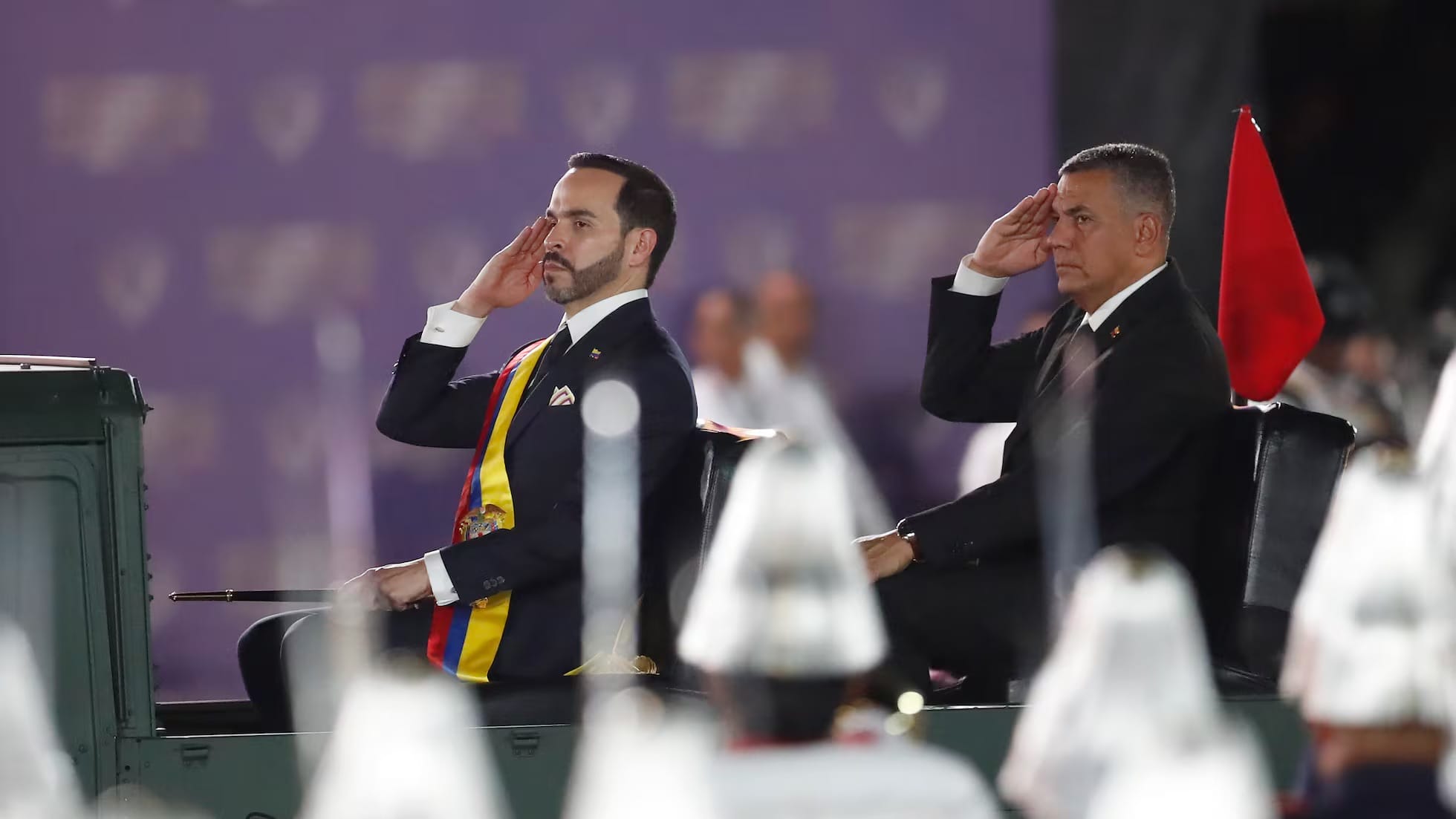
Then, in a striking first act of government carried out literally during his swearing-in ceremony in Cali, Colombia’s prison authority (INPEC) executed the immediate transfer of 117 high-profile inmates — 103 of them moved directly out of Itagüí’s maximum-security prison in Antioquia, a facility that had become a flashpoint of scandal earlier this year after images surfaced of a party held inside its walls with the participation of high-profile criminal leaders, prompting the suspension of eleven prison officials.
Among those transferred: alias “Douglas,” a leader of La Terraza and former Oficina de Envigado member who had served as a spokesperson in Petro-era urban peace talks in Medellín and the Valle de Aburrá; former paramilitary commander Hernán Giraldo; and social-media influencer-turned-inmate Epa Colombia.
The 117 inmates were redistributed to high-security facilities across Bogotá, Medellín, Girón, Valledupar, La Dorada, Palmira, Ibagué, and El Barne.
De la Espriella’s government characterized the move as necessary to prevent criminal networks from continuing to coordinate operations from behind bars — a direct rebuke of the access and relative comfort some negotiating-track inmates had been afforded under Petro’s framework — while explicitly casting doubt on the future of Medellín’s urban peace table in the process.
Washington Delivers $1 Billion Aid Package As Part Of New Administration
The clearest external validation of de la Espriella’s break from dialogue came from Washington itself, on the very day of his inauguration. The U.S. State Department announced it plans to direct $1 billion in security assistance to Colombia’s new government, delivered via a fact sheet distributed by the U.S. delegation to the inauguration, led by Acting Attorney General Todd Blanche.
The figure, still subject to congressional approval and not yet finalized, would match the highest levels of U.S. security assistance Colombia has received since the launch of Plan Colombia in 2000 under President Andrés Pastrana.
The package is explicitly framed around combating narco-terrorism and transnational criminal organizations, and includes expanded coca eradication and cocaine interdiction efforts, strengthening Colombian security forces with U.S. technology, and improving border security and military interoperability between the two countries’ forces.
The State Department described it as a “cornerstone” of a “renewed alliance,” with the Trump administration stating it intends to work closely with Colombia’s new government “to guarantee the security and prosperity of the United States, Colombia, and our hemisphere.”
The security package arrives bundled with a broader economic cooperation agenda, including nearshoring initiatives aimed at connecting Colombian small and medium-sized agroindustrial, manufacturing, and technology firms to U.S. supply chains, and a civil nuclear energy cooperation track — echoing the same kind of memorandum Washington signed with Paraguay just days earlier.
Colombia’s new government will also draw on a separate $60 million-plus technical cooperation commitment already active through the Inter-American Development Bank.
Timed precisely to coincide with de la Espriella’s inauguration and his government’s same-day prison transfer operation, the announcement leaves little ambiguity about how Washington intends to read — and reward — Colombia’s abrupt pivot away from negotiated peace and toward renewed military confrontation with the country’s armed groups.
What To Expect In The Months To Come
De la Espriella has scheduled his first official security council for Saturday, August 8, at the Marco Fidel Suárez air base in Cali, where his government is expected to lay out operational directives aimed at halting the expansion of illegal armed groups across Colombia’s southwest and to reiterate ultimatums against FARC dissident and ELN leadership.
His inaugural address included a promise of life sentences for those who kill women and children, part of a broader hardline judicial posture that will now be tested directly against a guerrilla landscape that grew stronger, not weaker, during four years of negotiation.
The scale of what de la Espriella inherits is not in question: over 27,000 combatants and support personnel, record levels of territorial dispute between rival armed groups, a security apparatus that has bombed dissident camps repeatedly without capturing a single top commander, and a social-leader death toll that shows no sign of slowing.
Whether abandoning dialogue in favor of what his own campaign rhetoric described as a more confrontational posture succeeds where four years of “Total Peace” did not is likely to become one of the defining tests of his presidency — beginning almost immediately, with Saturday’s security council just one day into his term.
Follow Sociedad Media on social media to stay up-to-date on the latest developments across Latin America, and their impact on Miami’s Latino community.
Our social media links are located on the top right corner of our homepage.


