

On May 8, Laura Fernández was sworn in as Costa Rica’s 49th president at the National Stadium in San José, before delegations from 71 countries and 18 international organizations. At 39, she becomes the second woman to lead Costa Rica after Laura Chinchilla, and she arrives in office with a set of political advantages that are genuinely rare in the country’s Central American history: a legislative majority, a clear mandate, and an unusually powerful ally sitting inside her own cabinet.
That ally is her predecessor.
Chaves Stays
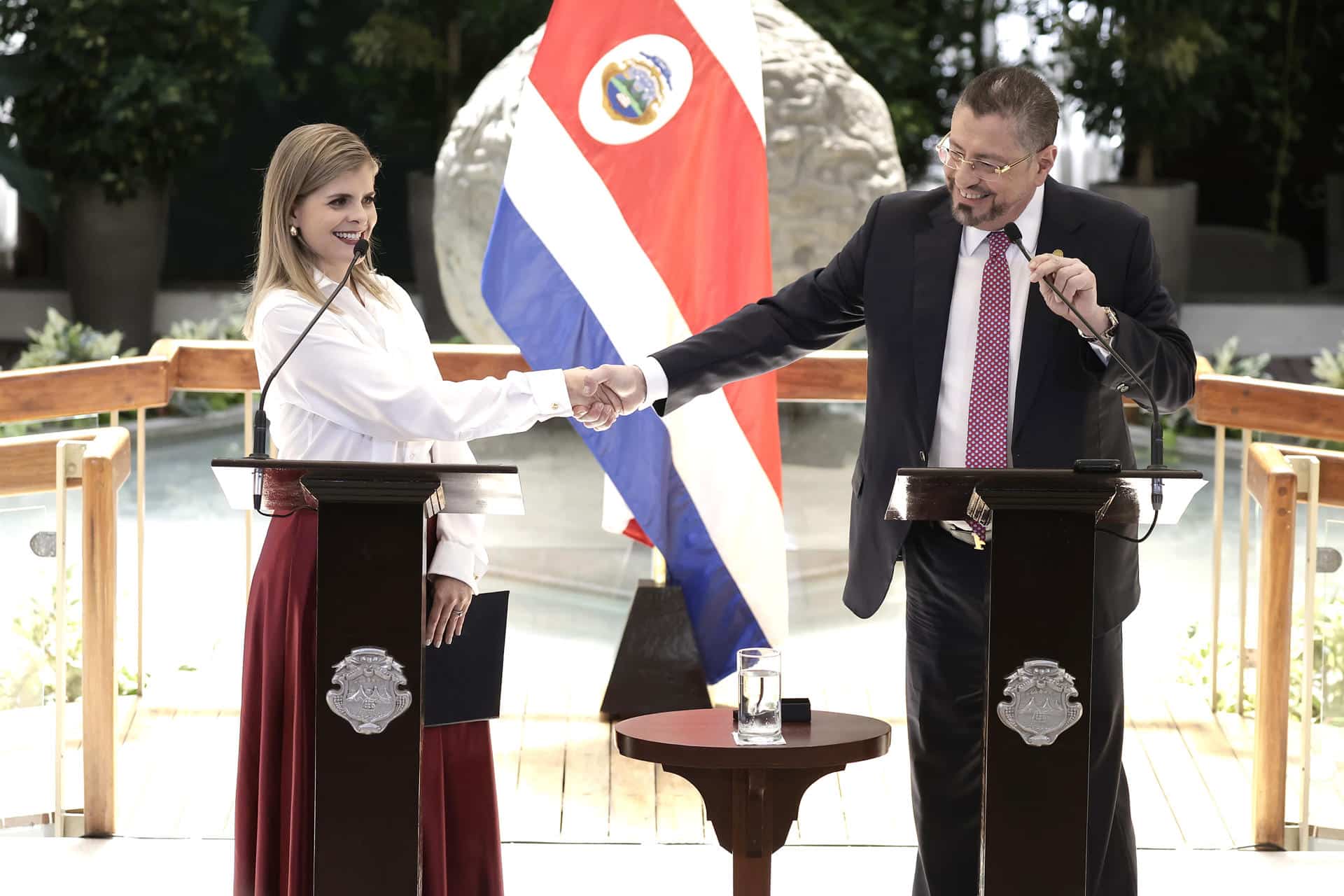
The single most consequential decision Fernández made before she was even sworn in was naming outgoing President Rodrigo Chaves as both minister of the Presidency and minister of Finance. That gives Chaves — who spent four combative years attacking judges, opposition politicians, and the media — direct control over the government’s relationship with the Legislative Assembly and over Costa Rica’s fiscal agenda, all while wearing a new layer of legal immunity.
Chaves faces several active investigations from the Public Prosecutor’s Office and the Supreme Electoral Tribunal, including allegations that he pressured officials to favor a former adviser and engaged in unlawful political activity during the campaign. He denies all of it.
Lawmakers tried twice to strip the former president of immunity during his presidency; both attempts failed. Now, with Fernández’s Sovereign People’s Party holding 31 of the 57 seats in the Legislative Assembly — the first single-party legislative majority in Costa Rica since 1990 — a third attempt looks even less likely.
The arrangement is being sold to supporters as continuity: keeping experienced hands on the wheel while the new administration finds its footing.
Critics, however, including opposition lawmaker José María Villalta, see it as something else — a setup designed more to protect a former president from prosecution than to strengthen institutions. Both readings can be true at the same time.
What Fernández Has Promised
On security, the new president has been direct:
“My hand will not shake in confronting organized crime.”
Costa Rica has long been one of the safest countries in Central America, but that reputation has frayed badly. Drug trafficking networks have increasingly used the country as a transit and logistics corridor, and violent crime has risen sharply.
Fernández has promised new security laws, tougher sentencing, and a maximum-security prison modeled on El Salvador’s CECOT mega-prison — a facility that has drawn significant international human rights criticism. She has also praised elements of Nayib Bukele’s domestic security strategy while insisting her government will respect Costa Rica’s democratic order and human rights framework.
Her broader agenda is built around what the Chaves movement calls the “Third Republic” — a reform project that promises to shake up Costa Rica’s political establishment, expand free enterprise, fight corruption, and modernize state institutions. The reform language is significant because Fernández does not just have the executive; she has the legislature, too.
Long-stalled policy changes that previous presidents could never move through a fragmented Congress are now within reach. That cuts both ways.
The Press Freedom Question
Costa Rica’s press freedom ranking fell from 8th to 38th in the Reporters Without Borders index over the four years of the Chaves government. In the days before the inauguration, it emerged that the U.S. government had revoked tourist visas for several board members of La Nación, the country’s most influential newspaper and a frequent target of Chaves’ criticism.
Former President Óscar Arias, a Nobel Peace Prize laureate, had his visa revoked earlier. Washington has yet to issue a public explanation on the decisions.
Fernández has positioned herself as Chaves’ political heir and “protector of his legacy.” That framing, paired with a working legislative majority and Chaves himself inside the presidential cabinet, means the checks that constrained the previous administration — a fragmented Congress, an independent judiciary, an aggressive press — are now under more pressure than before.
What It Means for the Region
Costa Rica’s shift now matters beyond its own borders for several reasons.
First, it deepens Washington’s alignment with a new generation of conservative-populist leaders across Central America. U.S. Homeland Security Secretary Kristi Noem attended the inauguration in her capacity as special envoy for the Trump administration’s “Shield of the Americas” initiative. Deputy Secretary of State Christopher Landau led the full U.S. delegation. The optics were intentional.
Costa Rica has already agreed to accept up to 25 third-country deportees per week from the United States — migrants with no ties to Costa Rica, stranded there under agreements that human rights organizations have widely condemned. Fernández has also confirmed she will continue that arrangement.
Second, the Bukele model is spreading. Costa Rica, joining El Salvador in building a CECOT-style prison and adopting hard-line security policies, represents a meaningful consolidation of that approach across the isthmus. Honduras and Guatemala are watching. The question of whether Bukele-style security delivers actual crime reduction — or simply concentrates power in the executive while filling prisons — remains very much open.
Costa Rica will now become a test case for that answer in a country with stronger democratic traditions than El Salvador.
Third, for the Miami Venezuelan and Colombian diaspora communities that Sociedad Media covers closely, Costa Rica's direction is directly relevant to migration dynamics. Costa Rica remains a significant transit and destination country for Venezuelans moving north. A harder security posture, third-country deportation agreements, and a prison-building agenda will affect how that population is treated on the ground.
The Bigger Picture
Fernández starts with advantages most Costa Rican presidents would have envied: a majority in the legislature, a loyal cabinet, strong public support, and a clear mandate. The question is whether she governs as a president in her own right or as Chaves’ continuation. The two are not yet the same thing, and the difference will become clear quickly.
Costa Rica has earned its reputation as one of Latin America’s most durable democracies over the past seven decades. That reputation is not destroyed in a single administration. The decisions being made in San José right now are ones worth watching.
Sociedad Media will continue to cover the Fernández administration and its implications for Central America and the region


