

On the morning of May 7, Brazilian President Luiz Inácio Lula da Silva arrived at the White House South Lawn to meet Donald Trump. Videos of the two leaders greeting each other were posted on X within minutes. The meeting was scheduled to last approximately ninety minutes and to conclude with a joint appearance before the U.S. and Brazilian press corps — questions from reporters, cameras, a public record of what had been agreed.
Three hours later, the Brazilian journalists waiting inside the White House began to leave the White House after learning Lula would depart following lunch without speaking publicly alongside Trump. The bilateral meeting had been set to be open to press at 11:15am but Brazil’s president said he preferred to wait. Spain’s ABC correspondent described the shift as “an unusual change” for what had been expected to be a high-profile bilateral meeting.
The only readout of the meeting came in the form of a Truth Social post by President Trump who indicated it went “very well.”
“Just concluded my meeting with Luiz Inácio Lula da Silva, the very dynamic President of Brazil. We discussed many topics, including Trade and, specifically, Tariffs,” Trump wrote.
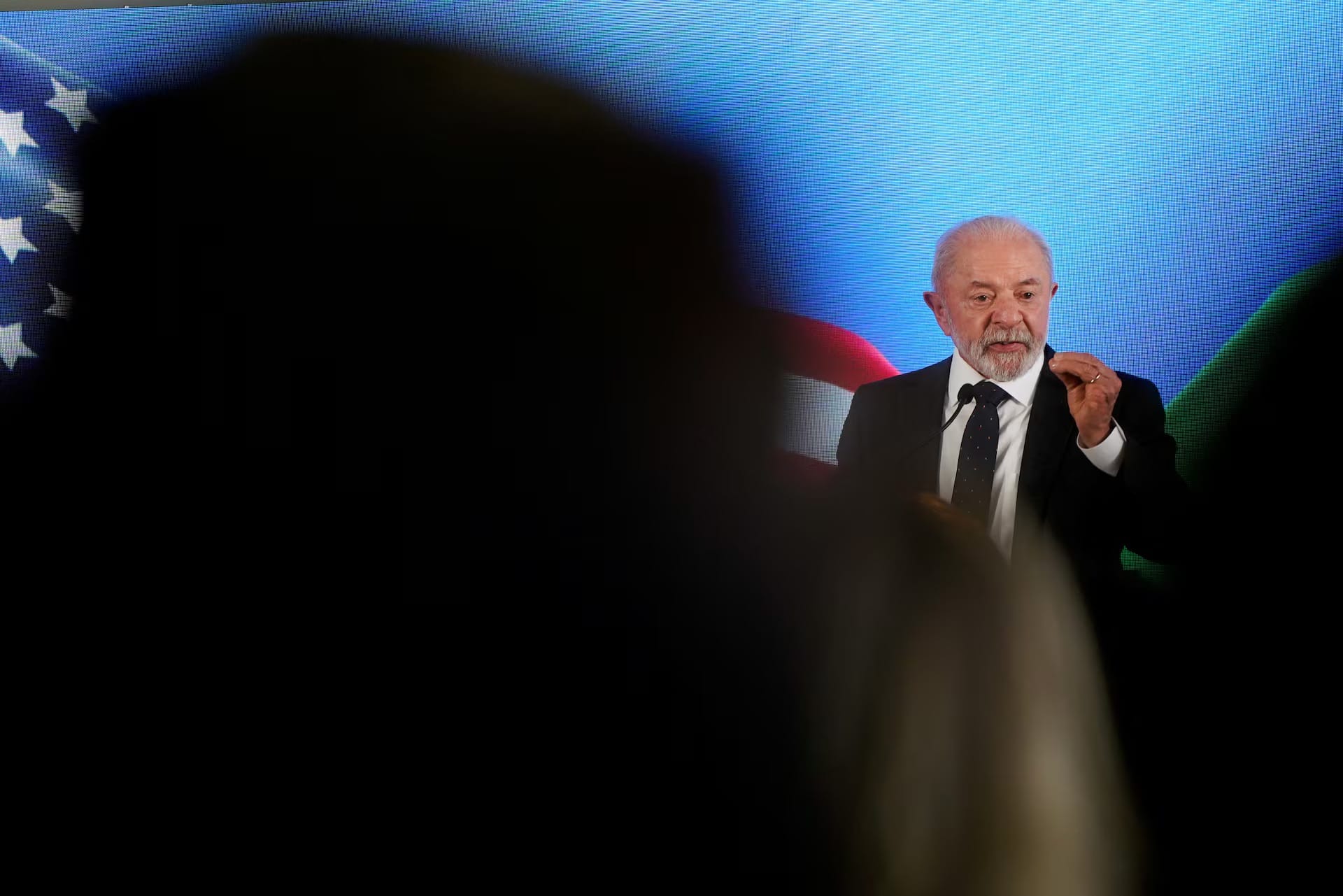
Lula’s readout was more expansive — delivered not from the White House but from the Brazilian Embassy, where he spoke to reporters without Trump present.
“I believe it was an important meeting for Brazil, and an important meeting for the United States,” Lula told reporters. “We took an important step in consolidating the Brazil-United States relationship. It is important that the United States regain an interest in things happening in Brazil.”
The canceled joint press conference generated immediate speculation about whether the meeting had gone badly. The substance that subsequently emerged suggested the opposite — that it had gone well enough that neither side wanted to risk a public appearance that could complicate what had been carefully negotiated in private.
What Was Actually Agreed
Despite the absence of a joint statement, the meeting produced several concrete outcomes — documented through the Brazilian delegation’s post-meeting briefings and subsequent reporting.
Lula and Trump agreed to set up a bilateral working group with a 30-day deadline to draft a proposal resolving the tariff dispute and the U.S. Section 301 trade investigation against Brazil. The group will be led by Brazil’s Industry and Commerce Minister Márcio Elias Rosa and U.S. Trade Representative Jamieson Greer, with both presidents reviewing the team-level recommendations.
The 30-day deadline — approximately June 6 — is the most significant structural outcome of the meeting. It transforms the tariff dispute from an indefinite source of bilateral friction into a defined negotiating process with a specific endpoint.
Critical minerals and rare earths emerged as a strategic priority on the agenda, with Lula informing Trump that Brazil’s Lower House had approved on May 6 the National Critical and Strategic Minerals Policy — which establishes a council to define which minerals qualify as critical and strategic. The timing of that approval — one day before the White House meeting — was deliberate. Brazil handed Washington a tangible deliverable before sitting down at the table.
Organized crime cooperation also featured prominently, with Lula announcing Brazil will launch a comprehensive plan against transnational criminal organizations the following week and confirming a U.S.-Brazil joint financial-asphyxiation track agreed with Trump. Finance Minister Durigan said Receita Federal teams and U.S. counterparts will conduct joint operations against arms and synthetic-drug trafficking flowing in both directions.
The FTO designation — the threat to classify the PCC and Comando Vermelho as Foreign Terrorist Organizations — was discussed but produced no public commitment either way. The joint organized-crime plan and the financial intelligence operations track are Lula’s substitute offer: security cooperation without the FTO designation that Brazil regards as a sovereignty violation.
Whether Washington accepts that substitution or continues pressing for formal designation is the question that will be answered between now and the June 6 working group deadline — if it is answered at all.
The Canceled Press Conference — and What It Means
The decision to cancel the joint press appearance was made by the Brazilian side — Lula’s delegation requested the change. The reasons have not been publicly stated.
Since there was no official joint statement or press conference, many observers inside Brazil held their breath. Despite the reported chemistry between both presidents at the United Nations General Assembly last September, bilateral tensions were far from resolved.
Several explanations have circulated. One is that the meeting ran longer than expected — three hours including a working lunch — and that the discussions were substantive enough that neither side wanted to risk an unscripted moment derailing what had been carefully constructed.
A second is that Lula’s domestic political situation made a joint appearance with Trump — photographed together, standing side by side, fielding questions about Bolsonaro — a liability rather than an asset for a president already under pressure from a Congress that had overridden his veto and rejected his Supreme Court nominee in the same week.
A third is that specific agenda items — the FTO designation, the Section 301 investigation, the Bolsonaro dimension — could not be addressed publicly without one side appearing to concede more than it had. Whatever the reason, the result was that the meeting’s most visible moment was not a joint statement but a Truth Social post and a Brazilian president’s satisfied debrief at his country’s embassy.
In the age of bilateral summitry, that is an unusual outcome — and it generated as much coverage as any specific agreement would have.
The Tariff Backstory
The two leaders have had an acrimonious relationship at times. In July 2025, Trump slapped a 50 percent tariff on Brazil in part over the prosecution of the country’s former right-wing president, Jair Bolsonaro, a prominent Trump ally.
The bilateral commercial relationship has been strained since 2025 when Trump initiated 25% tariffs on steel and aluminum imports, with Brazil among the most affected suppliers, while April 2026 added tariffs on a wider basket of products citing lack of commercial reciprocity. Brazil filed at the WTO and adopted reciprocity legislation, and late 2025 and early 2026 saw a partial U.S. rollback with product exclusions and substitution of the broader tariffs by a 10% global rate.
The 30-day working group framework that emerged from Thursday’s meeting is both a genuine negotiating mechanism and a diplomatic face-saver for both sides.
Washington gets a structured process that delays the WTO confrontation and creates a pathway to concessions. Brasília gets a defined timeline that allows Lula to tell Brazilian exporters, farmers, and manufacturers that he is actively managing the tariff threat — not simply absorbing it.
The Office of the U.S. Trade Representative last month also alleged that nearly half of Brazil’s timber exports come from illegal sources — which the Lula administration denies, arguing that it brought deforestation rates to historically low levels. That allegation — which Brazil’s environmental record directly contradicts — is a complicating factor in the trade negotiations that the working group will need to address alongside the broader reciprocity framework.
The Minerals Dimension — and China
The critical minerals agenda is the most strategically significant long-term outcome of Thursday’s meeting — and the one that connects most directly to the broader U.S.-China competition that Sociedad Media covered earlier this week.
Brazil holds the world’s second-largest reserves of rare earth elements after China — minerals essential to electric vehicles, advanced weapons systems, semiconductors, and the energy transition. The approval of Brazil’s National Critical and Strategic Minerals Policy on May 6 — one day before the White House meeting — gave Lula a concrete deliverable that aligned Brazil’s minerals framework with Washington's counter-China supply chain strategy without requiring Lula to formally sever economic relationships with Beijing.
The minerals deal is Brazil’s most valuable negotiating asset and its most delicate political liability simultaneously. A minerals agreement with Washington that is seen as subordinating Brazil's natural resources to U.S. strategic priorities — at the expense of Chinese partnerships that Brazilian industry has cultivated for decades — would generate domestic political opposition that Lula cannot afford in an election year.
The 30-day working group framework on trade may produce a minerals component that addresses Washington’s supply chain concerns without the sovereignty implications that a formal exclusive deal would carry.
China remains Brazil’s largest trading partner. The Trump administration has shown a consistent pragmatism beneath its ideological posturing. Its management of relations with Claudia Sheinbaum’s Mexico, its intermittent engagement with Venezuela, and now its reception of Lula all suggest that the White House can work with ideological opponents when strategic interests demand it. That pragmatism cuts both ways — Washington will accept a Brazil that maintains its China relationship as long as it also moves meaningfully toward U.S. supply chain priorities.
Thursday’s meeting established that both sides are willing to try.
The Brazilian Public & Media Response
The reaction in Brazil has been divided along the same fault lines that divide the country’s politics — which is to say, sharply.
Lula’s supporters framed the meeting as a diplomatic victory — proof that Brazil’s president could secure a White House meeting, produce concrete outcomes, and return home with a 30-day tariff negotiation framework without accepting the FTO designation or conceding on the Bolsonaro judicial proceedings. The Brazilian-only press conference that Lula held at the embassy — speaking without Trump, on his own terms — was read by Petistas as a sovereignty statement rather than a diplomatic slight.
Bolsonaristas read the same events differently. The canceled joint press conference was framed as evidence of dysfunction — a meeting that produced no joint statement, no visible agreement, and a Brazilian president who left the White House without standing beside the most powerful leader in the world for a photograph.
Flávio Bolsonaro, who has made his own Washington relationships a centerpiece of his campaign, used the optics to argue that only a right-wing Brazilian government can deliver the bilateral relationship the country needs.
The Brazilian media coverage was extensive and largely focused on the canceled press conference rather than the substance. That framing — which treats the diplomatic theater as the story rather than the 30-day working group, the minerals policy, or the organized crime track — reflects both the media’s appetite for drama over strained U.S.-Brazilian relations, and the genuine uncertainty about what the meeting actually produced beyond positive atmospherics.
The October Election Calculus
Lula wanted the conversation to succeed, not so much because of diplomatic concerns, but because he faces an uphill battle ahead of the October elections. His trip to Washington was, above all, a domestic political operation. Even if the meeting lacked specific results, the positive atmosphere reported by both presidents was a victory for Lula in the context of a presidential race that is already shaping up to be one of the most consequential in Brazil's recent history.
Flávio Bolsonaro has mounted a formidable electoral challenge. Polls now show him in a statistical tie with Lula in a hypothetical runoff — a remarkable position for a candidate whose political inheritance includes a father convicted of attempting a coup d'état in 2022 by what critics say is a partisan Supreme Court.
By securing a White House meeting, the Brazilian president sent a clear signal to his domestic audience: the relationship with Washington is not broken, and it does not require a Bolsonaro to fix it.
Each item on the bilateral agenda maps onto a domestic electoral fault line. On tariffs, Lula returns home having secured a negotiating process. On organized crime, he returns having offered cooperation without accepting FTO designation. On minerals, he returns having passed a national policy framework that positions Brazil as a strategic partner — not a dependency. And on democracy itself, the contrast with the Bolsonaro family is visible and specific: while Jair Bolsonaro remains under house arrest for plotting a coup, his son was unable to prevent Lula from being welcomed at the White House as a legitimate and apparently friendly head of state.
Whether those political benefits survive the 30-day working group process — whether the tariff negotiations produce results that Lula can present as a win before June 6, whether the organized crime plan launches with credibility next week, and whether the minerals framework advances without triggering a nationalist backlash — will determine whether Thursday’s meeting was the diplomatic turning point Lula needed or simply a well-managed afternoon with deferred consequences.
The October election is 148 days away. The 30-day working group deadline is 29 days away. The sequence of what comes first will matter.
Sociedad Media is monitoring U.S.-Brazil relations, the Lula-Trump bilateral agenda, and the October 2026 Brazilian presidential election. This article will be updated as the working group process produces outcomes. For tips and reporting, contact info@sociedadmedia.com


