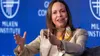

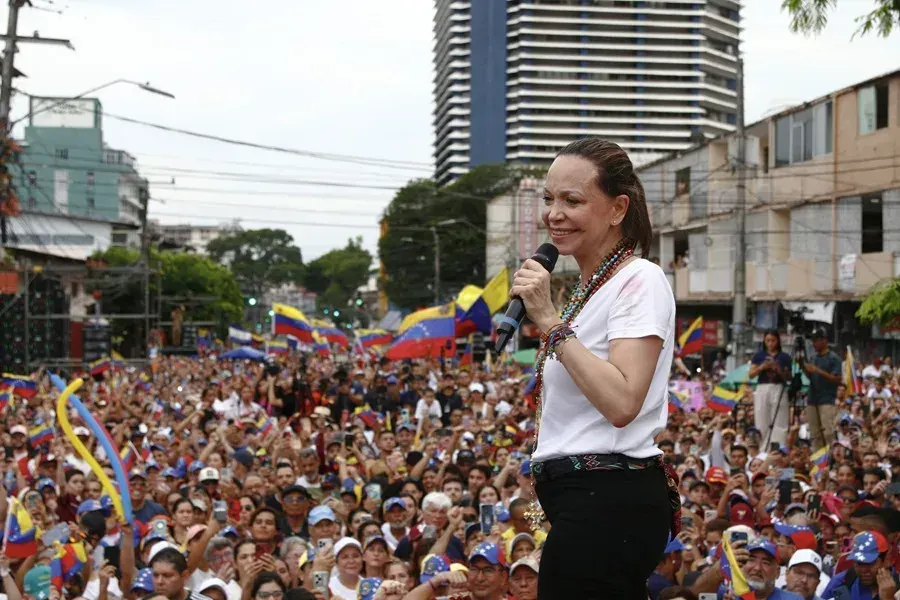
MIAMI — Venezuela’s Nobel Peace Prize laureate María Corina Machado announced on Saturday that she plans to run for president again and intends to return to her home country before the end of 2026. The announcement, made at a press conference in Panama City where she met with Venezuelan opposition leaders and diaspora community members, was direct and unambiguous:
“I will run,” she said. “I will be a candidate, but there may be others, of course. I would love to compete with everyone, with anyone who wants to be a candidate.”
There is no election date. There is no electoral calendar. And there is no agreed transition framework that includes her. And yet, the woman who holds a 72% approval rating among Venezuelans in independent polling, who won the opposition primary with 92.4% of the vote, and who spent 11 months in hiding before emerging to accept the Nobel Peace Prize in Oslo, has now said publicly what she has been saying privately for months: she is not a spectator in Venezuela’s transition. She intends to become its next president.
That announcement puts Washington in an uncomfortable position — and Machado knows it.
Machado Sidelined — For Now
Machado’s remarks come more than four months after the stunning White House decision to sideline her and instead work with Delcy Rodríguez — a Venezuelan ruling party loyalist — following the U.S. military’s capture of then-President Nicolás Maduro.
The decision to work with Rodríguez rather than Machado was not accidental. It reflected a calculation by the Trump administration that Rodríguez — who had the institutional machinery of the Venezuelan state, the loyalty of the military, and the ability to keep oil flowing — was a more reliable near-term partner than a candidate in exile with enormous popular support but no institutional power.
The oil industry has been opened to U.S. investment. Sanctions have been partially lifted. Alex Saab is in a Miami courtroom. From Washington’s transactional perspective, the Rodríguez arrangement has delivered.
What it has not delivered is what Machado — and the Venezuelan constitution — say is required: a presidential election. Venezuela’s constitution requires elections within 30 days of the president becoming “permanently unavailable.” That window has long passed. The Trump administration has dampened talk of elections, and no official date has been announced.
Machado said free and fair elections with proper guarantees would require between seven and nine months of preparation. She and the opposition leaders gathered in Panama called for a democratic transition “through free and fair presidential elections, where all Venezuelans inside and outside the country vote.”
The language is careful — it does not accuse Washington directly. But its implication is clear: the current arrangement, in which Rodríguez governs with U.S. blessing and no electoral mandate, is not a democratic transition. It is a managed succession between one set of Chavista hands and another.
The Nobel Laureate in Exile
Machado has been in exile since December 2025, when she emerged from 11 months of hiding inside Venezuela — a period during which she moved between safe houses to avoid detention by Maduro’s security apparatus — and traveled to Norway to receive the Nobel Peace Prize. The prize, awarded for years of democratic organizing against one of the hemisphere’s most entrenched authoritarian governments, made her one of the most recognized opposition figures in the world.
She voiced support for recent U.S. policies toward Venezuela, including the capture of Maduro and the sanctions pressure that preceded it. Her criticism of Washington’s post-capture framework is not the criticism of an adversary — it is the criticism of an ally who believes the job is half done. Removing Maduro was necessary. Installing Rodríguez as a permanent governing arrangement without elections is not the democratic transition Venezuelans voted for in 2024 and that the international community nominally supports.
The polling backs her up. In every credible independent survey conducted since Maduro’s capture, Machado leads any hypothetical Venezuelan presidential field by margins that leave no statistical ambiguity. Rodríguez does not appear as a candidate in those surveys — she has not indicated she would seek electoral legitimacy, and the calculation her government is making is that she does not need to while U.S. oil deals and sanctions relief keep the economy from collapsing entirely.
What Comes Next
Machado’s announcement in Panama is the opening move in what will be a complicated political campaign conducted largely from exile, directed at multiple audiences simultaneously: the Venezuelan diaspora, the Venezuelan population inside the country, the Trump administration, the international community, and the Venezuelan military whose loyalty remains the decisive variable in any transition scenario.
She has said that before the end of 2026 she intends to be back in Venezuela. Whether that is possible depends on whether the Rodríguez government — which has every institutional incentive to keep her out — permits her return, and whether Washington applies any pressure on her behalf.
The Trump administration’s silence on her candidacy announcement speaks volumes: neither endorsing nor opposing, maintaining the strategic ambiguity that has characterized its Venezuela policy since January 3.
For the Venezuelan community in Miami — which overwhelmingly supported Machado through years of opposition organizing, donated to her campaigns, marched in her name, and celebrated Maduro’s capture as the beginning of a democratic opening — Saturday’s announcement reactivates a hope that the post-January 3 accommodation with Rodríguez had begun to dim.
Machado is saying, from Panama, what much of that community has been saying from Doral and the rest of Miami and South Florida: the transition is not finished. The election has not happened. Venezuela is not yet free.
Whether Washington agrees — and whether it is willing to pressure Rodríguez to create the conditions for the election Machado is demanding — is the question that will define Venezuela’s political future for the rest of 2026.
Sociedad Media will continue to cover María Corina Machado’s campaign and Venezuela’s democratic transition. For tips, sources, and general inquiries — feel free to reach out to the outlet at info@sociedadmedia.com