


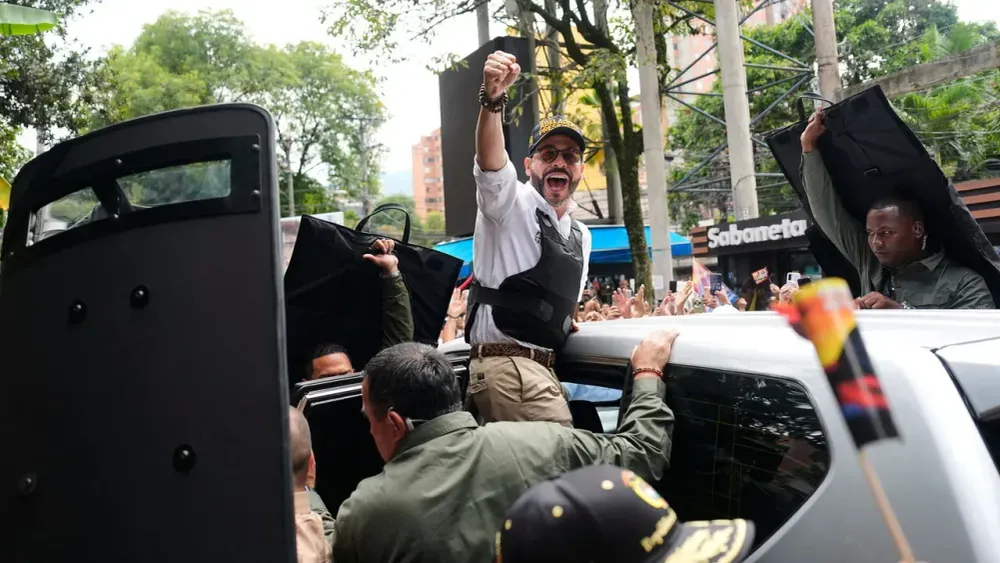
Colombia enters the final six days before its May 31 presidential election in a state of genuine uncertainty that did not exist two weeks ago. When Sociedad Media last reported on the race on May 18, Paloma Valencia had overtaken Abelardo De la Espriella for second place and the conventional wisdom was settling around a Cepeda-Valencia runoff. The last poll authorized before election day has upended that conventional wisdom entirely.
An AtlasIntel poll released on Saturday — the last to be issued before the May 31 vote — put Cepeda in the lead with 38.7% of the vote, followed by De la Espriella with 37.3%. The gap between the two front-runners is within the poll’s margin of error. More significantly, the poll predicts De la Espriella would defeat Cepeda in a runoff.
That is a different election than the one most observers thought they were watching.
A New Picture
The AtlasIntel surge for De la Espriella is the most dramatic single polling movement of the campaign. It places him not just in second — displacing Valencia, who had been climbing steadily for weeks — but in a near-tie with Cepeda for first, with a runoff projection that favors him.
AtlasIntel, a Brazilian data research firm focusing on elections in the region, uses online sampling rather than telephone or face-to-face approaches, which produces a structurally different respondent profile — and has historically captured late-breaking movement that traditional polling firms miss.
The shift is consistent with what prediction markets have been signaling for weeks. Both Kalshi and Polymarket both showed De la Espriella gaining against Cepeda through May, even as traditional Colombian pollsters continued to show Valencia in second place. The AtlasIntel result brings the public polling into alignment with what traders have been pricing.
The most likely explanation is the security crisis. The April 25 bombing that killed 21 civilians on the Pan-American Highway, the senator convoy ambush, and the drone killing of Sub-Lieutenant Bedoya Rivero have all landed in the final weeks of a campaign in which security is the dominant voter concern. De la Espriella’s hard-line security platform — which includes calling for U.S. troop interventions on Colombian soil and endorsing the Bukele model more explicitly than Valencia — appears to be finding a late audience among voters who have been watching the news from Cauca.
The Three Candidates in the Final Stretch
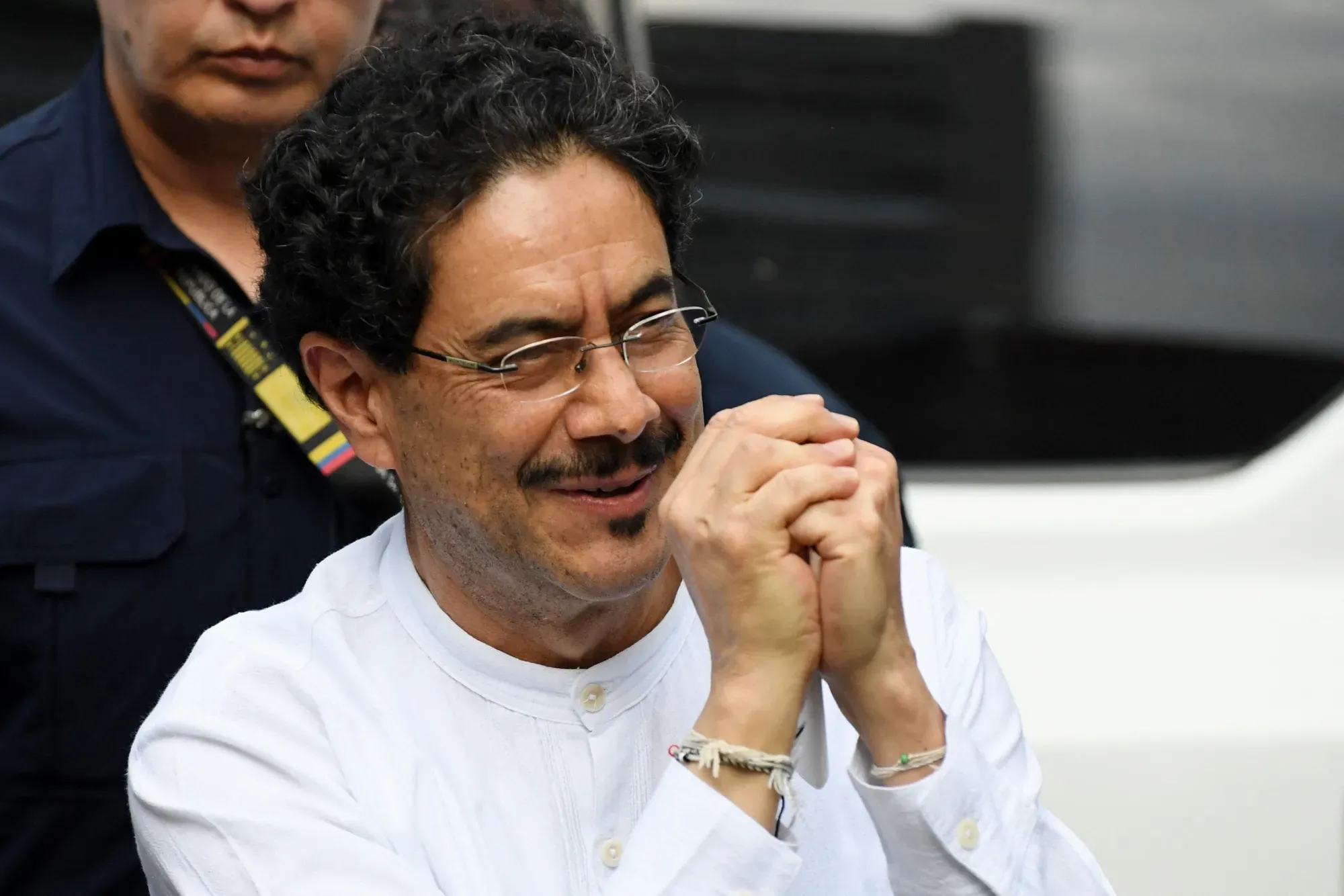
Iván Cepeda closed his campaign in Bogotá on Sunday with a rally in Plaza de Bolívar that his team described as the largest of the campaign. Cepeda has campaigned unconventionally throughout — focused on mounting rallies across the country, eschewing traditional advertising, doing limited media interviews, and participating in no debates. He has spent the final days returning to his core message: a vote for the Pacto Histórico is a vote against the political and economic establishment that, in his framing, produced the inequality and institutional failure that Petro’s government was elected to address.
Whether that message holds a sufficient coalition in a first round where he needs to clear 50% to avoid a runoff — or consolidate a strong enough second-place finish to win the June 21 runoff — is the question Sunday will begin to answer.
Cepeda, 63, lived his early life in the Colombian left. His parents were both members of the Colombian Communist Party, which drove the family into exile for much of his youth.
In 1994, state forces assassinated his father, then a senator. Cepeda has been a prominent voice for left-wing ideals and a de-escalation of the conflict between the government and paramilitaries. His candidacy is simultaneously a continuation of the Petro project and a product of a specific personal history with state violence that resonates deeply in a country where that violence has never entirely stopped.
Cepeda has been criticized by the more moderate elements of the Colombian populace for his far-left stance on social issues, as many fear a Cepeda administration a continuation of the disappointing tenure of his fellow-leftist and potential predecessor Gustavo Petro.
Abelardo De la Espriella closed his campaign in Barranquilla — the coastal city that has been one of the most responsive regions to his outsider message throughout the campaign. De la Espriella models himself after leaders like Nayib Bukele and Javier Milei — a far-right lawyer pitching himself as an outsider who will break the political establishment. His final days have been marked by escalating rhetoric on security and pointed attacks on both Cepeda and Valencia.
“Dear Paloma, the campaign is not for little games,” he wrote on X in a public rebuke of Valencia — a social media confrontation that reflects the intensity of the battle for second place and the personal dimension the conservative rivalry has taken on in the campaign’s final hours.
De la Espriella has pledged to join Washington‘s Americas Counter Cartel Coalition, called for U.S. troop operations on Colombian soil, and described the Petro government’s total peace framework as a failure that has produced the violence voters are living through. His base — younger, male, digitally engaged, economically frustrated — mirrors the coalition that carried Milei to the Argentine presidency in 2023 and that Bukele assembled in El Salvador before him.
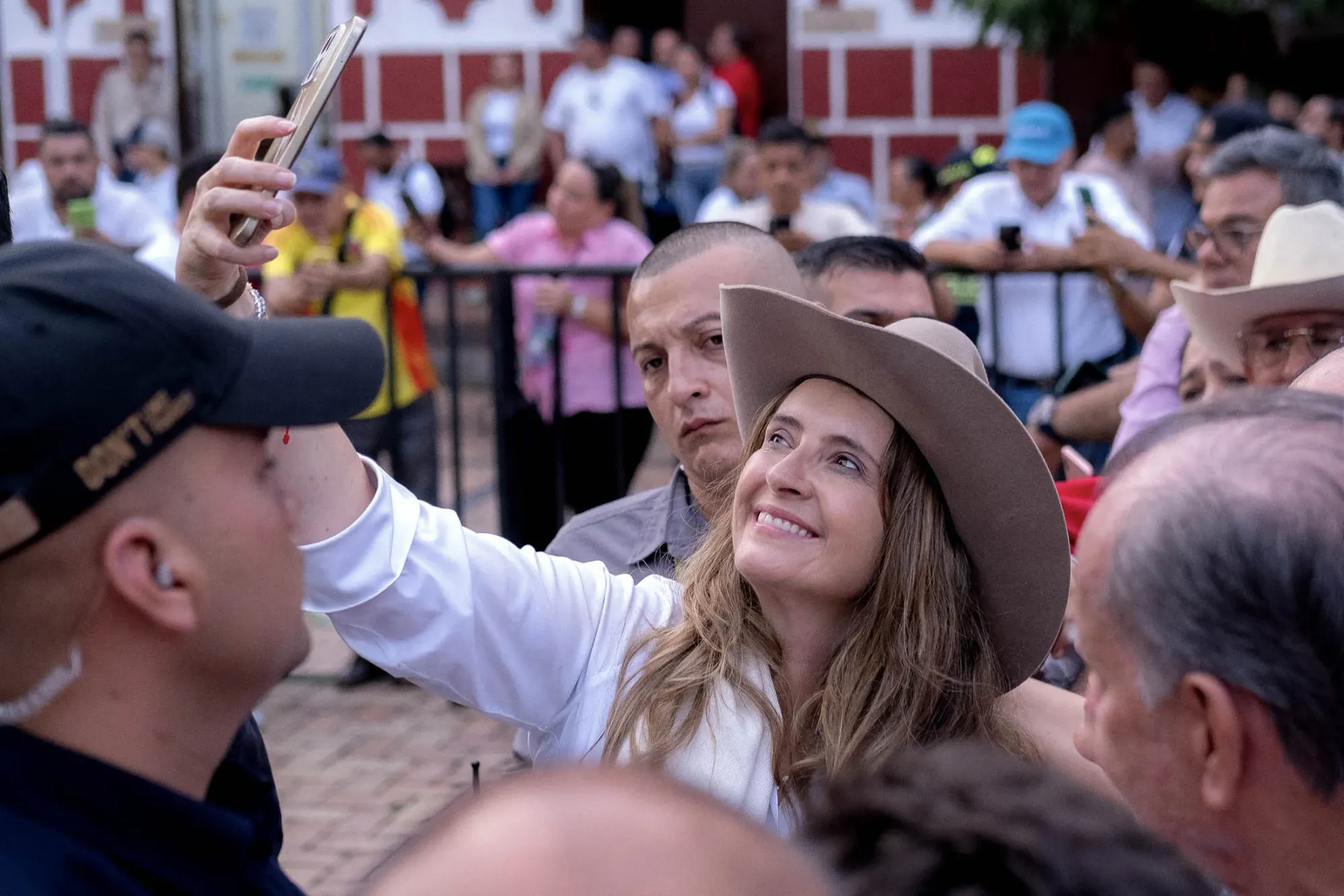
Paloma Valencia closed her campaign in Cali — symbolically chosen as the capital of the Valle del Cauca department that has borne some of the heaviest violence of the campaign period. Valencia is a senator and close ally of former President Álvaro Uribe, and was the big winner of the interparty primaries in March. Her final message has centered on the modernized Plan Colombia security framework she has proposed — a bilateral arrangement with Washington that echoes the security cooperation that defined the early 2000s and that her mentor Uribe is most associated with.
Valencia’s campaign has been the most institutionally credible of the three — backed by the Democratic Center’s organizational machinery, Uribe’s network, and the most detailed policy platform of any candidate. What it has struggled to generate is the emotional momentum that De la Espriella’s outsider positioning has produced in the final weeks.
The AtlasIntel poll placing her third — at a figure the poll does not specify in available summaries — is the most challenging data point her campaign has faced since the race began.
The Silence Before the Vote
Sunday, May 24 was the last day candidates could hold public campaign events. The following Sunday, May 31, Colombia votes. Colombian electoral law imposes a campaign silence period in the days before election day — no advertising, no public events, no new polling publications. The race enters its final week in a state of enforced quiet, with all three campaigns having made their final arguments and the outcome now in the hands of 39 million registered voters.
What happens on May 31 will produce one of three scenarios: a Cepeda-De la Espriella runoff, a Cepeda-Valencia runoff, or — in the scenario that remains possible but no poll currently supports — a first-round victory for Cepeda that ends the race outright. Each scenario produces a different June 21 and a different August 7 inauguration. Each has different implications for Colombia’s relationship with Washington, its security framework, its peace negotiations, and the 50 million Colombians who will live under whoever wins.
Colombians in Miami — hundreds of thousands of Colombian-Americans who have followed this campaign through its most turbulent moments — will be watching on Sunday from 3,000 miles away, unable to vote, unable to influence the outcome, and unable to look away.
Sociedad Media will continue to cover Colombia’s presidential election through the May 31 first round and the June 21 runoff. Tips, sources, and feedback welcome at info@sociedadmedia.com