


MEXICO — Two law enforcement actions announced within days of each other this month reveal the same fractured criminal organization under pressure on both sides of the border — one through the blunt instrument of mass arrest in southern Mexico, the other through the sharper legal tool of a U.S. terrorism indictment in San Diego. Together they illustrate how Washington and Mexico City are pursuing parallel, largely uncoordinated tracks against the Sinaloa Cartel even as the organization tears itself apart from within.
Nine Arrests in Chiapas
On July 8, the bodies of eight people — six men and two women — were found along the Jitotol–Bochil highway near the municipality of El Bosque in Chiapas, dumped alongside cardboard signs warning that the killings were a message to local drug dealers. Chiapas Attorney General Jorge Luis Llaven Abarca said the messages accused the victims of distributing crystal meth in the area, and doses of the drug were scattered over the bodies. All eight died from gunshot wounds to the head, and several showed signs of torture.
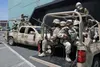
By July 13, state prosecutors had detained nine men who, in their own statements, identified themselves as members of the Sinaloa Cartel. Llaven Abarca said the motive was a dispute over control of retail drug sales in the region. Authorities seized three vehicles, 29 firearms — including AK-47 and AR-15 rifles — along with tactical gear, drones, cell phones, radios, and documents laying out the cell’s internal rules.
Five of the eight victims have since been identified; three bodies, including two women, remain at the forensic morgue in Tuxtla Gutiérrez awaiting identification.
The banners recovered at the scene closely resemble those found in March at a Sinaloa Cartel safe house in Acacoyagua, in the same state — a cell that investigators linked to the Los Mayos faction, suggesting the group responsible for the July killings may belong to the same wing of the cartel.
Chiapas has become a secondary battleground in the Sinaloa Cartel’s broader civil war, with the state also caught in an ongoing dispute between Sinaloa and the Jalisco New Generation Cartel over smuggling routes toward the Guatemalan border.
A Narcoterrorism Case in San Diego
Roughly 1,500 miles northwest, federal prosecutors this month unsealed a separate case against Carlos Paez Pereda, a 30-year-old Sinaloa Cartel figure known as “Carlitos” or “Carlitos Rugrats,” who allegedly runs a trafficking wing called “Los Rugrats” out of Tijuana.
The indictment — filed in March but only unsealed and announced this month — charges Pereda with narcoterrorism, providing material support to a designated terrorist organization, and operating a continuing criminal enterprise tied to fentanyl, cocaine, and methamphetamine shipments across the California border.
Prosecutors allege Pereda answers to René Arzate, a Sinaloa Cartel figure accused of controlling smuggling corridors from Baja California into San Diego for roughly fifteen years; Arzate remains at large. Pereda has not been arrested and is believed to still be in Sinaloa state.
The case is among the first uses of the narcoterrorism statute against a Sinaloa Cartel figure since the Trump administration formally designated the cartel a Foreign Terrorist Organization in February 2025 — a designation initially built around the cartel's role in trafficking fentanyl into the United States.
Where the Chiapas operation represents traditional homicide prosecution by Mexican state authorities, the San Diego indictment tests a newer legal framework that treats cartel trafficking activity itself as material support for terrorism, carrying steeper penalties and expanded prosecutorial reach.
One Cartel, Two Strategies
Neither action targets the cartel’s top leadership, and neither appears connected to the other. But both arrive against the backdrop of the same underlying crisis: a Sinaloa Cartel splintered since the 2024 arrest of Ismael “El Mayo” Zambada, now locked in an internal war between the Los Mayos and Los Chapitos factions that has killed and displaced thousands and bled into states well beyond Sinaloa itself, including Chiapas and Baja California.
For Mexico, the Chiapas arrests offer a rare quick resolution to a mass-casualty case, though the motive — a retail drug dispute — points to a level of local, decentralized violence that outlasts any single leadership shakeup.
For the United States, the San Diego indictment signals a longer-term strategy: building terrorism cases against mid-level operators, one cell and one faction at a time, in hopes that the accumulated legal pressure outlasts a cartel whose fragmentation has made it harder to target as a single entity.
Sociedad Media is a Miami-based digital news publication covering security incidents, organized crime, and political developments across Mexico & Latin America. For questions or tips, contact info@sociedadmedia.com