


MEXICO CITY — Mexico’s Dos Bocas refinery was supposed to be the physical proof that AMLO’s (Andrés Manuel López Obrador) promise of energy sovereignty was real. Designed with a nameplate capacity of 340,000 barrels per day, it was built specifically to process Mexico’s sulfur-rich heavy crude and reduce the country’s reliance on fuel imports.
Four years and more than $20 billion later, it is producing at 42% of design capacity, bleeding public funds, and generating the kind of public corruption scandal that Washington has been waiting for.
A notary’s office validated a multibillion-peso lease contract for the Dos Bocas facility this week — a 4.8 billion peso arrangement that Mexican investigative reporters and opposition legislators say exemplifies the opacity, cost overruns, and procurement irregularities that have defined the project from its inception. The timing is devastating: the project has been marked by a lack of transparency since construction began, and the latest revelation arrives seven days before the third round of USMCA negotiations between the U.S. and Mexico, scheduled for July 20 in Mexico City.
A Refinery Built on Bad Blueprints
The Dos Bocas scandal did not begin this week. It began before the first shovel broke ground.
The decision to use old blueprints for the refinery has had far-reaching consequences. “Dos Bocas has continued to face problems due to failures in design, and the absolute mistake of skipping the FEED stage,” said Bernardo Del Castillo, founder and chief executive of Soteria Consulting. Since many of Dos Bocas’ plans were borrowed from a refinery planned in a mountainous part of Mexico, the facility doesn’t have the equipment to work at a lower, more humid altitude.
The refinery has struggled with repeated interruptions, including a three-month shutdown in late 2024 when crude supplies failed quality standards due to water and salt contamination. In April 2025, a malfunction during electrical load balancing triggered a cascade of equipment failures that required more than a week to restart operations.
The human cost has also mounted. Fuel leaked from the refinery and ignited in late March, killing five workers. A second oil spill followed days later. An oil slick spread more than 370 miles along the Gulf of Mexico coast, from Tabasco through Veracruz to its northern border with Tamaulipas.
Pemex received 395.3 billion pesos in Mexican government support in 2025 to help significantly reduce its debt, which stood at $85.2 billion. Despite that support, the refinery continues to underperform. “We’re a long way from the rhetoric of Dos Bocas meeting the reality,” said Pablo Zarate, an energy analyst at FTI Consulting.
Sheinbaum’s Impossible Position
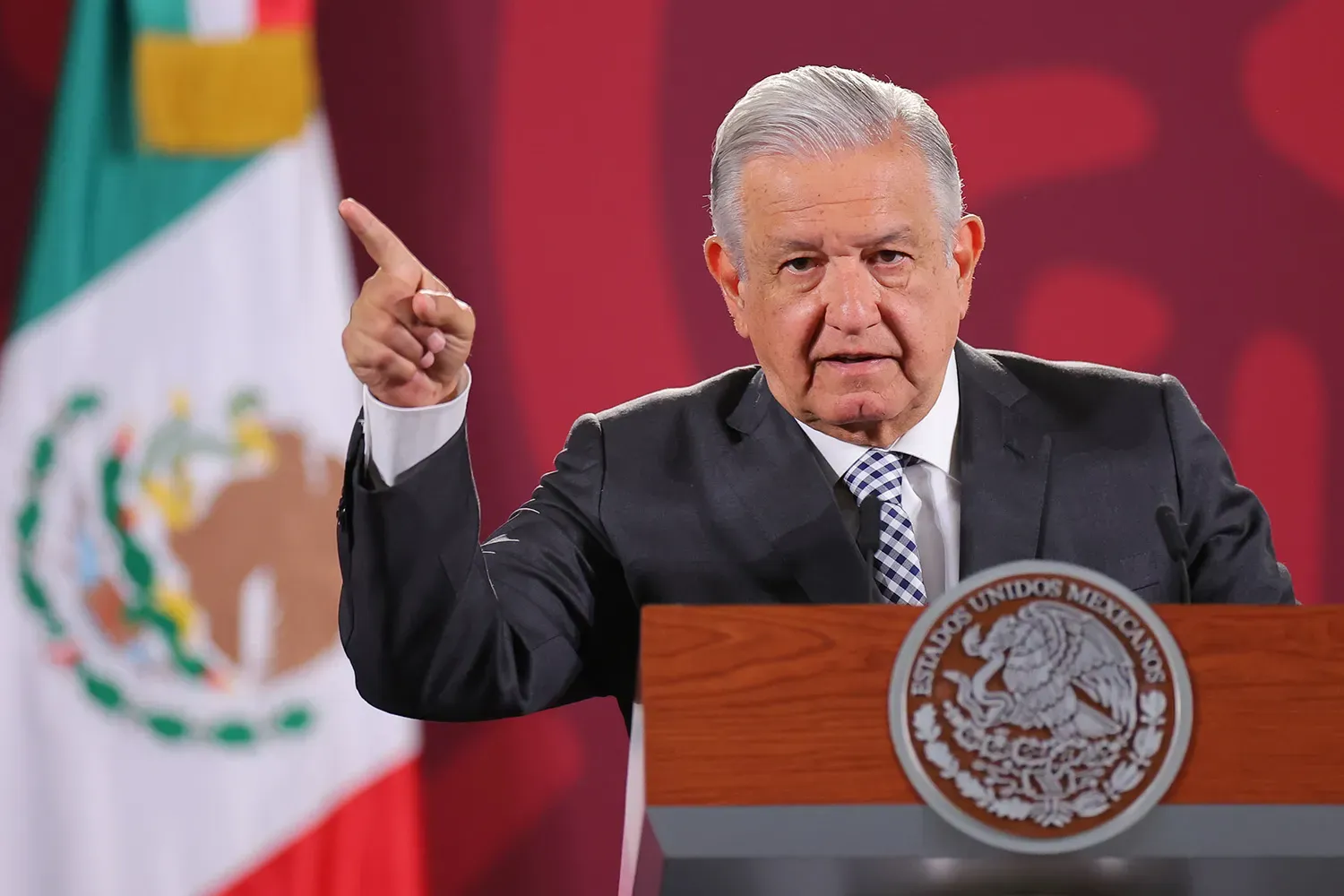
President Claudia Sheinbaum inherited Dos Bocas along with everything else AMLO left behind — and she has doubled down on his energy sovereignty narrative even as the refinery has repeatedly failed to justify it. The Olmeca refinery has been a cornerstone of the Mexican government’s push for energy sovereignty under MORENA administrations, positioned as a key driver to reduce reliance on imported fuels. But the MORENA government has since failed to fulfill those promises.
The 4.8 billion peso lease scandal gives the opposition exactly the ammunition it needs to argue that Sheinbaum’s energy sovereignty project is not a public interest program — it is a procurement vehicle that enriches connected contractors while producing half the fuel it was designed to deliver.
For Sheinbaum, who has carefully managed her relationship with Washington through eighteen months of tariff pressure, cartel designation threats, and USMCA renegotiation, the timing could not be worse.
She has no good options. Distancing herself from Dos Bocas means acknowledging that AMLO’s signature infrastructure project was mismanaged — a politically costly admission for a president whose electoral mandate is built on continuity with her predecessor. Defending it means owning a scandal that Washington is about to weaponize at the negotiating table.
Washington’s Leverage Point
The Trump administration’s USMCA negotiating position has always included a non-trade agenda — fentanyl enforcement, cartel penetration of state institutions, Chinese goods routing through Mexico, and the broader question of Mexican institutional integrity.
The refinery is not connected to the national pipeline network or main road corridors, forcing Pemex to rely on trucking and coastal shipping. That logistical failure has produced exactly the opacity in procurement and distribution that U.S. trade negotiators have identified as symptomatic of the state capture problem they are pushing Mexico to address.
The 4.8 billion peso lease scandal is not about oil. It is about whether Mexico’s state institutions are capable of managing public resources without corruption — and that question is precisely what Washington wants on the table in Mexico City on July 20.
The Dos Bocas scandal does not end the diplomatic dexterity required for cordail relations with the United States. But it hands Trump’s team a concrete example — documented in Mexican media, validated by a notary, and priced at 4.8 billion pesos — of exactly the institutional dysfunction Washington says it is negotiating to fix.