

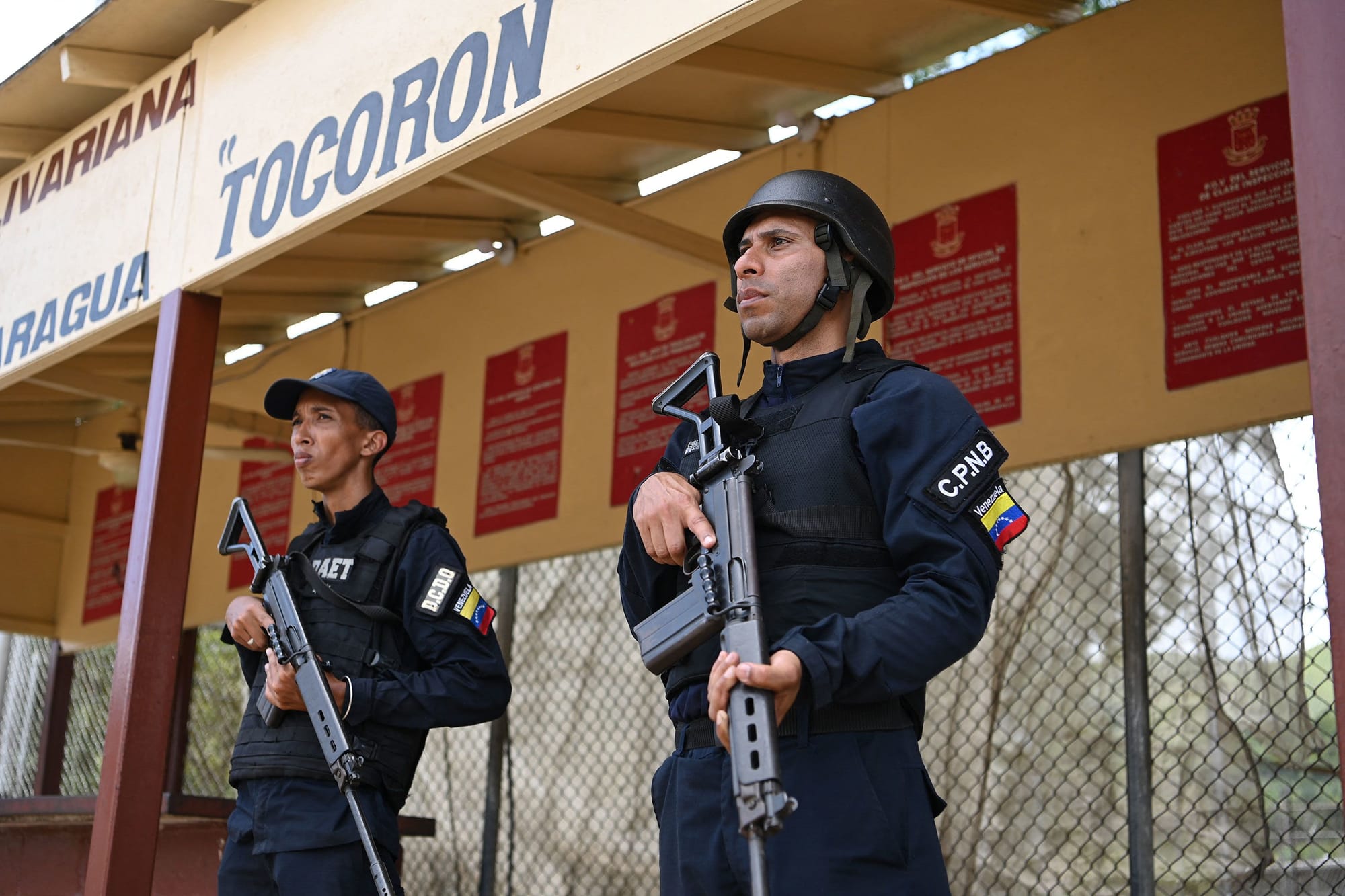
MIAMI — The story of Tren de Aragua begins in a prison in the state of Aragua, Venezuela, sometime around 2014. It begins with a man named Héctor Rusthenford Guerrero Flores — alias Niño Guerrero — who transformed a prison-based criminal enterprise into what would become the most internationally significant gang to emerge from Latin America in a generation.
It also begins with a government that let him do it.
With the Maduro regime’s tacit tolerance of pranes — inmate-bosses — Niño Guerrero transformed Tocorón prison into a de facto headquarters, funding weapons and organization through the la causa inmate tax and contraband profits. As Caracas unraveled under hyperinflation and collapse, millions of Venezuelans crossed borders in search of food and safety.
Tren de Aragua exploited the vacuum.
Tren de Aragua, the ELN, and FARC dissident structures functioned as integrated instruments of Venezuela’s hybrid criminal-state — not independent external criminals. These actors operated as strategic enablers that extended coercion, generated revenue, and provided deniable force projection across national borders in South America — and still do.
They controlled corridors, enforced illicit taxation, stabilized black-market governance, and manufactured insecurity to shape political outcomes when needed.
That architecture was built for Maduro’s Venezuela. But with Maduro gone, now in a cell at the Metropolitan Detention Center in Brooklyn, awaiting trial on narco-terrorism charges, the architecture he built remains — and what it does without the government that created it is the question that no one in Washington, Caracas, Bogotá, or Santiago has fully answered.
How the Gang Was Built — and Why the State Needed It
Tren de Aragua in the Maduro era was not simply a criminal organization that the Venezuelan state tolerated. It was, in significant measure, a criminal organization that the Venezuelan state deployed.
Between 2018 and 2021, Caracas quietly turned Tren de Aragua outward — precisely toward the governments most vocal in the Lima Group, the bloc created in 2017 to delegitimize Maduro. With judicial cooperation limited and extradition channels stalled, Venezuelan security organs showed scant interest in stopping pranes who walked out of Tocorón. Instead, the regime reframed Tren de Aragua as a deniable vector of disorder: every time a new cell appeared in Lima’s northern bus terminals, Santiago’s peri-urban communities, or Brazil’s Roraima border towns, violence spiked, police resources were overstretched, and anti-Venezuelan sentiment soared, shifting local debate from sanctions policy to street-level insecurity.
For Caracas, the payoff was elegant. Each kidnapping in Tarapacá, each Plaza Norte shakedown, and each drug convoy across Roraima imposed costs on governments pledged to topple Maduro. Yet none of the mayhem traced cleanly back to Venezuelan officials. By unleashing Tren de Aragua in hostile jurisdictions, the regime exported the chaos it had honed domestically, blurring foreign policy fault lines and sowing disorder beneath the noses of unfriendly governments.
The 2023 Tocorón prison raid — which the Maduro government staged as a show of force — illustrated the relationship’s complexity. A heavily publicized raid on Tocorón in 2023 — meant to project Maduro’s strength ahead of the 2024 elections — failed to capture Guerrero and other gang leaders, who were reportedly warned about the raid after negotiating with the government in advance.
The state was not eliminating the gang. It was managing it.
New Order Post-Jan. 3
The U.S. operation that captured Maduro did not dismantle the infrastructure he had built. It removed the man at the top and left everything beneath him structurally intact — including the relationship between Venezuela’s security apparatus and the criminal networks it had cultivated.
Washington links recent military activity to Venezuelan elites’ alleged involvement in narco-trafficking, particularly Tren de Aragua and the Cartel of the Suns — though experts note that the post-Maduro transition has created uncertainty about how these networks operate under the new power structure.
Key uncertainties center on the cohesion of the Venezuelan military, the role of militias and security services, and whether remaining elites can coalesce around Delcy Rodríguez.
Analysts have speculated that criminal gangs such as Tren de Aragua will capitalize on the political instability, leading to increased violence. The heightened presence of colectivos — armed pro-Maduro militias patrolling the streets of Caracas since Maduro’s capture — represents a parallel power structure that Rodríguez has not dismantled and may not be able to.
Maduro’s capture does not automatically dismantle the regime’s hybrid criminal-state architecture. That structure functions as a network that mimics institutions and has a rapid capacity for reorganization and adaptation. Although operating more cautiously under pressure from the U.S., the infrastructure that allowed Maduro to survive persists. Venezuela’s core threat is not a single individual but a hybrid criminal-governance system that fuses repression, illicit economies, and asymmetric enablers.
The Rodríguez government faces a structural dilemma. To satisfy Washington’s conditions for sustained sanctions relief — and to attract the foreign investment that Venezuela’s economic recovery requires — she needs to demonstrate that the criminal networks embedded in the state are being dismantled. But dismantling those networks requires confronting the same military and security apparatus that keeps her in power.
The colectivos are not simply criminal groups. They are the armed enforcement mechanism of Chavista political control.
The Fragmentation Problem
Whatever the Rodríguez government’s intentions, the evidence on the ground suggests that Tren de Aragua is not being dismantled. It is fragmenting — and fragmentation, in the gang’s particular organizational model, is not destruction. It is adaptation.
These blows have led to further fragmentation within the group, which now operates more like a loose network of dispersed franchises than a cohesive organization.
The mass migration that enabled the Tren de Aragua’s expansion has also shifted. Between 2018 and 2022, there was little criminal infrastructure in South America equipped to handle the sheer number of Venezuelan migrants moving across the continent — allowing the Tren de Aragua to step in and claim much of the profits. The shift in migration routes toward the United States has reduced its income from migrants within its traditional territory.
Reports of new cells continue to emerge across South America, though authorities believe many are copycats seeking to capitalize on the Tren de Aragua’s notoriety. Whether the gang can survive the fragmentation of its structure across the region remains to be seen.
The fragmentation creates a specific law enforcement problem. A coherent, hierarchically organized gang can be disrupted by targeting its leadership. A dispersed franchise network — where cells operate semi-autonomously under a common brand and criminal methodology — is structurally resistant to decapitation strategies. Arresting the local commander of a Tren de Aragua cell in Santiago or Lima does not disrupt operations in Bogotá or Caracas. Each cell has its own revenue streams, its own recruitment pipeline, and its own local criminal relationships.
TdA thrives in states with weak institutional capacity, making them particularly difficult to combat. Current U.S. policy frameworks lack the nuanced detail necessary for combatting this threat because of the lack of coordination between affected countries, especially the Venezuelan government, the Colombian, and the Brazilian, along with the rapid evolution and expansion of TdA.
Washington’s Framework — and Its Problems
The Trump administration’s response to Tren de Aragua has been legally aggressive and analytically contested.
The FTO designation in February 2025. The invocation of the 1798 Alien Enemies Act to deport Venezuelan migrants alleged to be gang members. The transfer of more than 200 Venezuelans to CECOT in El Salvador. The use of tattoos — crowns, flowers, the phrase “real hasta la muerte,” a silhouette of Michael Jordan — as the primary evidentiary basis for gang membership determinations.
Defense attorneys argue that the arrests were made without concrete evidence. Former Venezuelan officials deny that the gang used any specific symbolism in tattoos. Despite the absence of evidence of an organized gang operation in the United States, more than 200 Venezuelans were transferred to CECOT under the Alien Enemies Act. One of the most notable purported cases is that of Jerce Reyes Barrios, a 36-year-old Venezuelan fútbol player deported by the Trump administration due to his alleged association with Tren de Aragua.
Reyes Barrios had legally entered the United States in 2024 and applied for asylum after allegedly fleeing torture in Venezuela.
The legal and evidentiary problems with Washington’s approach do not mean that Tren de Aragua is not a genuine security threat. They mean that the framework being used to address it is simultaneously over-inclusive — sweeping in Venezuelan migrants with no gang connections — and under-inclusive — failing to address the structural conditions inside Venezuela that produced the gang and that continue to sustain it.
The FBI released a January memo claiming to prove links between the Venezuelan government and Tren de Aragua. The memo contradicted two other government reports that negated the link — one from the Office of the Director of National Intelligence declassified on May 5, 2026, and an April 17 National Intelligence Council statement.
On May 16, Director of National Intelligence Tulsi Gabbard fired two authors of the first report.
What the Rodríguez Transition Means for the Gang
The post-Maduro transition has restructured Venezuela’s criminal landscape in ways that are still becoming visible.
The Rodríguez government has been systematically purging Maduro-era loyalists — seventeen ministers replaced, eight Supreme Court justices forced out, a Central Bank audit underway. Whether those purges extend to the security and intelligence apparatus that managed the state’s relationship with Tren de Aragua and the Cartel of the Suns is the operational question that Washington has the most direct interest in and the least publicly available information about.
Successful stabilization will inevitably have to put pressure on extra-regional actors and criminal networks inside Venezuela. The collateral result should be the overflow of this influence into neighboring countries. The United States needs to coordinate cooperation mechanisms with Colombia, Brazil, Caribbean partners, and Panama in the areas of surveillance and maritime and border controls, extradition treaties, and financial intelligence.
The Petro-Rodríguez meeting at Miraflores on April 24 — covered by Sociedad Media in depth — produced a joint commitment to address the armed groups operating along the Colombia-Venezuela border. Whether that commitment includes specific operational cooperation against Tren de Aragua cells operating in the Catatumbo corridor is not publicly known. The meeting produced a framework, but frameworks do not dismantle franchises.
What the post-Maduro transition has unambiguously changed is Tren de Aragua’s relationship to the Venezuelan state. Under Maduro, the gang had a patron — a government that tolerated, managed, and occasionally deployed it. Under Rodríguez, the relationship is genuinely unclear. The infrastructure of state-criminal complicity that Maduro built was not dismantled on January 3. But its management is no longer in the hands of the man who designed it.
There may not be a better opportunity to negotiate bilaterally with Venezuela given the arrest of Maduro. Willingness to cooperate internationally is not unlimited in duration.
That window is the one that matters. Tren de Aragua was built during a period of Venezuelan state dysfunction and deliberate state complicity. It is now operating during a period of Venezuelan state transition — a moment when the new government has incentives to cooperate with Washington on criminal network suppression that the old government never had.
Whether that cooperation materializes before the franchise network completes its adaptation to the post-Maduro landscape is the security question that the hemisphere’s next twelve months will answer.
Sociedad Media is monitoring Venezuela’s post-Maduro transition, Tren de Aragua’s regional evolution, and the region’s fight against organized crime. For tips and reporting, contact info@sociedadmedia.com


