

On December 16, Secretary of State Marco Rubio made an announcement that landed quietly in Washington and with considerably more force in Bogotá.
“Today, the Department of State is designating Clan del Golfo as a Foreign Terrorist Organization and a Specially Designated Global Terrorist,” Rubio wrote.
“Based in Colombia, Clan del Golfo is a violent and powerful criminal organization with thousands of members. The group’s primary source of income is cocaine trafficking, which it uses to fund its violent activities. Clan del Golfo is responsible for terrorist attacks against public officials, law enforcement and military personnel, and civilians in Colombia,” the memorandum said.
The designation was formally grounded in Section 219 of the Immigration and Nationality Act and Executive Order 13224 — the same legal framework Washington has been deploying across Latin America’s criminal landscape with increasing frequency since Trump returned to office. It was, in one sense, procedurally unremarkable. In another sense, it was the most consequential single action Washington has taken in U.S.-Colombia relations since Trump called Petro a ”drug trafficker” and threatened sweeping tariffs in early 2025.
Since then, Petro and his U.S. counterpart in Washington have publicly reconciled after a visit to the White House. But with elections fast approaching, Colombia votes on May 31. The Clan del Golfo designation is the foreign policy earthquake that the campaign has been absorbing ever since, and could further fracture Petro’s already fragile peace efforts with his nation’s criminal elements.
Who Are the Clan del Golfo?
The Clan del Golfo — also known as the Gaitanist Army of Colombia, or EGC — is not a cartel in the Mexican sense. It does not have a single charismatic leader projecting power from a fixed territorial base. It is something more diffuse, more politically sophisticated, and in some ways more difficult to dismantle than the organizational structures that the FTO framework was designed to address.
Colombian authorities estimate the Clan del Golfo has roughly 9,000 armed members and controls significant portions of the country’s cocaine trade, in addition to engaging in extortion, illegal mining, and human trafficking. The group emerged from the demobilization of right-wing paramilitary forces in the mid-2000s — inheriting the criminal infrastructure of organizations that had themselves emerged from Colombia’s decades of guerrilla conflict.
The group evolved through multiple rounds of expansion under the control of the Úsuga brothers, known as Giovanni and Otoniel. Otoniel was captured in 2022 and extradited to the United States, where he was sentenced to 45 years in prison in 2023. Despite his capture, the Clan del Golfo did not disband. Colombian authorities report that it fragmented into regional cells, maintaining its capacity for violence and international presence.
Before Otoniel’s arrest, the criminal network moved around 20 tons of cocaine monthly — part of which was smuggled into Europe via agricultural product containers, with key distribution hubs in ports like Rotterdam, Antwerp, and southern Spain. The European dimension is rarely discussed in U.S. coverage of the designation — but it is precisely the transnational financial reach that the FTO and SDGT frameworks are designed to disrupt. A European company whose logistics provider has Clan del Golfo connections is now potentially exposed to U.S. sanctions liability.
The designation’s reach is deliberately expansive. Members of the Clan del Golfo are now banned from entering the United States, and any already present are eligible for removal.
Any of the organization’s assets identified as being in the U.S. are subject to freezing. Material support for the group is now illegal. Non-U.S. persons who engage in prohibited transactions with the Clan del Golfo subject to U.S. jurisdiction may face civil or criminal penalties and sanctions from OFAC.
Elizabeth Dickinson, Deputy Director for Latin America at International Crisis Group, noted that the designation could expose links between the EGC and legal enterprise — an organization with “deep tentacles in the business world.”
Not only could cases be brought against members of the Clan del Golfo, but against any businessmen, facilitators, logistics operators, or anyone who provides even something as simple as buying them a meal.
The Peace Talks Problem
Although the designation was applied in December of last year, the ramifications of the move and the potential for impacting Colombia’s upcoming presidential elections, and a possible referendum on the Petro government’s stalled peace talks with groups like the EGC, arrived at a moment that could not have been more diplomatically sensitive for Petro’s government.
Since September 2025, Colombia’s government and the Clan del Golfo had been engaged in peace talks in Doha, Qatar, with mediation from Spain, Norway, Switzerland, and Qatar. In December, both sides announced the creation of three special concentration zones in northern and western Colombia where group members would be temporarily positioned starting March 2026 — the first concrete step toward a potential demobilization. Colombia’s chief negotiator Álvaro Jiménez said the U.S. decision was not unexpected: “From the moment President Donald Trump took office, he indicated that he would name several groups as terrorist organizations. It is too early to assess how the designation might affect the talks.”
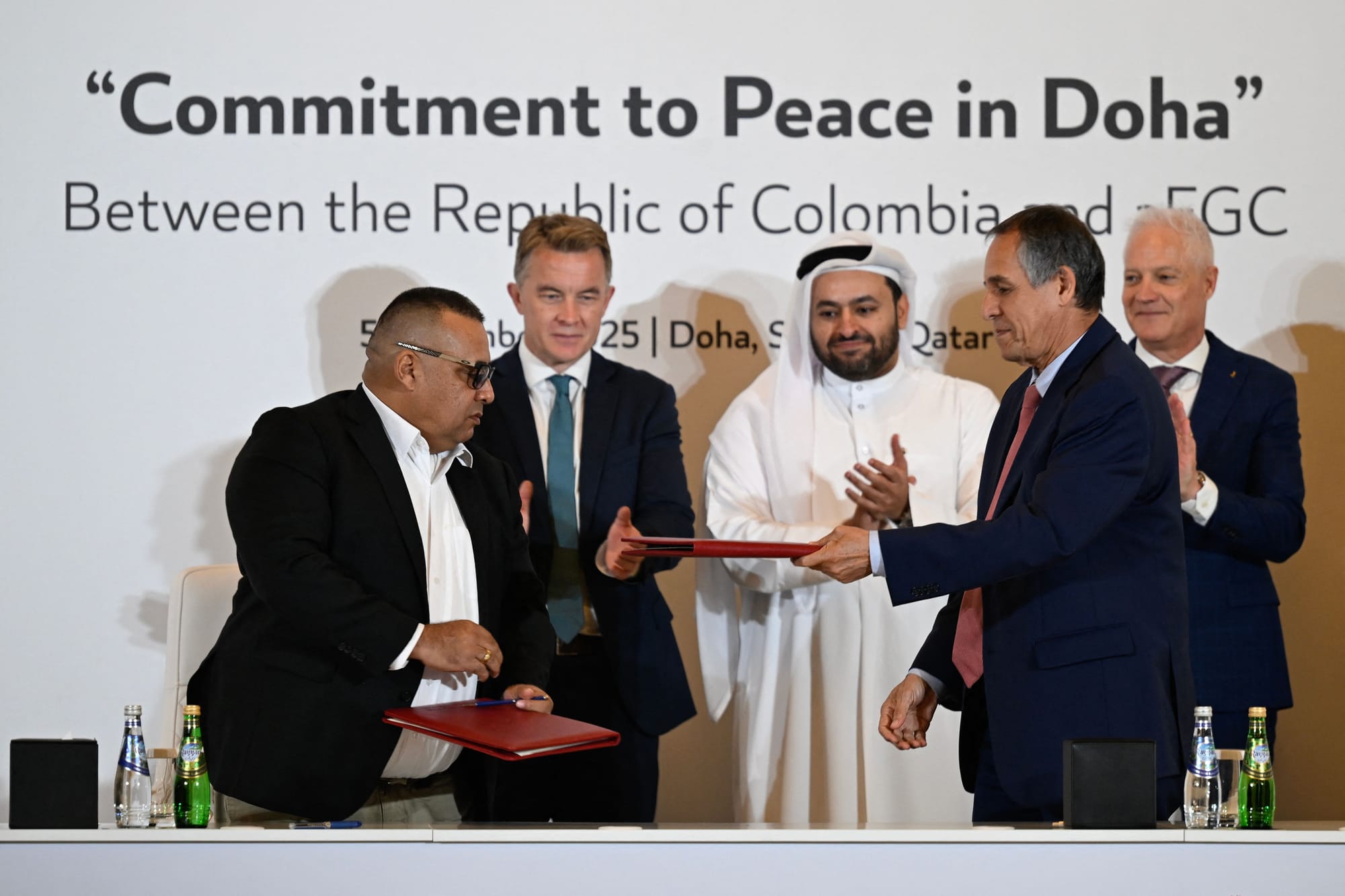
The analysts monitoring the talks were less diplomatic. FIP’s Arias warned that the FTO classification will complicate both the subject of talks and the logistics of engaging in negotiations — EGC negotiators will struggle to attend talks safely outside Colombia, and Colombian authorities will be unable to provide credible non-extradition guarantees to the group’s leaders. The State Department’s FTO designation threatens to derail talks entirely, according to multiple analysts.
“I think there’s a lot of pending questions right now about the future of negotiations with this group,” Dickinson said.
A peace negotiation requires the government to offer the armed group’s leaders something in exchange for laying down weapons — typically some form of legal protection, reduced sentences, or political participation. The FTO designation removes the Colombian government’s ability to credibly offer any of those things, because any Colombian official who provides material support to an FTO — including attending a negotiating session and providing safe passage — is potentially exposed to U.S. legal jeopardy.
Petro’s Total Peace strategy — the defining security policy of his government — was built on the premise that all of Colombia’s armed groups could be simultaneously engaged in dialogue. The Clan del Golfo designation is Washington’s most direct intervention yet in that premise — not through military action or economic sanctions against Colombia, but through the legal reclassification of Petro’s negotiating partner as a terrorist organization.
The talks in Doha have not formally collapsed, but they have effectively been suspended pending a legal architecture that nobody has yet figured out how to build.
The Military Action Question
The FTO designation carries an implication that Washington has not stated explicitly and Bogotá has not directly asked about — but that neither government can ignore.
The move could provide a pretext for military action against the EGC in Colombia, with the Trump administration saying in recent weeks that drug production in any country is a legitimate target. An FTO designation in and of itself is not a justification for military action. However, it has historically been a step along the road to paving a narrative politically against other Latin American leaders that could lead to U.S. intervention.
That sequence — FTO designation, followed by escalating rhetoric, followed by military action — is precisely the pattern Washington applied to Venezuela before January 3.
The Maduro government was designated a narco-terror state. U.S. prosecutors filed charges. The rhetoric escalated. Then the operation happened. Whether the same logic applies to an armed group operating inside a sovereign democracy — rather than a government that had lost international legitimacy — is a legal and political question that neither the Trump administration nor the Bogotá government has answered directly.
What is documented is that Trump has said Colombia could be hit by U.S. strikes, then he called Petro a “drug trafficker.” What is also documented is that SOUTHCOM has been conducting lethal strikes on maritime vessels in the Caribbean since September, and that the FTO designation of the Clan del Golfo is the legal instrument that, historically, has preceded rather than followed U.S. military engagement with designated organizations.
A senior State Department official told alternative news outlets: “Clan del Golfo is not just a drug cartel, it’s a Foreign Terrorist Organization that has inflicted untold suffering on the Colombian people and threatens our region’s stability. This group is a direct threat to our national security interests, and we will use every tool at our disposal — sanctions, law enforcement, intelligence, and international cooperation — to dismantle it.”
Every tool at our disposal. That phrase, from a senior State Department official, is the part of the designation announcement that Bogotá's national security community is still parsing.
The Election Dimension
Colombia votes on May 31 — 25 days from now. The Clan del Golfo designation, the collapse of the peace talks, and the broader security crisis converge on that date in ways that each candidate in the race has been trying to exploit.
For Paloma Valencia and the right — who proposed Álvaro Uribe as Defense Minister and whose entire campaign is built on ending Petro’s Total Peace — the FTO designation is a validation. Washington has officially agreed with Colombia’s conservative position that the Clan del Golfo is a terrorist organization, not a peace partner.
The designation is the foreign policy endorsement that Valencia’s campaign could not have bought.
For Iván Cepeda and the left, who is leading in most polls, the designation is an external intervention in Colombia’s sovereign peace process, executed by the same administration that has targeted Petro personally and whose Donroe Doctrine has been systematically removing hostile governments and aligned groups from power across the hemisphere. The FTO designation is not a security measure. It is a political weapon.
For Colombia’s voters, the choice on May 31 includes an implicit referendum on whether to continue negotiations with an organization that Washington has just called a terrorist group — or to embrace the security framework that Washington is promoting across the hemisphere, at the price of whatever progress the Doha talks represented.
The Cauca bombings that killed 21 people last weekend were carried out by FARC dissidents, not the Clan del Golfo — but they reinforced the broader security crisis that the election is navigating.
The FTO designation means that the next Colombian president — whoever wins — inherits a bilateral relationship with Washington that has been fundamentally restructured around the counter-terrorism framework, with a peace negotiation process that has been effectively frozen by a foreign government’s legal classification, and with an armed group of 9,000 members that is now simultaneously Colombia’s most powerful criminal network and Washington’s designated terrorist organization.
The next president does not get to start from scratch on any of this. They inherit it on July 28 — and they govern it from day one.
Sociedad Media is monitoring Colombia’s May 31 presidential election, the Clan del Golfo FTO designation, and heightened regional security implications. For tips and reporting, contact info@sociedadmedia.com


