


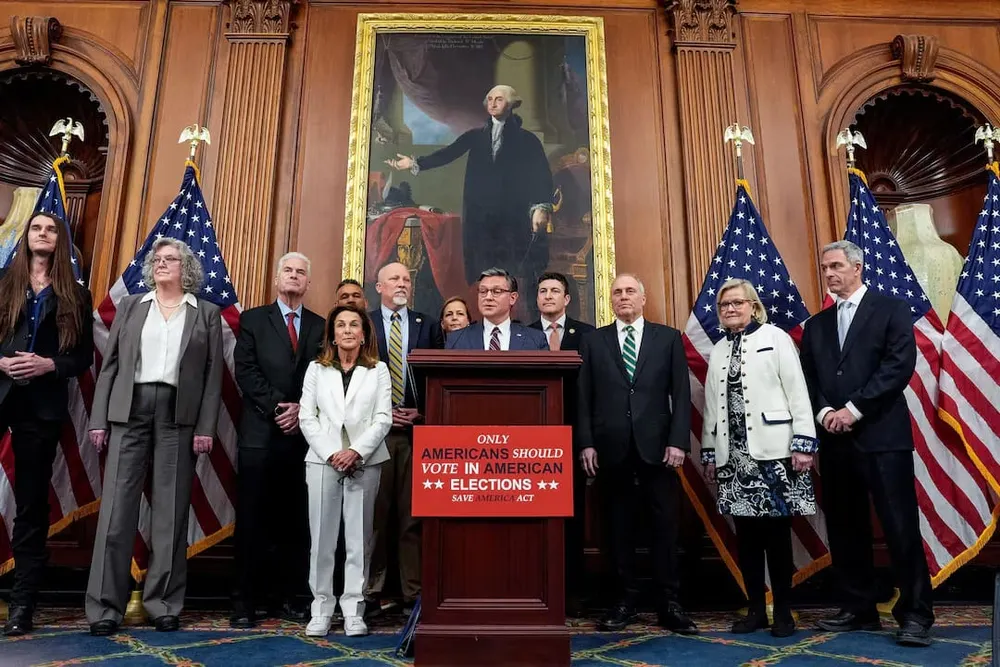
WASHINGTON, D.C. — The U.S. House of Representatives passed its annual defense policy bill on Wednesday evening with an unusual rider attached: the SAVE America Act, the citizenship-verification voting bill President Trump has pushed for more than a year and repeatedly called a top legislative priority.
The House Vote
The chamber approved the National Defense Authorization Act (NDAA) for Fiscal Year 2027, a $1.15 trillion measure, by a vote of 216-212, sending it to the Senate.
The tally split largely along party lines, with 209 Republicans and six Democrats voting in favor, and seven Republicans joining 205 Democrats in opposition. A day earlier, the House voted 214-211 to authorize attaching the SAVE Act’s text — previously passed by the House as a standalone bill, S. 1383 — onto the defense measure during the engrossment process, with the House clerk permitted to renumber provisions and make technical corrections to merge the two bills.
The underlying defense bill authorizes military pay raises of 5 to 7 percent, increases weapons procurement, and replenishes depleted stockpiles. One adopted amendment would cut the Pentagon’s budget by 0.5% if it fails a financial audit, redirecting those funds away from the Treasury Department.
What the SAVE Act Would Do
Formally titled the Safeguard American Voter Eligibility Act, the bill would require documentary proof of U.S. citizenship — such as a passport or a REAL ID-compliant form of identification indicating citizenship — for anyone registering to vote in federal elections. Supporters, including the Trump administration, frame it as a common-sense measure ensuring that only American citizens decide American elections; the White House has pointed to an incident in New Jersey, where Democratic Gov. Mikie Sherrill acknowledged a software error had registered approximately 6,600 noncitizens to vote between 2023 and 2024, some of whom cast ballots, as justification for the bill.
Voting-rights organizations and Democrats have raised different concerns, arguing the measure would effectively eliminate most current online and mail-in voter registration methods, since it would generally require voters to present citizenship documents in person.
A Bill With Two Legislative Tracks Right Now
The NDAA attachment is not the only avenue Republicans are pursuing for the SAVE Act this week. On a separate track, the House also voted 216-214 to approve a budget reconciliation framework that includes $10 billion in election-related grants over ten years, structured as an incentive rather than a mandate: states would not be required to adopt citizenship-verification or photo ID requirements, but those that do would qualify for federal funding.
That broader reconciliation package, which also includes funding tied to the conflict with Iran and aid for farmers affected by tariffs, still requires individual House committees to draft the underlying legislation before a final reconciliation bill takes shape.
Separately, the House also passed legislation banning members of Congress from trading individual stocks, which included its own added photo-ID voting provision — a bill Democrats have characterized as more of a partisan messaging exercise than a serious legislative vehicle.
Why the Senate Is the Real Obstacle
This marks the second time this year the House has advanced the SAVE Act after passing an earlier standalone version in February, which has since stalled in the Senate despite an extended-debate push led by Sen. Mike Lee.
Senate Republicans have lacked the votes to eliminate the legislative filibuster, and Senate Democrats blocked a procedural cloture vote on the NDAA itself last week by a 50-46 margin, with Majority Leader John Thune switching his own vote to preserve Republicans’ ability to bring the motion up again later.
The reconciliation approach faces its own obstacle: Senate rules restrict what can pass via reconciliation to provisions that are primarily budgetary in nature, and the Senate parliamentarian ruled last month that earlier SAVE Act language did not qualify — a ruling that prompted Trump to call for her removal. Given these structural hurdles, most legislative trackers view it as unlikely that any version of the SAVE Act becomes law before the 2026 midterm elections, regardless of which vehicle Republicans use to advance it.
What Comes Next
The Senate must now decide whether to take up the NDAA with the SAVE Act rider attached, separately from whatever reconciliation bill eventually emerges from House committees. Given the chamber’s recent voting history on the underlying measure, the defense bill’s passage is likely to reopen the same partisan standoff that has kept the SAVE Act from reaching the president’s desk throughout 2026.