

WASHINGTON — King Charles III arrived at the U.S. Capitol on Tuesday to extended applause, the pageantry of a state visit, and the weight of a diplomatic moment that has been carefully constructed for months. He was greeted by Speaker Mike Johnson (R-LA), addressed both chambers of Congress, and received repeated standing ovations. In approximately twenty minutes of remarks, he said everything the British government needed him to say — and nothing that protocol prevented him from saying directly.
He spoke of the “interlinked” destinies of the United States and the United Kingdom, describing the story of the two countries as one of “reconciliation, renewal and remarkable partnership.” He acknowledged the shooting at the White House Correspondents’ Dinner on Saturday, strongly condemning acts of political violence. The King also invoked the approaching 25th anniversary of September 11, and by every measure of royal diplomacy, expressed precisely what his government needed him to be in a period of tested loyalties over the most pressing issues of our time.
What he could not be — what the constitutional constraints of the British monarchy do not permit — was direct. The disagreements that have strained the “special relationship” to its most acute breaking point in decades were not named. But they were present in every line of the speech nonetheless.
The Alliance Under Strain
Relations between the United States and the United Kingdom have been strained since the start of the U.S.-Israeli war with Iran, after Trump criticized Prime Minister Keir Starmer’s refusal to offer substantial military assistance.
President Trump has gone on the offensive over the British government’s lack of political will to stand firm with Washington’s position on major global straits. The British government had been hoing for several months that Charles’s visit can help ease those tensions, and get Trump back onside.
The visit is, in diplomatic terms, an exercise in soft power deployed precisely because the hard power conversation has broken down. When two governments cannot resolve their disagreements through normal diplomatic channels — when a sitting U.S. president is publicly on bad terms with a sitting British prime minister and refusing to extend the cooperation frameworks that have defined the alliance for eighty years — a monarch’s state visit to Congress becomes the substitute instrument. It projects unity at the symbolic and international level while the substantive disagreements remain unresolved at the political one.
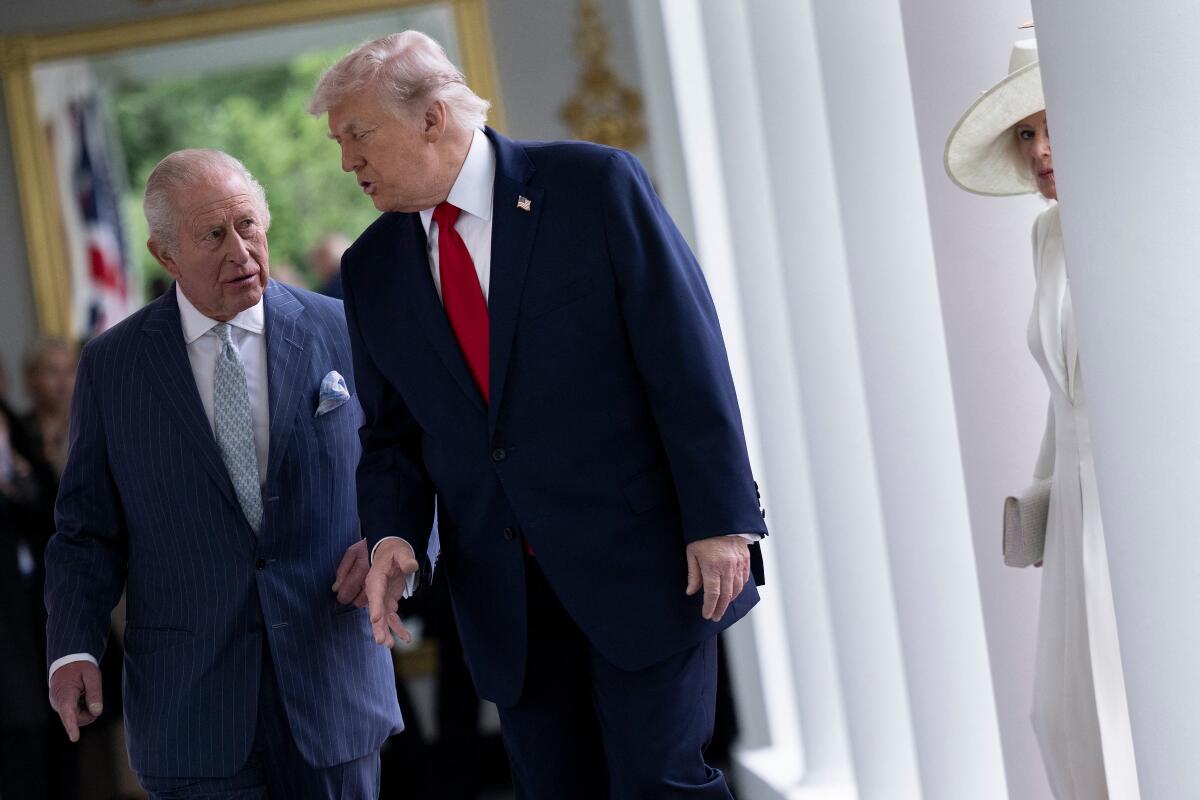
King Charles navigated this constraint with deliberate precision. He framed the UK-U.S. alliance as “more important today than it has ever been” — and in a moment that was remarkable for its constitutional boldness, he explicitly quoted Prime Minister Starmer on the congressional floor, calling the partnership “indispensable” and warning that it …must not disregard everything that has sustained us for the last eighty years.”
Quoting a sitting prime minister in an address to a foreign legislature is not an accident. It is as close as a constitutionally bound monarch can come to delivering his government’s political message directly. Charles did not say that Trump was wrong to sideline Britain on Iran. He said the alliance that predates both of them must not be abandoned. The distinction is technical, and the meaning is clear.
He praised NATO — the organization Trump has repeatedly criticized for not joining the Iran war — and urged the United States to continue defending Ukraine against Russia. Neither position is controversial within NATO or among America’s traditional allies. Both are in direct tension with the current direction of U.S. foreign policy. Charles said them anyway, from the House chamber, to a joint session of Congress, with the cameras running.
And in perhaps the speech’s most strategically constructed moment, Charles quoted Trump’s own words back at him — citing the president’s previous declaration that “the bond of kinship and identity between America and the United Kingdom is priceless and eternal. It is irreplaceable and unbreakable.”
The effect was to hold the president’s stated position up against his government’s recent conduct and invite Congress — and the watching world — to note the distance between them.
The Falklands Dimension
The diplomatic tension between Washington and London extends beyond Iran — and nowhere is it more directly relevant to Latin America than in the South Atlantic.
Sociedad Media reported this week that a Pentagon memo prepared by Elbridge Colby — the Pentagon’s top policy adviser — outlined options for punishing NATO allies that refused to support the Iran war. Among those options: reassessing U.S. diplomatic support for British sovereignty over the Falkland Islands.
The memo was not a formal policy declaration. It was, however, a signal — the first time in four decades that Washington has placed the Falklands question on the table as a diplomatic instrument.
The timing of King Charles’s Congressional address is not incidental to that signal. He delivered his speech on the same day that the USS Nimitz and USS Gridley were conducting a naval PASSEX exercise in Argentina's Exclusive Economic Zone — waters adjacent to the Falkland Islands — as part of Operation Daga Atlántica, the joint U.S.-Argentina military exercises authorized this month by President Milei through an emergency decree that bypassed congressional approval.
The juxtaposition is striking. A British monarch is addressing Congress with a plea for alliance solidarity, while American warships are conducting exercises with the Argentine navy in waters that Argentina claims as its own, near islands whose sovereignty Washington has just floated reconsidering.
The “special relationship” and the Donroe Doctrine are, in this specific week, pulling in directly opposite directions.
Queen Elizabeth II’s 1991 address to Congress was delivered after the Gulf War, when the U.S. and UK had seen eye-to-eye on every major decision. “Our views were identical, and so were our responses,” she told the House Chamber. That alignment produced the kind of speech that required no careful threading of diplomatic needles. Americas Quarterly Charles’s speech required nothing but.
What the Speech Could and Could Not Do
State visits are not policy negotiations. They are, at their best, investments in the relational capital that makes policy negotiations possible — reminders that the institutional foundations of an alliance are deeper and more durable than the disagreements of any particular moment.
Constitutional expert Craig Prescott noted ahead of the speech that Charles has shown willingness in other settings to confront difficult moments in shared history directly — as he did during his 2023 visit to Germany. The question was always how much of that directness would survive the constraints of addressing an American Congress while a sitting U.S. president watched from the White House.
The answer, on Tuesday, was: enough to be noticed, not enough to provoke.
Charles said what needed to be said about NATO, Ukraine, and the indispensability of the alliance. He said it in language that was unambiguous to anyone paying attention, and he did not say anything that could be construed as a direct challenge to Trump or as British government policy delivered through a constitutional backdoor — even as he came as close to that line as the monarchy’s conventions permit.
Whether it worked — whether a monarch’s speech to Congress can genuinely stabilize a relationship that has been strained by the Iran conflict, water access to the Strait of Hormuz, and a Pentagon memo about the Falklands — is a question that will be answered not in Washington this week but in the bilateral decisions that follow in the months ahead.
The USS Nimitz is still in Argentine waters. The Colby memo has not been rescinded. The Iran war continues without British participation. And the special relationship, for all the standing ovations it received on Tuesday afternoon, remains under the most significant strain it has faced in a generation.
Sociedad Media is monitoring the U.S.-UK relationship, the Falklands sovereignty dispute, and U.S.-Latin America relations. For tips and reporting, contact info@sociedadmedia.com


