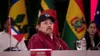


CARACAS — A second round of political dialogue between Venezuela’s government and an opposition faction is now underway, and Interior Minister Diosdado Cabello used a Monday press conference to declare its opening session a success — while accusing opposition sectors who declined to participate of actively trying to sabotage the process.
Friction
Speaking at a weekly press conference of the ruling United Socialist Party of Venezuela (PSUV), where he serves as secretary general, Cabello said the first meeting of this new dialogue round concluded with “the expected results.” He detailed that several working groups had been formed during the session, after which proposals were presented from each side.
According to Cabello, the discussions centered on two priority issues: attention to victims of Venezuela’s June 24 earthquakes, and recovery of Venezuelan gold reserves held abroad — a reference to the country’s long-running dispute over frozen international assets, including reserves held at the Bank of England that the government has previously and unsuccessfully attempted to recover.
Cabello confirmed that delegations from the 2015-elected National Assembly — the opposition-aligned body led by Dinorah Figuera — and Venezuela’s current, Chavista-controlled parliament agreed to form joint working commissions to address the issues raised during the talks, extending the institutional framework established during the first dialogue cycle, which concluded August 12.
A Pointed Accusation
Cabello reserved his sharpest language for opposition figures who did not take part in the negotiations. He said these sectors “want to implode” (“quieren implosionar”) the recently initiated talks, and dismissed their criticism, saying that political actors left out of the discussions are “andan chillando” — a colloquial phrase meaning they’re “running around whining” — after finding themselves excluded from the process.
Despite the criticism, Cabello reaffirmed that the government intends to keep its channels of dialogue open regardless.
He separately called on opposition negotiators to honor whatever commitments emerge from the table, framing the government's own approach in terms of reliability:
“We will go to dialogue with the commitment to keep our word, hopefully the opposition does the same,” he said, adding that the government’s delegation would maintain “a coherent policy” and that whatever proposals it makes at the table, it intends to follow through on.
Invoking Chávez
To illustrate what he described as the government’s enduring “vocation for peace,” Cabello invoked the response of the late President Hugo Chávez to the April 2002 coup attempt against him — recalling the moment Chávez displayed a crucifix and called for calm and dialogue with those who had just attempted to remove him from power.
The comparison positions the current talks, in Cabello’s framing, as a continuation of a longstanding Chavista tradition of extending dialogue even to political adversaries.
What Chavismo Actually Wants
Cabello’s comments this week build on remarks he made in late July, just before the first dialogue round began, when he confirmed that the government’s unified negotiating position — represented at the table under Jorge Rodríguez’s leadership — centers on a single core demand: the lifting of international sanctions imposed on the government and its senior officials.
That framing suggests sanctions relief, rather than any specific democratic or electoral concession, remains Chavismo’s primary objective throughout this negotiating process.
The Unchanged Absence
As with the first dialogue cycle, this second round continues without the participation of Venezuela’s most internationally prominent opposition figures: Nobel Peace Prize laureate María Corina Machado and President-elect Edmundo González Urrutia, both of whom have said they will not obstruct the talks but have declined to join a process they say was designed without their input.
Cabello’s “implode” accusation appears directed, at least in part, at figures aligned with that position, though he did not name specific individuals in his remarks.
What To Come
Neither Cabello nor the opposition delegation announced a specific date for the next formal session, though the newly formed joint working commissions are expected to continue developing proposals on earthquake assistance and asset recovery in the interim.
With the first cycle having produced commitments on judicial renewal and frozen-asset recovery but no electoral timeline, this second round’s ultimate test will likely be whether its stated priorities — earthquake relief and recovered gold reserves — translate into the kind of concrete, implemented outcomes that remained largely aspirational after the first cycle concluded.