


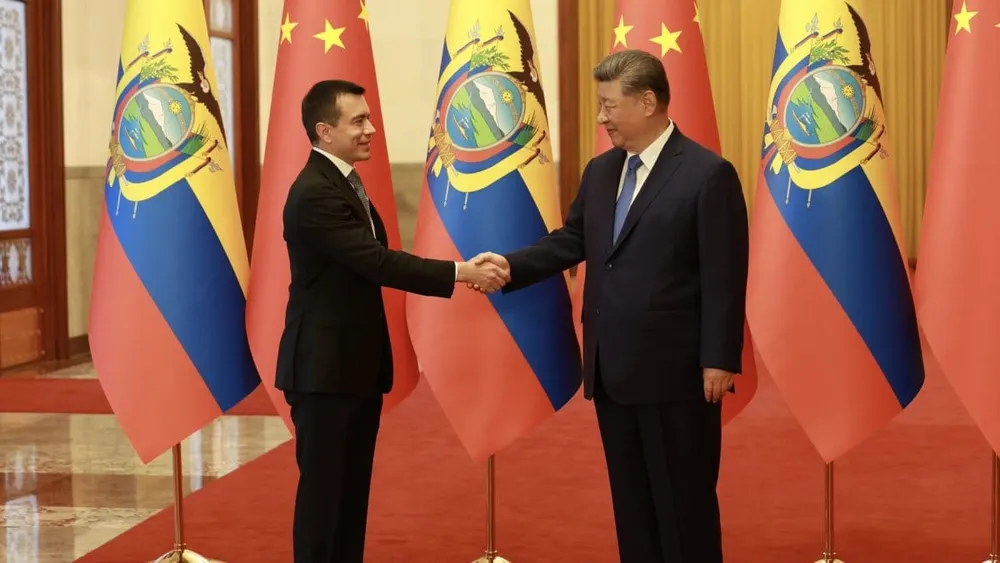
Ecuadorian President Daniel Noboa met with Chinese President Xi Jinping in Beijing on Tuesday, August 18, in his first state visit to China — a trip aimed at deepening trade and investment ties with Beijing even as Noboa has spent much of this year building an increasingly close security partnership with Washington.
Xi received Noboa with an official welcome ceremony at the Great Hall of the People, held in the complex’s North Hall, the customary venue for receiving foreign heads of state, according to Chinese state broadcaster CCTV.
The ceremony was followed by a bilateral meeting between the two presidents focused on strengthening economic cooperation, and by a signing of bilateral cooperation instruments in the presence of both leaders.
Noboa arrived in Beijing on Sunday, August 16, and is scheduled to remain in China until August 23, before continuing on to Singapore and Vietnam as part of a broader Asia tour running through August 28. This marks Noboa’s first state visit to China, though not his first trip there — he visited Beijing in June 2025 and met with Chinese officials and business leaders at that time as well.
What’s on the Agenda
According to Ecuador’s Foreign Ministry, the visit is centered on trade, investment, cooperation, infrastructure, energy, technology, and sustainable development.
Several concrete, long-running bilateral issues sit at the center of the talks. Ecuadorian shrimp exports to China are a significant point of discussion: Beijing recently restored export authorization to eight Ecuadorian shrimp exporters that had been suspended between October 2025 and January 2026, though six other facilities remain affected by ongoing restrictions.
Ecuador is also seeking progress on its outstanding debt to China’s Eximbank, along with unresolved matters tied to the Coca Codo Sinclair hydroelectric plant — Ecuador’s largest by installed capacity, built by Chinese state contractor Sinohydro and formally handed over to the Ecuadorian government in April 2026 after years of construction and operational disputes.
Ecuador’s government said its broader goal for the visit is to “consolidate” a strategic relationship that advances priority initiatives across each of those sectors.
China’s government, for its part, has said it hopes the visit “further consolidates” trust between the two countries. Separate meetings with Chinese Premier Li Qiang and National People’s Congress Standing Committee Chairman Zhao Leji are also planned during Noboa’s stay.
The Backdrop: A Long-Standing Trade Relationship
Ecuador and China have maintained a free trade agreement since 2023, and Ecuador joined China’s Belt and Road Initiative in 2018.
During Noboa’s June 2025 visit, the two governments signed a cooperation plan tied specifically to that Belt and Road framework.
China has become one of Ecuador’s most significant sources of infrastructure financing and investment over the past decade, with the Coca Codo Sinclair project standing as the most visible — and most contested — symbol of that relationship, given the technical problems and debt obligations it has generated for Ecuador’s government since coming online.
Why the Timing Matters
Noboa’s China visit lands at a notable moment in Ecuador’s broader foreign policy trajectory. Over the past several months, Ecuador has emerged as one of the most active participants in Washington’s regional security architecture, deploying a specialized 47-member search-and-rescue team to support Colombia’s earthquake response, and standing among the founding members of the U.S.-led “Shield of the Americas“ anti-cartel coalition. That deepening security alignment with Washington runs on a parallel, and in some respects competing, track from Ecuador’s continued economic relationship with Beijing — a balancing act increasingly common among Latin American governments navigating both U.S. security partnerships and Chinese trade and infrastructure investment simultaneously.
With bilateral instruments already signed and additional meetings with senior Chinese officials still ahead this week, Noboa’s stay in Beijing is expected to produce further detail on specific trade and investment commitments before he departs for Singapore on August 23.
His broader Asia tour continues through August 28, after which attention will likely turn to how the agreements reached in Beijing interact with Ecuador’s simultaneous and deepening security commitments to the United States — two relationships Noboa’s government has so far pursued without treating them as mutually exclusive.