

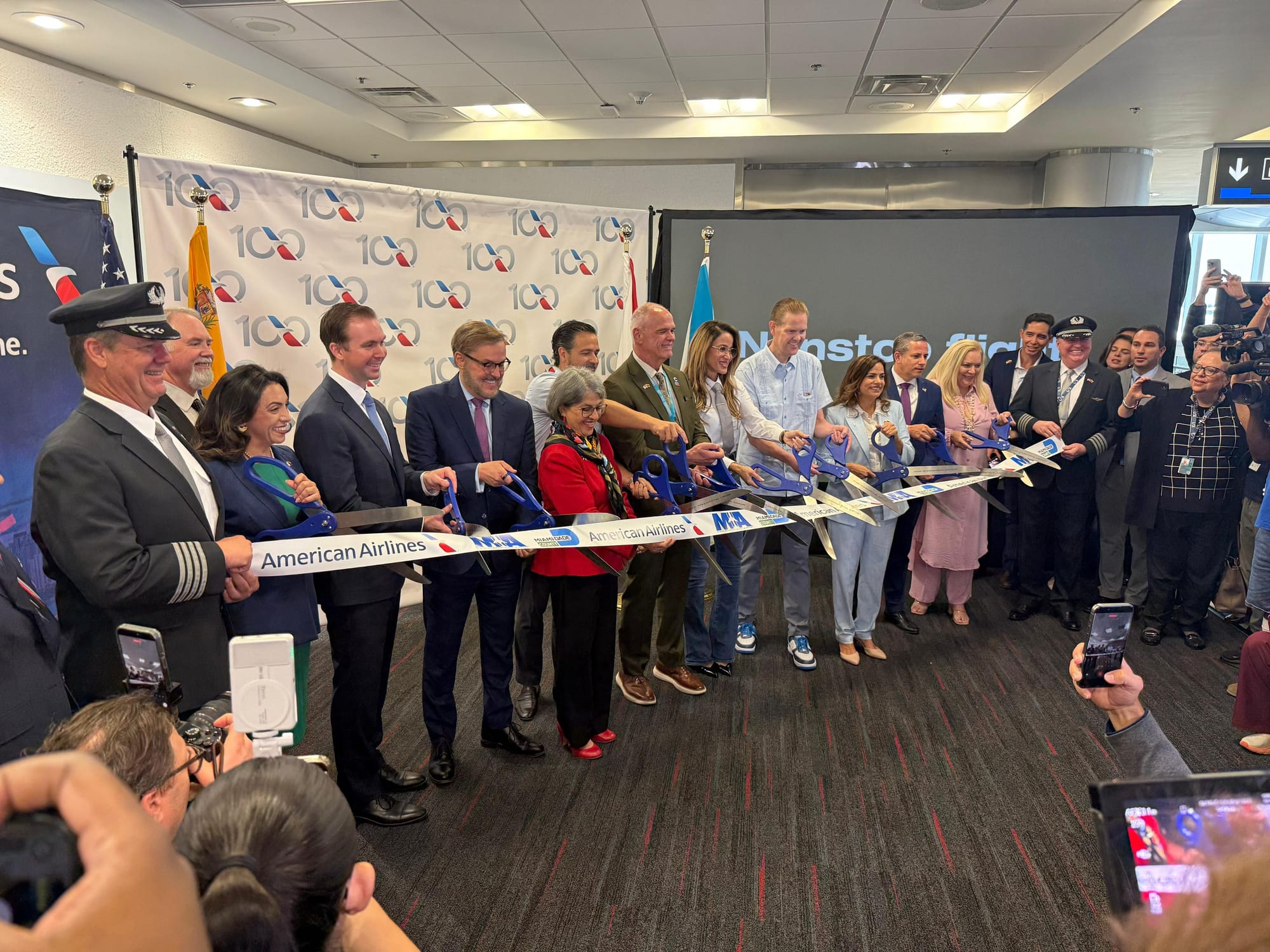
MIAMI — Thursday morning, American Airlines Flight 3599 departed Miami International Airport and arrived at Simón Bolívar International Airport about 16 miles west of Caracas — the first nonstop commercial flight between the United States and Venezuela in nearly seven years. At the boarding gate, music was blaring, balloons in the colors of the Venezuelan flag lined the walls, and arepas — Venezuela’s national dish — were being served free of charge. The pilots waved Venezuelan and American flags before departure.
Trump administration officials attended a ribbon-cutting ceremony at the Miami International Airport gate. Passengers on the first flight were served coffee and arepas in the air.
At Simón Bolívar International Airport in Caracas, a saxophonist played the theme from “New York, New York" as the plane arrived.
For Miami’s Venezuelan community — the largest concentration of Venezuelans per capita in the United States — the departure of Flight 3599 was not just a scheduling change. It was the first tangible, daily proof that the world their families inhabit has changed.
Seven Years of Workarounds
The suspension of direct U.S.-Venezuela commercial flights in 2019 did not stop Venezuelans from traveling between Miami and Caracas. But it made the journey exhausting, expensive, and uncertain.
What was once a three-hour nonstop flight became a complex multi-leg journey — often exceeding ten hours through connecting airports in Bogotá, Panama City, Lima, or Santo Domingo. The indirect routes cost more, took longer, and added logistical complexity that fell hardest on working-class Venezuelan families who could not afford business-class connections or last-minute itinerary changes when political developments disrupted travel plans.
American Airlines had operated in Venezuela from 1987 until March 2019, when it suspended service over safety concerns after the U.S. Department of State issued warnings about crime and the detention of American citizens. It was the last major U.S. carrier to fly to Venezuela.
The consequences of the suspension extended beyond individual travel. Business relationships that required face-to-face presence atrophied. Medical travel — Venezuelans coming to Miami for procedures unavailable on the mainland — became more difficult and more costly. Families separated by immigration status or economics lost the routine connection that a direct flight enables.
Ricardo Mariani, who was traveling on the afternoon American Airlines return flight from Caracas to Miami to attend his daughter's graduation in Florida and to get his vision checked, described what the new service means: “It is a big opportunity for the country, for all of us. Before it could take an entire day flying from layover to layover.”
How the Flight Became Possible
The resumption of commercial service is the most visible civilian expression of the normalization process that began on January 3 — the day U.S. forces captured Nicolás Maduro in Caracas.
The diplomatic breakthrough for commercial aviation came on January 29, when Trump announced after a phone conversation with acting President Delcy Rodríguez that U.S. commercial airspace over Venezuela would be reopened. American Airlines announced its intent to resume flights the same day Trump instructed the Department of Transportation to take steps to reestablish air service to Venezuela.
The U.S. formally rescinded its 2019 flight ban two weeks ago after the Department of Homeland Security determined that “conditions in Venezuela no longer threaten the safety and security of passengers, aircraft, and crew.” The U.S. also formally resumed operations at its embassy in Caracas in late March.
The U.S. Department of Transportation approved the reinstatement of services after reviewing safety and operational readiness. Aviation security assessments conducted by the Transportation Security Administration confirmed that Caracas airport facilities met required standards.
The route is operated by Envoy Air — a wholly owned American Airlines subsidiary — using an Embraer 175 dual-class aircraft with 76 seats. Flight AA3599 departed Miami shortly after 10:00 a.m. and arrived in Caracas around 1:30 a.m. The return flight AA4194 departs Caracas at 2:40 p.m. and arrives in Miami at 6:13 p.m. A second daily flight is expected to begin on May 21.
American Airlines Chief Commercial Officer Nat Pieper said: “American’s Miami hub is the preeminent U.S. gateway to Latin America, and our service to Venezuela is a key part of our history and our future.”
What it Means for Miami — and for the Transition
For Miami’s Venezuelan community — concentrated in Doral, where nearly 80% of residents are of Hispanic origin, and the highest concentration of Venezuelans per capita in the United States lives — Thursday’s departure carries weight that no ribbon-cutting ceremony fully captures.
Liz Rebecca Alarcón, a Venezuelan-American entrepreneur in the Miami area who founded the media outlet Project Pulso, welcomed the resumption: “Anything that brings the diaspora closer to people in Venezuela is positive news. I hope American’s flights are fairly priced and that these changes are part of the transition to democracy we all want.”
That last sentence carries the tension embedded in the celebration. The flight’s resumption is a diplomatic normalization signal — a concrete, daily expression of the post-Maduro framework that Washington has been constructing with the Rodríguez government since January. But normalization and democratic transition are not the same thing.
The U.S. outlined to Venezuela a three-phase plan in January to guarantee stabilization, recovery, and a democratic transition. Venezuela’s acting government has shown little sign that it will give up power or call for new elections. “The elections will be held whenever they are, and on that day the revolutionary forces will be prepared to win as we have always won,” Interior Minister Diosdado Cabello said earlier this month.
Cabello — who was in the room when Petro and Rodríguez met at Miraflores last week, who is named as a co-defendant in Maduro’s New York narco-terrorism indictment, and who has been one of the most consistent obstacles to any genuine power transfer within the Chavista system — is still Venezuela’s Interior Minister. His presence in the government that Washington is now connecting to Miami by daily nonstop flights is the unresolved contradiction at the heart of the normalization process.
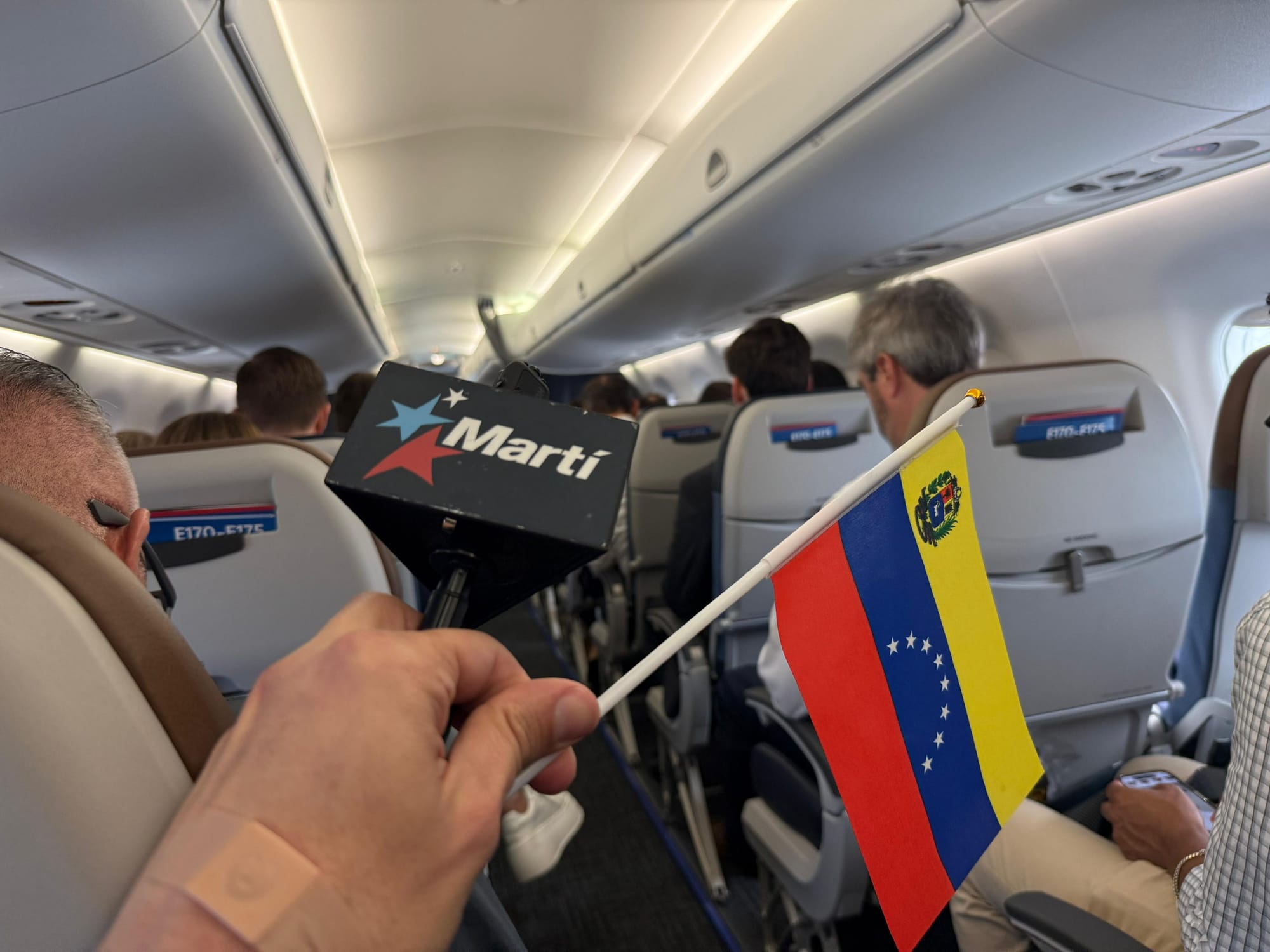
Around two-thirds of the seats on the first flight were taken due to weight restrictions, and were largely filled with journalists and officials. The commercial demand — the real measure of whether the route is sustainable — will be visible in the weeks ahead, as ordinary passengers rather than officials and press begin filling the seats.
What Comes Next
Industry experts suggest that additional routes and increased frequencies could follow if demand remains strong and regulatory conditions continue to improve.
Airlines may also explore connections to other Venezuelan cities, further strengthening regional connectivity. The long-term sustainability of these operations will depend on political stability, security conditions, and ongoing cooperation between aviation authorities.
Round-trip tickets departing Miami in early May and returning at the end of the month are currently priced at more than $1,000 — a fare level that reflects both the route’s novelty and the pent-up demand from a diaspora that has been waiting seven years for this flight. Whether that demand sustains at prices accessible to working-class Venezuelan families — rather than officials, journalists, and business travelers — will determine whether the Miami-Caracas route becomes the daily connection the diaspora needs or a diplomatic symbol with empty seats.
For now, Flight 3599 flew across the Caribbean. The saxophonist played Sinatra in Caracas. The arepas were served over Caribbean waters. And for a few hours on a Thursday morning in late April 2026, the Florida Straits felt a little narrower than they had been in seven years.
Sociedad Media is published from Miami and covers Venezuela and U.S.-Latin America relations in English. For tips and reporting, contact info@sociedadmedia.com


