

MEXICO CITY — On February 17, 2026, members of the Mexican Army’s special anti-drone battalion gathered at Military Camp Number 1 in Naucalpan, State of Mexico, for a demonstration for the press. They were not preparing for a conventional military threat. They were preparing for the 2026 FIFA World Cup — and for the possibility that the same criminal organizations that have been deploying explosive-laden drones against soldiers, police stations, and rival cartel compounds across Mexico might attempt to deploy them near one of the most watched sporting events in human history.
The demonstration took place six days after a more alarming event: on February 11, the FAA abruptly ordered a ground stop at El Paso International Airport, initially for up to 10 days, after the U.S. military tested an anti-drone laser weapon in response to suspected Mexican cartel drones crossing into U.S. airspace. The restriction was lifted within hours — but not before disrupting commercial flights, drawing national media attention, and raising a question that the U.S. and Mexican governments have been circling for years: what happens when cartel drone capability crosses a threshold that existing legal and operational frameworks cannot contain?
The Numbers
Between 2021 and 2025, U.S. Homeland Security’s NCITE (National Counterterrorism Innovation, Technology, and Education Center) assessed 221 weaponized drone incidents in Mexico attributed to cartels or other criminal groups — 27 of those attacks resulted in fatalities, with a total of 77 killed.
Weaponized drone attacks have been geographically concentrated in central Mexico — especially Michoacán and Guerrero — but have become more dispersed in recent years, including into northern border regions with the United States.
That figure — 221 confirmed incidents over four years — almost certainly understates the actual volume. Mexican officials have publicly acknowledged that cartels have used explosive-laden drones to attack police, soldiers, and enemy cartel personnel. In Michoacán, residents in some areas describe drone attacks as a near-daily occurrence. The official count captures only those incidents that are reported, investigated, and attributed — a fraction of what is happening on the ground in territories where criminal organizations exercise de facto governance.
The most recent escalation is concentrated in Guerrero. Between 800 and 1,000 families have been forced to flee their homes in the mountains of central Mexico as a criminal organization known as Los Ardillos attack communities with handmade explosives launched from drones and powerful weapons.
The displacement began in mid-May and continues.
Guerrero — one of Mexico’s most chronically violent states — is now experiencing a drone-enabled civilian displacement campaign that resembles, in its tactical logic, the drone warfare being conducted in active conflict zones elsewhere in the world.
How the Capability Developed
The trajectory of cartel drone warfare follows a pattern that security analysts have been tracking since 2020, when explosive-laden drones appeared in Mexico for the first time.
In October 2025, the CJNG flew an off-the-shelf drone loaded with a primitive explosive device — known in Mexico as a potato bomb — into a heavily-protected compound of the state prosecutor’s office in Tijuana. Although no one was killed, the cartel demonstrated that it could penetrate high-defense areas and render vulnerable facilities previously believed to be highly protected.
The technical sophistication is growing. A July 2025 report by Defense News said Ukrainian counterintelligence was investigating suspected infiltration of Ukraine’s International Legion by Latin American operatives with alleged cartel ties who wanted first-person-view, or FPV, drone training.
The investigation began after Mexico’s National Intelligence Center warned that some Mexican volunteers had joined foreign fighter units specifically to learn FPV drone tactics.
FPV drones — the first-person-view platforms that have defined drone warfare in Ukraine — are significantly more capable than the off-the-shelf quadcopters that Mexican cartels used in their first generation of attacks. They are faster, more maneuverable, harder to detect, and capable of precision targeting at ranges and speeds that simple commercial drones cannot match. If cartel operatives have successfully transferred FPV tactics from the Ukrainian battlefield to Mexican criminal operations, the drone threat in Mexico has moved to a qualitatively different level.
Precision targeting is still a real challenge for criminal groups, but also unnecessary. The decreasing costs of off-the-shelf drones allow explosive-laden drones to simply crash into the target and explode on impact. Not having to return to the pilot also reduces the intelligence footprint of the kamikaze drone, and thus the ability to track the network behind it.
The U.S. Border Issue
The cartel drone threat has moved across the border in ways that U.S. law enforcement is only beginning to develop legal and operational frameworks to address.
In the second half of 2024, CBP seized more than 1,200 pounds of methamphetamine and other narcotics being transported by drone from Mexico, according to congressional testimony. In October 2023, CBP seized a drone carrying 3.6 pounds of fentanyl pills — enough to kill tens of thousands of people.
The International Narcotics Control Board reported that traffickers have shifted to custom-made drones capable of transporting up to 100 kilograms, or 220 pounds.
The legal response has been slow to keep pace. The SAFER SKIES Act, part of the 2026 National Defense Authorization Act signed into law in December, eases restrictions on disabling or destroying drones. Under previous law, only federal law enforcement was allowed to do so. But the El Paso incident demonstrated the limits even of the new framework: the challenge of securing the border from drones is the fact that there is so much civilian presence.
There is real potential for a miscalculation that creates an international incident.
The World Cup Problem
Mexico opens the 2026 World Cup on June 11 — 15 days away — at the Estadio Azteca in Mexico City. The tournament will also be played in Guadalajara and Monterrey, cities in states where cartel drone activity is well documented.
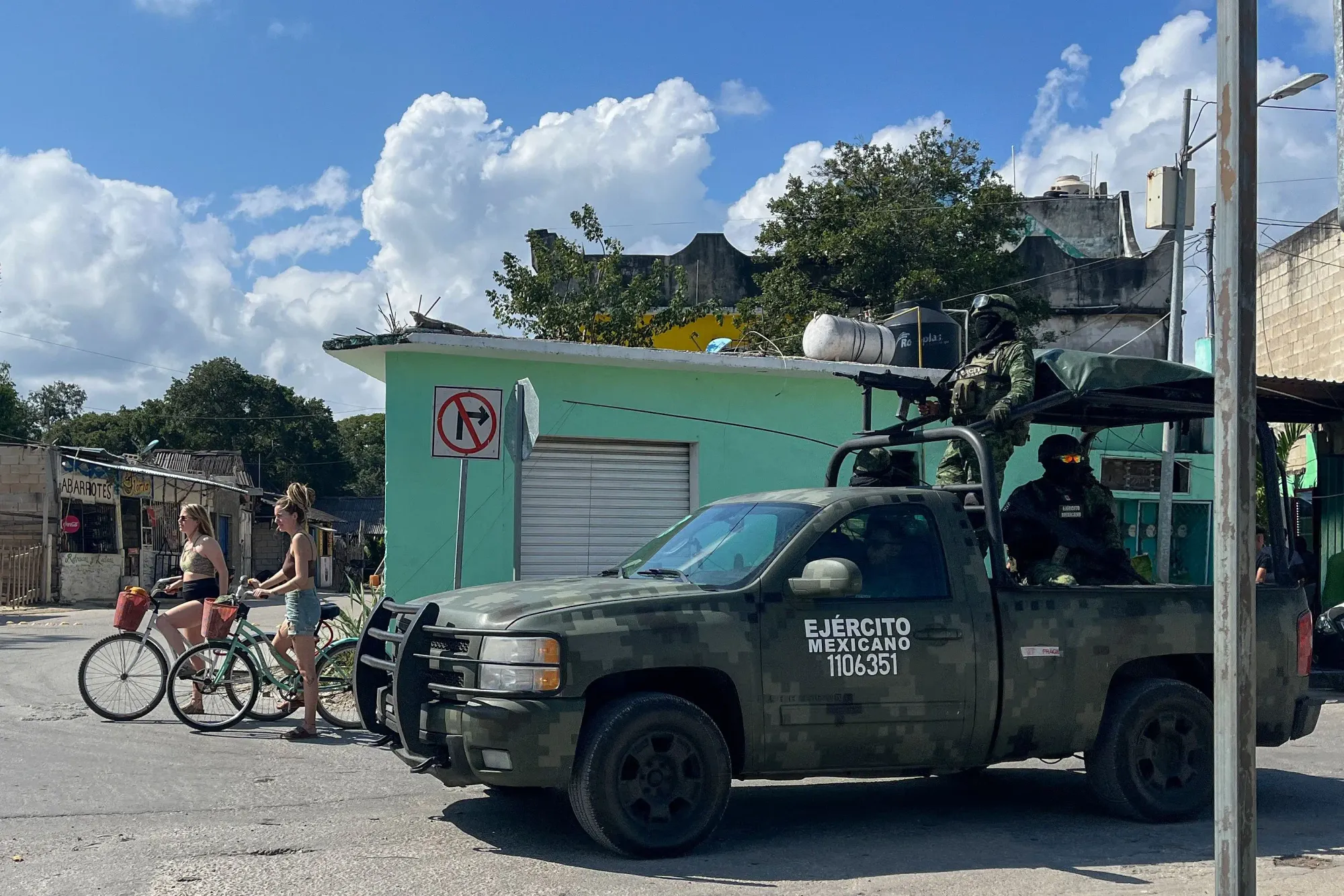
The Mexican Army’s anti-drone battalion exists precisely because the government recognizes that the World Cup creates a target environment that criminal organizations might seek to exploit — whether for extortion, territorial signaling, or the global attention that an incident at a World Cup match would generate.
The battalion’s February demonstration was a deliberate signal — to the public, to FIFA, to visiting delegations, and to the cartels themselves — that the state is prepared. Whether preparation is sufficient depends on variables that no demonstration can resolve: the operational reach of criminal organizations in the host cities, the intelligence available to counter-drone units, and whether groups that have spent five years developing drone warfare capability will conclude that the World Cup represents an opportunity or a red line they prefer not to cross.
FIFA has not commented publicly on Mexico’s drone security challenges. The Mexican government has not acknowledged that cartel drones pose a specific threat to World Cup infrastructure. Both silences are understandable. Neither changes what the numbers show.
Sociedad Media will continue to cover security developments in Mexico and the 2026 FIFA World Cup. Tips, sources, and feedback welcome at info@sociedadmedia.com


