

ASUNCIÓN — Long before the Trump administration designated Brazil’s Primeiro Comando da Capital and Comando Vermelho as foreign terrorist organizations on June 5, Paraguay had already done it.
In October 2025 — eight months ahead of Washington — Paraguay’s National Defense Council formally classified the PCC and CV as terrorist organizations, giving the state legal authority to deploy military intelligence and specialized assets against the groups, impose more aggressive sentencing, expedite extraditions, and freeze illicit assets.
The designation was not symbolic. It was the formal foundation of a security transformation that has turned a small, landlocked nation into one of Washington’s most aggressive counter-organized crime partners in South America.
What is now unfolding along the Brazil-Paraguay border is one of the most significant militarized security campaigns in the region — and it is accelerating.
The Strategy
Paraguay occupies a singular position in South America’s criminal geography. According to the Global Initiative Against Transnational Organized Crime’s 2023 Global Organized Crime Index, Paraguay ranks among the top countries globally for organized criminal activity, placing fourth out of 193 UN member states. Its criminality score surged from 6.70 in 2021 to 7.52 in 2023 — one of the largest increases worldwide — and was 4.74 times higher than the Western Hemisphere average.
The country is the region’s largest producer of marijuana and the hemisphere’s largest trafficker of illegal cigarettes — a distinction that reflects the depth of criminal network penetration into Paraguay’s economy and institutions. Former alliances between Paraguay’s domestic criminal organizations and Brazilian groups like the PCC and CV have shifted to rivalry, intensifying competition for control of illicit markets and driving a surge in violence that has compelled the government to escalate its response.
Ciudad del Este — the border city at the junction of Paraguay, Brazil, and Argentina — remains the operational hub of this criminal ecosystem. The Tri-Border Area is one of the most surveilled and contested criminal corridors in the hemisphere, a zone where drug trafficking, weapons smuggling, money laundering, and counterfeit goods trade converge across three national jurisdictions simultaneously.
The U.S.-Paraguay Security Architecture
The Paraguayan government has taken decisive steps to solidify its alliance with the United States, intensifying its offensive against organized crime through high-level diplomatic and military integration with Washington.
As 2025 drew to a close, the two nations formalized their security partnership with the signing of a modern Status of Forces Agreement — signed in Washington by Paraguayan Foreign Minister Rubén Ramírez and U.S. Secretary of State Marco Rubio — aimed at more efficiently facilitating joint efforts against narcotrafficking and regional transnational crime.
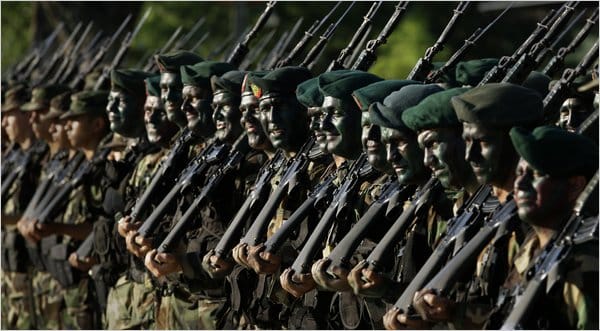
The SOFA was not the only instrument. The Paraguayan Senate authorized the entry of U.S. military personnel with weapons and equipment, and confirmed the transfer of 150 armored vehicles from the United States to Paraguay — a significant hardware commitment that reflects the depth of the bilateral security relationship.
Paraguay is also slated to host Fuerzas Comando in August 2026 — the prestigious Special Operations competition sponsored by U.S. Southern Command that brings together elite teams from across the Americas — underscoring Paraguay’s growing prominence as a hub for regional security cooperation.
The PCC Designation & Its Consequences
Paraguay’s designation of the PCC and CV as terrorist organizations in October 2025 was designed to allow for more aggressive sentencing, expedited extradition, and the freezing of illicit assets. The urgency of this measure was almost immediately validated by a surge of violence in Brazil sparked by the largest police operations in Rio de Janeiro against these organizations.
The Trump administration’s parallel designation of PCC and CV as foreign terrorist organizations on June 5, 2026 — eight months after Paraguay moved — now creates a joint legal framework between the two countries for pursuing PCC and CV assets, networks, and personnel.
For Paraguay, which shares a 1,290-kilometer border with Brazil and whose Tri-Border Area has historically served as a PCC financial and logistics corridor, the synchronized designations represent a significant escalation in the legal architecture available to prosecutors and military commanders on both sides.
Ground Operations
The military campaign along the Brazil-Paraguay border has been intensifying for over two years. The armed forces of Brazil and Paraguay joined forces in Operation Basalto and Operation Agate — deploying 1,950 Paraguayan troops and more than 2,000 Brazilian service members along their shared border — seizing more than six tons of marijuana, confiscating weapons, and destroying 33 narco camps.
Paraguayan Defense Minister Óscar González said that in the first phase of Basalto alone, military and police seized nearly $19 million from narcotrafficking organizations, along with more than 100 firearms and 103,000 rounds of ammunition.
The operations covered the Paraguayan departments of Alto Paraná and Canindeyú — the precise corridor where PCC territorial presence is most concentrated — and the Brazilian states of Paraná, Mato Grosso, and Mato Grosso do Sul directly across the border.
Paraguay also designated Hamas, Hezballah, and Iran’s Islamic Revolutionary Guard Corps as terrorist organizations in April 2025 — becoming the first Latin American country to designate the IRGC — a series of moves that reflects the Santiago Peña government's deliberate alignment with Washington’s broader security and foreign policy agenda.
The Limits of Militarization
The escalation is not without its complications. Corruption facilitates criminal organizations’ access to automatic weapons and impedes law enforcement efforts across Paraguay — a structural vulnerability that military deployments alone cannot resolve. The PCC’s financial networks are deeply embedded in Paraguay’s legitimate economy, particularly in the Tri-Border Area’s import-export trade, and the institutional capacity to pursue financial crimes has historically lagged behind the military capacity to conduct border operations.
There is also the question of the EPP — the Paraguayan People’s Army — which remains active in the departments of Concepción, San Pedro, and Amambay, conducting attacks against remote police and army posts, ranchers, and peasants accused of collaborating with security services, while carrying out extortions and kidnappings that maintain local influence despite sustained government crackdowns.
Paraguay’s security forces are fighting on multiple fronts simultaneously.
What is not in doubt is the direction of travel. Paraguay under President Santiago Peña has made a deliberate strategic choice — deeper U.S. alignment, aggressive terrorist designations, military hardware, and joint operations — that positions the country as the southern anchor of Washington’s regional counter-organized crime architecture, at precisely the moment when the PCC and CV have been formally incorporated into that architecture's target list.
Have a tip or story lead? Contact us at info@sociedadmedia.com
Sociedad Media covers security and organized crime across Latin America as part of its core editorial mission. Our reporting on criminal organizations, state responses, and the human cost of violence follows strict journalistic standards and does not reflect the editorial positions of any government or security agency.


