

CATATUMBO, NORTE DE SANTANDER — Armed men loyal to FARC dissidents planted a flag this week on a rural highway outside Tibú, a small but pointed act of territorial assertion in one of Colombia’s most exhausted conflict zones. It capped several days of renewed fighting between the dissidents and the ELN that has once again confined residents to their homes, damaged water infrastructure, and forced the cancellation of independence-day cultural events in a region that has now endured 18 months of near-continuous war.
Renewed Violence
Since July 18, fighting has intensified between the ELN and dissidents of the FARC’s 33rd Front in the rural districts of Tres Bocas and Campo Dos, part of the municipality of Tibú in Norte de Santander. The clashes stretched over several days and directly affected the civilian population: public transportation stopped operating, commercial activity in Campo Dos was suspended entirely, and residents reported homes damaged by gunfire.
According to local accounts, at least four ELN fighters were killed, though authorities have not confirmed an official casualty count or issued a public statement on the fighting.
The confrontation forced the cancellation of cultural events planned for July 20, the holiday marking Colombia’s 216th anniversary of independence.
Days later, armed men were seen installing a FARC-dissident flag at Kilometer 25 of the rural highway outside Tibú — a symbolic marker of territorial control that local authorities have not addressed publicly, but that fits a now-familiar pattern in a region where such displays have become routine punctuation to ongoing combat.
A War Now Entering Its Second Year
The current fighting is only the latest chapter in a conflict that began January 15, 2025, when the ELN’s Northeastern War Front launched a coordinated offensive against the 33rd Front after blaming the dissidents for the murder of a family — including a nine-month-old infant — on the highway between Tibú and Cúcuta.
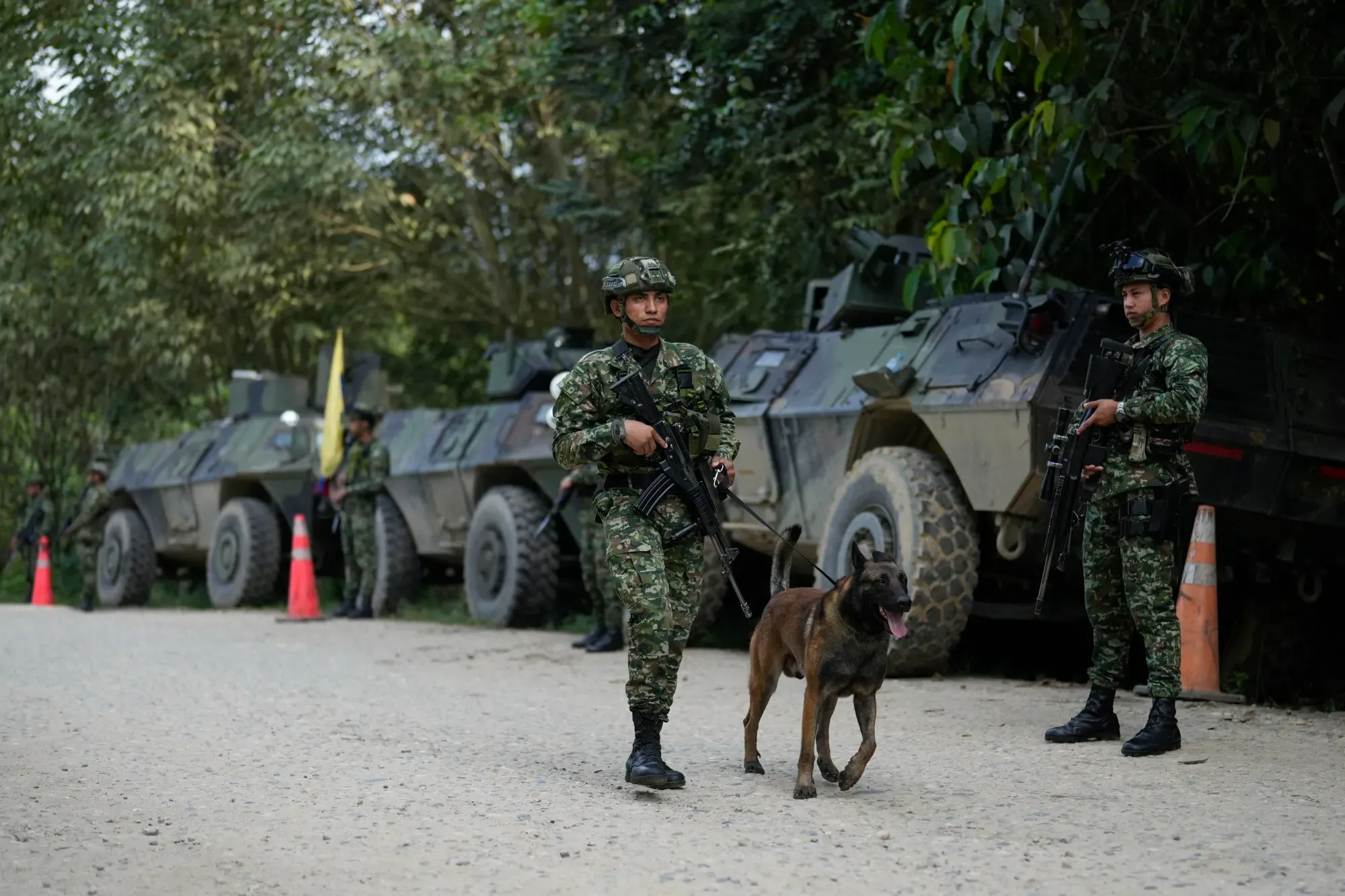
Colombia’s Human Rights Ombudsman’s Office (Defensoría del Pueblo) had already warned as early as November 2024 that armed groups were escalating tensions in the region, and issued a formal early-warning alert in October 2025 specifically flagging the risk to Tibú’s population; Colombia’s Constitutional Court later ordered national and local authorities to report on their response to that warning.
The toll one year in was severe: by mid-January 2026, the region had recorded 166 homicides and more than 138,000 people internally displaced from Catatumbo’s rural municipalities into urban centers including Ocaña, Tibú itself, and Cúcuta — one of the largest and fastest mass-displacement events in Colombia in decades.
Researchers at the Fundación Ideas para la Paz have pointed to three drivers sustaining the conflict: the 33rd Front’s ability to reinforce itself with fighters from other dissident factions despite repeated military pressure, a slow and largely ineffective government response that has left communities without real protection, and the deepening instability in neighboring Venezuela, where the ELN has expanded its presence along the border — a dynamic FIP notes predates even the U.S. operation that captured Nicolás Maduro in January.
Why Tibú Keeps Reappearing in the Headlines
Fighting in Tibú and neighboring El Tarra has continued in repeated waves throughout 2026, including a February military offensive against both the ELN and the 33rd Front, and further clashes as recently as this month in Cauca between the same two ELN and dissident factions, underscoring that the conflict spans well beyond a single municipality.
Reporting from earlier this year noted the 33rd Front had roughly doubled in size, from about 260 to 500 fighters, drawing recruits from Bolívar, Caquetá, and Putumayo along with logistical support reportedly originating in Venezuela.
What To Watch For
With Colombia’s presidential transition to Abelardo de la Espriella set for August 7, Catatumbo’s crisis adds urgency to a security portfolio the incoming government will inherit immediately.
De la Espriella has already signaled a harder security posture through the newly announced “Plan Patriota 2.0” cooperation framework with Washington, and governors in nearby Caquetá and Tolima have separately warned of rising FARC-dissident intimidation timed to the transition period.
Whether that shift in approach reaches Catatumbo specifically, or whether Tibú continues its now-familiar cycle of flags, confinement, and displacement, remains to be seen once the new administration takes office.


