

MIAMI — On Monday morning, Fox News anchor John Roberts posted on X that he had just gotten off the phone with President Trump. The president, Roberts wrote, told him he is “seriously considering” making Venezuela the 51st state of the United States. His reasoning: there is “$40 trillion in oil there” and “Venezuela loves Trump.”
By the afternoon, Venezuelan interim president Delcy Rodríguez had her answer ready. “That would never have been considered,” she told reporters. “If there is one thing we Venezuelan men and women have, it is that we love our independence process, we love our heroes and heroines of independence.” She added: Venezuela is “not a colony, but a free country.”
And that, for all practical purposes, is where this story ends.
Except it isn’t, quite. Because Trump has now floated this idea twice — first in March, when Venezuela beat Italy in the World Baseball Classic and he posted on Truth Social, “Good things are happening to Venezuela lately! I wonder what this magic is all about? STATEHOOD, #51, ANYONE?” — and again this week, with more specificity. Senator Lindsey Graham (R-SC) has publicly endorsed the idea. Polymarket even has a live prediction wager on it, with $39,000 in volume, currently trading at roughly 2% probability.
So let’s take it seriously for exactly one minute. What would it actually look like?
The State of Venezuela
The United States has admitted 37 states since the original 13. The last was Hawaii in 1959. The process, as established by the Northwest Ordinance of 1787 and subsequent constitutional practice, requires three things: an enabling act passed by Congress, a state constitutional convention, and formal approval by both Congress and the president. Crucially, the territory seeking statehood must either already be a U.S. territory or be acquired by treaty or purchase — and the people living there must, at least nominally, consent.
Venezuela is a sovereign nation of 28 million people with its own constitution, military, currency, legal system, and 200-year history of independence.
It has diplomatic relations with 170 countries. It is a member of the United Nations. Its territory spans 916,000 square kilometers — larger than Texas and California combined. Admitting it as a state would require, at minimum, an act of Congress, a constitutional amendment to handle the transition from a foreign nation to a domestic state, and the formal consent of the Venezuelan government and people.
Rodríguez’s government has already said no. The Venezuelan Supreme Court — which ruled that Maduro is still technically president and that his “kidnapping” by U.S. forces constitutes a forced absence rather than a removal — would certainly agree. The Venezuelan military, which still exists and still retains arms, could have its own views on the matter. The 28 million Venezuelans who have not been consulted would also, presumably, have views.
On the international law side: annexing a foreign country without its consent is a violation of the UN Charter’s prohibition on the use of force to acquire territory — the same principle that underpins the global condemnation of Russia’s annexation of Ukrainian territory. The United States has historically been among the loudest advocates of that principle.
The short answer is: it cannot happen the way Trump described it. The longer answer is that it was never meant to.
What $40 Trillion in Oil Actually Buys You
Trump’s stated motivation — the oil — is worth examining on its own terms, because the number is real even if the proposal isn’t.
Venezuela holds the world’s largest proven crude oil reserves: approximately 303 billion barrels, valued at various estimates between $14 trillion and $40 trillion depending on oil price assumptions. For context, the entire U.S. GDP is roughly $29 trillion. The Orinoco Belt, which contains the bulk of these reserves, is the largest single accumulation of petroleum in the world.
The problem is that having the oil and being able to extract it are very different things. Venezuela’s oil infrastructure has been in catastrophic decline for two decades. PDVSA, the state oil company, is technically insolvent. Production peaked at 3.5 million barrels per day in the late 1990s and collapsed to under 700,000 by 2020. It has recovered to around one million barrels per day now under the post-Maduro transition, supported by Chevron, Repsol, Eni, and other international operators — but that recovery is fragile, built on aging infrastructure and dependent on continued foreign investment.
The U.S. already has access to Venezuelan oil under current arrangements. Energy Secretary Chris Wright confirmed in February that revenue from Venezuelan crude sales had exceeded $1 billion, with oil being transported to U.S. refineries. The administration set up agreements to sell an additional $5 billion of Venezuelan oil over several months. Washington is, functionally, already extracting the economic value Trump is pointing to — without the considerable complications of annexation.
Statehood would not give the United States more oil. It would give it a massive governance problem, a country with 28 million people, a collapsed public sector, a broken currency, and a legal system built around a socialist constitution that would need to be dismantled from scratch.
The Leverage Play
Here is the more honest interpretation of what Trump is doing, and why the comment is worth paying attention to even if the policy isn’t.
Trump has a pattern of floating maximalist territorial claims — Canada as the 51st state, Greenland for national security, Panama for the canal — not because he expects them to happen but because they function as anchoring devices. By putting an extreme position on the table, he shifts the negotiating frame.
Canada’s response to the 51st state rhetoric was to elect a government that made “Never 51” its rallying cry — but also to accelerate trade and defense conversations with Washington. Denmark’s response to the Greenland remarks was to announce increased investment in Greenlandic infrastructure and defense. The provocation produces movement. Every time the U.S. president stirred the territorial conquest pot — he got something out of it. Only the blind critics who get flustered by his every move believe that the threats are a real potentiality.
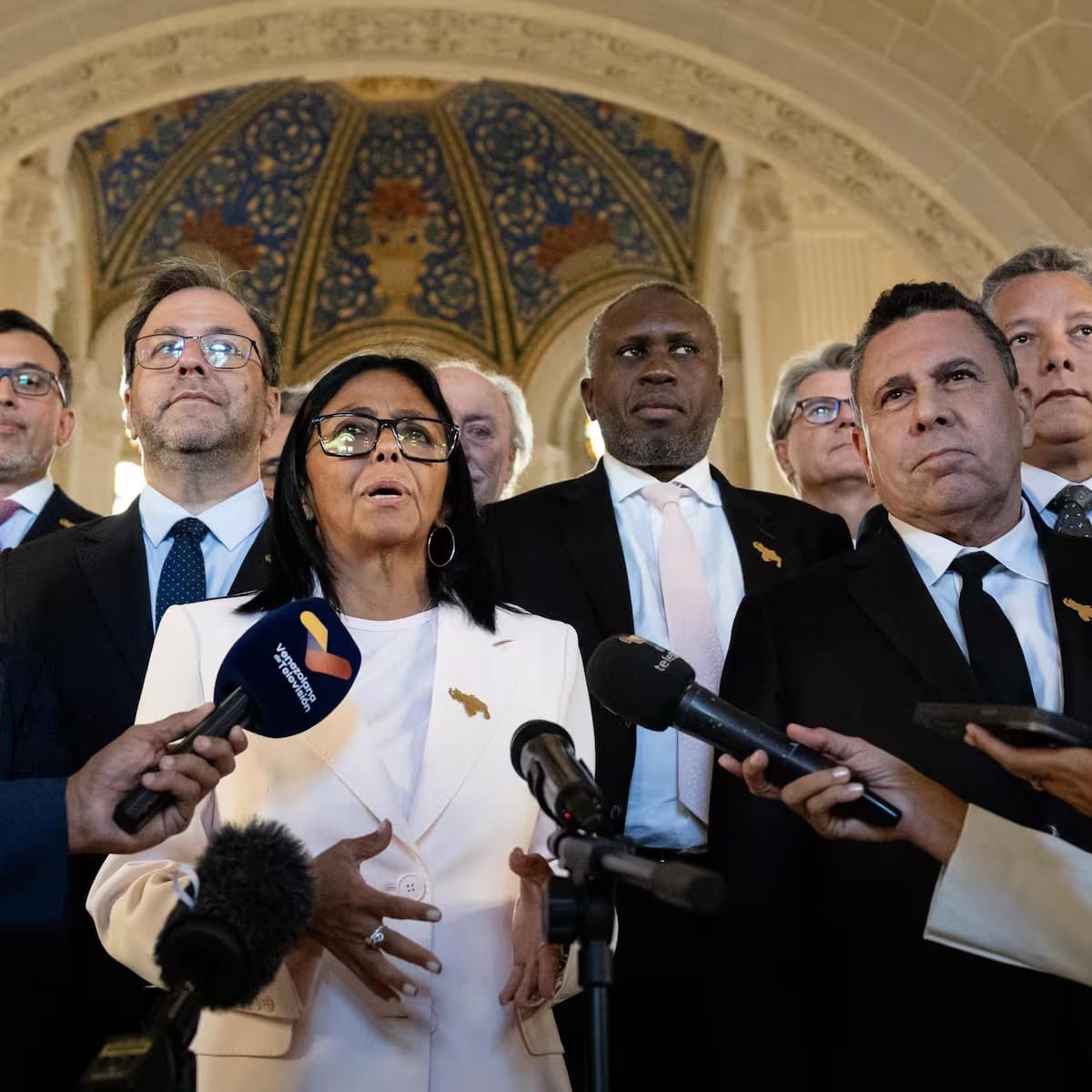
In Venezuela’s case, the statehood comment serves a specific purpose and here’s why. Rodríguez is walking a careful line: cooperating with Washington enough to keep the oil flowing and the sanctions pressure manageable, while preserving enough Chavista institutional legitimacy to govern over the pro-Maduro hardliners. Her “free country, not a colony” response was delivered quickly and confidently — it was exactly what her domestic audience needed to hear, and it cost her nothing with Washington because Washington was never serious about the underlying proposal.
The subtext of Trump’s comment is not annexation. It is a reminder to Rodríguez of the asymmetry of their relationship. Washington captured her predecessor, and controls the revenue from her country’s most valuable export. The statehood comment is Trump saying, in public and with a smile: you exist in this transition on terms we set, and we can change those terms whenever we choose.
Rodríguez understands this perfectly. Her response — invoking Bolívar, defending independence, wrapping herself in the flag — was for the Venezuelan street, not for the White House.
What It Would Actually Look Like
For the sake of the editorial exercise Trump himself invited: imagine, for a moment, that it did happened.
Venezuela would enter the Union as the most populous state after California and Texas, with 28 million people and Caracas would be the second-largest city in the United States after New York. Venezuelan citizens would become American citizens, gaining the right to vote — an electorate that has consistently, in free polling, favored center-left and left-wing political parties.
The Venezuelan community in Miami, which is deeply anti-Chavista, would be joined by the Venezuelan population inside Venezuela, which is considerably more politically diverse.
Este trino oficial de la Casa Blanca es una idea completamente contraria a la de Simón Bolívar.
— Gustavo Petro (@petrogustavo) May 13, 2026
Esta nueva idea en el gobierno de los EEUU no se puede hacer sin la voluntad del pueblo de Venezuela al que habría que pedirle la traición a su hijo: Simón Bolívar, el fundador de la… https://t.co/MKCBrvo2R1
Colombian President Gustavo Petro posts on X lamenting the idea of the United States making Venezuela a U.S. state via @petrogustavo/X
Venezuela’s GDP per capita of roughly $4,300 would make it by far the poorest state in the union — Mississippi, the current poorest, sits at around $42,000. The federal government would immediately become responsible for healthcare, education, infrastructure, and social services for 28 million people whose public institutions have been in collapse for a decade.
The tab would run into the hundreds of billions annually, not to mention, throw a wrench into the already complicated electoral college map dictating who becomes president of the United States.
Venezuela’s oil wealth would eventually offset some of the debt — but “eventually” is doing a lot of work in that sentence. At current production trajectories, it would take decades of investment and infrastructure rebuilding before Venezuelan oil revenues matched the cost of governing the state. In the meantime, American taxpayers would be funding the reconstruction of a country whose problems are generational, not situational.
The congressional math is also arresting. Venezuela would be entitled to at least two U.S. senators and, based on population, approximately 30 congressional representatives — the third-largest delegation in the House. The politics of that addition, in a narrowly divided Congress, are left as an exercise for the reader.
The Number That Matters
Polymarket currently puts the probability of Venezuelan statehood at around 2%. That feels about right. The market for Trump saying something outrageous that produces real diplomatic consequences, on the other hand, is trading considerably higher.
The statehood comment is not a policy. It is a signal. What it signals is that Washington views Venezuela as a problem it has not finished solving, a resource it intends to keep accessing, and a government it will continue to pressure until the transition produces something closer to what the administration actually wants — which is not a 51st state, but a compliant, oil-producing partner with no Chinese military bases, no Russian intelligence presence, and no future that looks like the last 25 years.
Rodríguez knows that. She said no, wrapped herself in the flag, and went back to work.


