

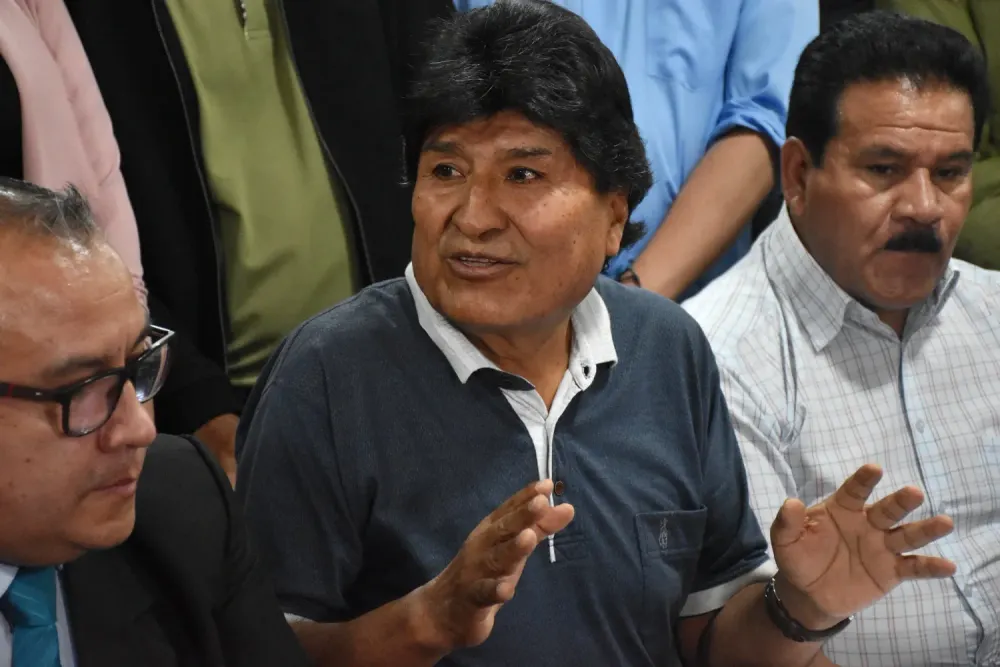
MIAMI — A Bolivian criminal court declared former President Evo Morales in contempt on Monday after he failed to appear for trial in the city of Tarija, where he faces charges of aggravated human trafficking and statutory rape. The hearing was scheduled to begin the final stage of proceedings in a case that has been building since 2019 — and that Morales has refused to engage with at nearly every turn.
The court issued a new arrest warrant. And it is not the first.
What the Case Involves
The charges stem from an alleged relationship between Morales and a girl identified as Cindy Vargas, who was 15 years old in 2015 when the relationship is alleged to have begun. Prosecutors say Morales fathered a child with Vargas in 2016, while he was serving as president. A birth certificate found in Tarija lists Morales as the father. DNA testing has been conducted as part of the investigation.
The Tarija regional prosecutor’s office charged Morales with aggravated human trafficking — aggravated, specifically, because the alleged crimes took place while he held public office. Vargas’ mother, Idelsa Pozo Saavedra, has also been charged, on the theory that she facilitated the relationship in exchange for political and material benefits. Both face sentences of 10 to 15 years under Bolivian law if convicted.
“The evidence is overwhelming and the accused must answer for his actions before the law,” the regional prosecutor’s office said Monday after Morales failed to appear.
Why He Didn’t Show Up
Morales’ legal team offered two explanations for his absence. One was procedural: his lawyers argued the case had already been addressed and resolved in 2020, and that prosecuting him again violates his rights. The other was security: attorney Nelson Cox told Bolivian broadcaster Unitel that there were insufficient guarantees to safely transport Morales from the Chapare region of Cochabamba, where he has been based and where he is protected by networks of loyal social movements.
Cox also described the entire case as a “political fabrication” intended to disqualify Morales from future electoral competition. Morales has echoed that framing consistently, calling the legal proceedings a “brutal legal war” against him.
Prosecutors and lawyers representing the alleged victim rejected both arguments.
Morales has missed multiple hearings across the life of this case. An earlier arrest warrant was issued in October 2024 after he refused to testify. A second warrant was confirmed in March 2025 after an appeal by his defense was declared inadmissible. Monday’s ruling is the latest in a pattern.
The Case’s Long Road
The investigation was originally opened in 2019 — the same year Morales resigned the presidency following a disputed election that plunged Bolivia into political crisis. It was effectively frozen for several years before prosecutors reactivated it in late 2024, citing new evidence including the birth certificate and DNA results.
Morales was formally charged with aggravated human trafficking in December 2024. Prosecutors requested six months of preventive detention at a hearing scheduled for January 2025. Morales did not appear for that hearing either. The case has proceeded in fits and starts ever since, with Morales declining to engage while his supporters — thousands of whom have taken to the streets in his defense — maintain that the entire proceeding is political.
The Political Fallout
Morales, 66, spent the final years of the administration of Luis Arce locked in a bitter power struggle with his former ally over control of Bolivia’s Movimiento al Socialismo — or Movement for Socialism (MAS) party.
That conflict helped fracture MAS heading into the 2025 election, which centrist senator Rodrigo Paz won decisively in October with 54.5% of the vote — ending 20 years of MAS rule. Morales was barred from the ballot by the Constitutional Court over term limits. He urged supporters to cast null votes in protest; invalid ballots exceeded 20% of the total. Paz took office on November 8, 2025, and the trafficking case now proceeds under a government with no political interest in protecting Morales.
Morales has insisted he intends to run for president again despite a Constitutional Court ruling that bars him from doing so after three terms.
Separate charges filed against Morales last year — including terrorism, public incitement, and obstruction of electoral processes — stem from roadblocks organized by his supporters in protest of his exclusion from the 2025 presidential race.
The combination of charges has led his camp to argue, with some consistency, that the justice system is being used as a political weapon against him. That argument has traction among his base. It has less traction among the prosecutors, judges, and victim advocates who have spent years building the trafficking case and who have publicly criticized Morales’ repeated failure to appear.
What Comes Next
With Morales now in contempt and a new arrest warrant issued, Bolivian authorities face the same problem they have faced before: actually executing it.
Morales remains in Chapare, a region where he has deep roots and where local support makes a straightforward police operation complicated. Bolivia’s Special Crime Fighting Force is formally tasked with carrying out the arrest. Whether they will move to do so — and what the political consequences of that would be — remains to be seen.
But what we do know is that the trial cannot proceed without the accused present. How Bolivia resolves that tension will say something significant about the strength of its institutions and the limits of political protection.