
WASHINGTON, D.C. — Within the span of about 24 hours this week, the U.S. government sent two visibly different messages to Mexico: a map posted by President Trump blanketing Mexican territory in the American flag, and a statement from his own ambassador in Mexico City calling for a “strong partnership” between the two countries — a contrast that has drawn attention to the tone of Washington'’s approach to its southern neighbor.
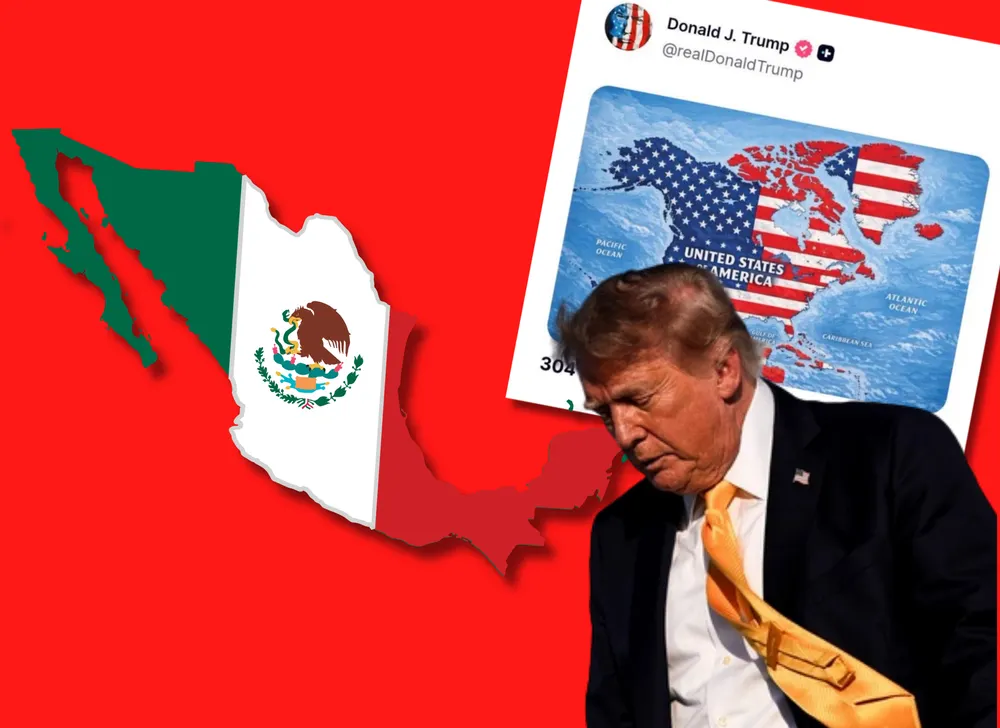
On Sunday, September 7, Trump shared an image on Truth Social depicting Mexico, Canada, Greenland, Iceland, and several Caribbean islands, including Cuba, covered in the design of the American flag — red and white stripes with a blue field.
The Gulf of Mexico and the Gulf of California were labeled “Gulf of America” on the map. President Trump included no caption or additional context alongside the image. The post follows a pattern of similar territorial-themed messaging from Trump throughout 2026, including previous suggestions that New Mexico be renamed “New America” and that Lake Ontario be called “Lake America.”
U.S. Ambassador Issues Statement
The following day, Monday, September 8 — U.S. Labor Day — U.S. Ambassador to Mexico Ronald Johnson posted a considerably different message on X. Johnson wrote that Labor Day honors “the American workers who build, produce, create, and drive our Nation forward,” and said Trump has placed American workers “at the center of his economic agenda.”
Johnson then extended the message to Mexico directly, saying the bilateral partnership “can create more opportunities for workers on both sides of the border,” and that when the two countries “compete together, produce together, and build together,” both economies strengthen and better jobs are created. He concluded that this is what “a strong economic partnership” between the two nations should offer.
The Backdrop: A Trade Comment From Days Earlier
The map was not the only recent friction point. On Friday, September 4, speaking to reporters in the Oval Office, Trump discussed his broader approach to countries running trade surpluses with the United States, saying: “We could do tremendous good for ourselves by just not trading with countries.”
Turning specifically to Mexico, the U.S. president remarked: “We lose with Mexico $195 billion a year. They have nothing that we have to have, I mean, hot tamales, tomatoes, a couple of things. But basically, they have nothing that we need... We have oil, we have everything.”
Trump added that he did not intend to actually halt trade with Mexico, citing his relationship with Sheinbaum specifically: “We get along very well with the President. We like the President, respect her a lot.”
🔴Donald Trump compartió en Truth Social una imagen modificada de un mapa en el que México aparece cubierto parcialmente con la bandera de Estados Unidos.
— Azucena Uresti (@azucenau) September 7, 2026
El presidente estadounidense publicó la imagen sin añadir algún mensaje o explicación sobre su significado. pic.twitter.com/5K5bVaHmDv
Trump’s specific characterization of the U.S.-Mexico trade relationship has drawn factual scrutiny. According to the Office of the U.S. Trade Representative, the United States imported $534.3 billion in goods from Mexico in 2025, and Mexico remained the United States’ top overall trading partner, top supplier, and top export market through at least July 2026, when Mexico alone supplied $60.5 billion in goods to the U.S. in that month.
Sheinbaum’s Response
President Claudia Sheinbaum addressed the map controversy the same day it circulated, posting on X without directly naming Trump. Framing her message around Mexico’s September Independence celebrations, she wrote:
“In the month of the homeland, we reaffirm that Mexico is not and will not be a colony or protectorate of any foreign country. We are proudly a free, independent, and sovereign country.”
Sheinbaum’s phrasing was not new. She has used nearly identical formulations repeatedly since the start of Trump’s second term. In May 2026, responding to a U.S. Department of Justice extradition request, she said: “We are not a protectorate or colony of the United States... we understand ourselves as equals.”
Just days before the map controversy, at an event in Monterrey, she summarized her government’s standing position toward Washington: “Cooperation always, subordination never.”
In her Second Government Report, delivered the previous week, Sheinbaum acknowledged the relationship with Washington has faced “difficulties,” while maintaining her government will continue seeking mutual understanding.
Reading the Two Messages Together
The juxtaposition between Trump’s map and Ambassador Johnson’s statement reflects a recurring pattern in U.S.-Mexico relations throughout this calendar year: sharply worded, sometimes provocative rhetoric from Trump himself, alongside more measured, partnership-oriented messaging from U.S. diplomatic officials operating in Mexico.
Whether that divergence reflects a deliberate “good cop, bad cop” approach, differing institutional roles between the president and his ambassador, or simply inconsistent messaging within the administration is not something either government has directly addressed.
What is clear is that the pattern has now repeated closely enough — provocative gesture followed by conciliatory diplomatic language, met with a firm but restrained sovereignty statement from Sheinbaum — that observers on both sides of the border have begun treating it as a recognizable cycle rather than an isolated incident.