

BUENOS AIRES — President Javier Milei used a national television and radio address on Thursday evening to announce a package of new legislative and executive measures defending Argentina’s sovereignty claim over the Falkland Islands, in a broadcast his own government tied directly to recent, deliberately vague comments from President Trump suggesting Washington might reconsider its decades-long neutral position on the dispute.
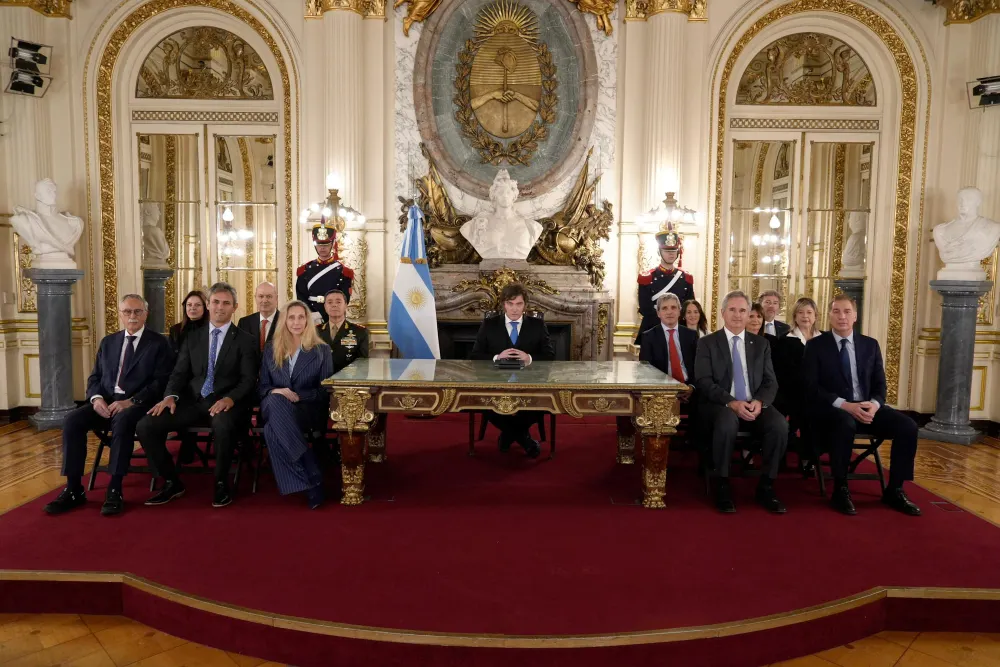
Speaking from the Salón Blanco of the Casa Rosada, flanked by his cabinet, Milei opened with Argentina’s foundational claim: “Las Malvinas son argentinas, por historia y por derecho. No hay discusión al respecto” — “The Falklands are Argentine, by history and by right. There is no discussion about it.”
Milei announced he would sign a regulatory decree and send a package of legislation to Argentina’s Congress in direct response to what his government’s office described as the “condemnable” Sea Lion project — an offshore oil exploration effort advancing near the islands without Argentine authorization.
The measures include sanctions targeting companies that attempt to exploit oil and other resources in waters surrounding the archipelago, and the construction of a new Integrated Naval Base in Tierra del Fuego, alongside expanded telecommunications capabilities in the region.
“The national government will expand the Ministry of Defense’s resources to advance construction of an Integrated Naval Base in Tierra del Fuego and increase our telecommunications capabilities,” Milei said, framing the cause in explicitly non-partisan terms: “Las Malvinas no pertenecen a un gobierno ni a un partido político. Es una causa nacional” — “The Falklands do not belong to any government or political party. It is a national cause.”
The Trump Comments That Triggered This
Milei’s address came directly on the heels of a press conference at the White House in which U.S. President Donald Trump suggested his administration was reviewing the historic U.S. position of neutrality on the Falklands sovereignty dispute — remarks that broke from a stance Washington has maintained since Britain and Argentina went to war over the islands in 1982.
Trump’s comments were notably vague, offering no specifics on what a policy review might produce or when.
Reporting from the British newspaper The Telegraph has suggested a different motivation entirely behind the ambiguity: Pentagon officials have reportedly floated adjusting the U.S. position on the Falklands specifically as leverage against the United Kingdom, tied to pressure on British Prime Minister Andy Burnham to raise U.K. defense spending to NATO’s 5%-of-GDP target — meaning the driving force behind Washington’s sudden ambiguity may have far more to do with trans-Atlantic defense politics than with any genuine reconsideration of Argentina’s claim.
Milei’s Team Reads It as an Opening Anyway
Regardless of the comment’s underlying motivation, Milei’s own advisers have treated it as a meaningful opportunity. Presidential adviser Santiago Caputo wrote on social media in the days before the address that “England represents the past while Argentina is the future” — and said it was healthy for the United States to review its Falklands position, describing the sovereignty claim as a “sacred cause for all Argentines.”
Foreign Minister Pablo Quirno briefed Milei’s cabinet on the state of diplomatic initiatives surrounding the islands ahead of Thursday’s broadcast, according to Argentine outlets tracking the preparations.
Built on Regional Momentum
Thursday’s address followed directly from Milei’s meeting with Chilean President José Antonio Kast in Santiago earlier the same day, during which Kast reaffirmed Chile’s support for Argentina’s “legitimate sovereignty rights” over the Falklands, South Georgia, and South Sandwich Islands, and called on the United Kingdom to resume negotiations toward a peaceful resolution.
Milei, in turn, recognized Chilean sovereignty over the entirety of the Strait of Magellan in the same joint statement — a reciprocal diplomatic gesture that set the stage for the evening’s broadcast just hours later.
A Broadcast, and a Genuine Shift, Worth Watching
Thursday marked the fourth time this year Milei has used a national address specifically to discuss progress on the Falklands sovereignty cause, according to La Nación’s reporting, with Argentine broadcasters reporting a combined audience rating of 30.2 points across all channels and news networks — a notably large audience for a policy-focused address.
Opposition figure and Security Minister Patricia Bullrich praised the speech directly, calling it the “most important step in Argentina’s history on Malvinas (Falklands) sovereignty.”
The speech also arrives against the backdrop of an earlier, more controversial shift in Milei’s own rhetoric on the islands. At an earlier Malvinas Veterans Day ceremony this year, Milei had drawn criticism and debate for appearing to endorse a form of self-determination for the islands’ residents — suggesting the Falkland Islanders should come to want to be Argentine “without need for coercion or persuasion,” a notable departure from Argentina’s traditional diplomatic and bilateral framing of the sovereignty claim, which has historically rested on historical and legal argument rather than islander consent.
With legislation and a regulatory decree now headed to Argentina’s Congress, and construction of a new naval base in Tierra del Fuego formally announced, Milei’s government has moved the Falklands question from rhetorical territory into concrete policy commitments.
Whether Trump’s own ambiguous comments translate into any actual shift in U.S. policy — or remain, as reporting suggests, primarily a lever aimed at Britain’s defense spending rather than Argentina’s sovereignty claim — will likely determine whether Thursday’s address marks a genuine turning point in the decades-old dispute or another chapter in a cause that has resurfaced repeatedly without resolution.
🚨🇦🇷🇨🇱 | ALERTA/AMERICAS: Tras reunirse con Milei en Santiago, el presidente chileno José Antonio Kast reafirmó el respaldo de Chile a los “legítimos derechos de soberanía” de Argentina sobre las Islas Malvinas, Georgias del Sur y Sandwich del Sur.
— Sociedad Media (@sociedadmedia) September 3, 2026
El comunicado conjunto llama… pic.twitter.com/FELQ6S2NgM