

On Tuesday morning, U.S. Immigration and Customs Enforcement posted a wanted notice on X that, in a different era, would have dominated the news cycle for days.
“$10M REWARD FOR CHAPITOS SINALOA CARTEL LEADER Ivan Archivaldo Guzmán Salazar and his three brothers known as the Chapitos inherited drug trafficking networks from their notorious father Joaquin ‘El Chapo’ Guzman Loera. Guzman Salazar is a fugitive and should be considered armed and dangerous.”
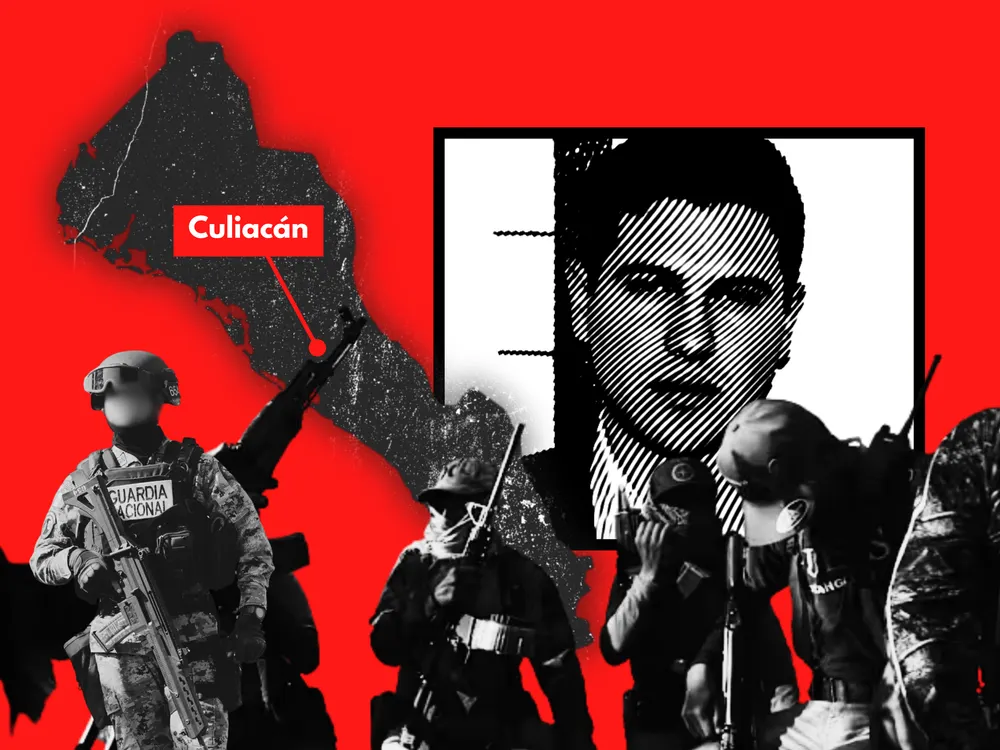
ICE reiterated on April 14 the validity of the up to $10 million reward for information leading to the capture of Iván Archivaldo Guzmán Salazar. The U.S. Embassy in Mexico amplified the announcement simultaneously. The reward is backed by the U.S. State Department and the DEA, who include Guzmán Salazar among their highest-value targets involved in the Mexican drug trade.
His last known location is Culiacán, Sinaloa.
The renewed bounty is not new information. The $10 million reward has been on the books for years, doubled from an original $5 million as the fentanyl crisis deepened and Los Chapitos’ role in it became undeniable. What makes Tuesday’s reissuance significant is the timing — a moment when two of Iván’s brothers are in American prison cells cooperating with federal prosecutors, the cartel faction he leads is fighting for survival against a rival faction that may be winning, and the Trump administration has designated the Sinaloa Cartel a foreign terrorist organization and staked significant political capital on dismantling it.
Despite all of that, Iván Archivaldo Guzmán Salazar remains free. Here is why — and why it matters.
The Four Sons of El Chapo
Iván Archivaldo, Jesús Alfredo, Ovidio, and Joaquín — known collectively as the Chapitos — were brought into the Sinaloa Cartel’s criminal operations at a young age by their father El Chapo Guzmán and Sinaloa co-founder Ismael Zambada García, alias El Mayo, in order to learn the organization from the inside.
Unlike El Chapo, who grew up poor in the mountains of Sinaloa, the Chapitos were born into wealth paid for by the cartel. Many initially dismissed them as spoiled and privileged. But they proved to be sharp over time, and shrewd criminal operators who modernized their father’s organization in one critical direction — synthetic drugs.
Following El Chapo’s arrest and extradition to the United States, the Chapitos modernized the cartel, making it more ruthless, more violent, and more deadly. They became the architects of the deadliest drug epidemic the United States has ever faced — that of illicit fentanyl, according to the U.S. Drug Enforcement Administration.
The fentanyl pivot was strategic. Heroin and cocaine require agricultural supply chains that are geographically constrained. Fentanyl requires chemical precursors — primarily sourced from China — and laboratory infrastructure that can be moved and hidden far more easily.
Los Chapitos-controlled laboratories introduced fentanyl in counterfeit pills manufactured by the Sinaloa Cartel and trafficked to the United States. The faction’s dominance over fentanyl trafficking is largely the result of its capacity to procure precursor chemicals while controlling production via secret laboratories in Sinaloa.
The human cost is staggering. Over 500,000 Americans have died of fentanyl poisoning — a toll that has made Los Chapitos the most consequential criminal organization operating against the United States in the modern era.
The Unraveling
The Los Chapitos story in 2026 is not one of unchecked power. It is one of an organization under acute, simultaneous pressure from multiple directions — and still lethal despite it.
The first blow came in July 2024, when Joaquín Guzmán López flew to the United States on a private plane alongside El Mayo, whom Joaquín had allegedly lured into the trip under false pretenses. Both were arrested on landing. In May 2025, Ovidio agreed to cooperate with U.S. prosecutors.
In July 2025, Ovidio Guzmán López pleaded guilty to two counts of drug conspiracy and two counts of knowingly engaging in a continuing criminal enterprise in the U.S. District Court of Chicago. As part of his plea agreement, he admitted that he and his brothers assumed their father’s leadership role following his arrest. He admitted to resorting to violence against law enforcement, civilians, and rival traffickers to protect the cartel’s drug operations.
Two of four brothers — inside American courtrooms, are providing information about the cartel’s operations, networks, and personnel to federal prosecutors.
The second blow was internal. Since the arrests of El Chapo and El Mayo, the Sinaloa Cartel has undergone foundational changes that created two dominant factions vying for power. Turf wars between Los Mayos and Los Chapitos have resulted in the deaths of over a thousand people in the Mexican state of Sinaloa.
The conflict began in September 2024 and has not stopped. Heavy losses and La Mayiza’s rising dominance have sparked a wave of defections from Los Chapitos, with several operators switching allegiances to join the faction led by Ismael Zambada Sicairos, alias Mayito Flaco.
Iván Archivaldo allegedly responded to the pressure by purging his own inner circle — according to reports, Iván Archivaldo himself allegedly ordered the handover of his father-in-law, brother-in-law, and his right-hand man and head of security after detecting betrayals and information leaks within his inner circle.
A cartel leader purging his own family members is not a sign of strength. It is often a sign of paranoia produced by weakness.
Why Iván is Still Free
The $10 million reward has existed for years. The DEA has a dedicated email address — ChapitosTips@dea.gov — for tips on his whereabouts. The U.S. Embassy in Mexico amplifies the bounty periodically. Ovidio is cooperating with prosecutors and presumably providing information about his brother’s operations. The Mexican military is conducting operations in Sinaloa. And yet Iván Archivaldo Guzmán Salazar remains at large in Culiacán.
The answer is structural rather than operational. Iván’s last known location is Culiacán, Sinaloa State, where he is probably hiding and coordinating the work of his criminal cell.
Culiacán is Los Chapitos' home territory — a city whose economy, politics, and security apparatus have been shaped by decades of Sinaloa Cartel presence. The cartel does not merely operate there. It is, in many respects, embedded within the local institutional fabric in ways that make a clean law enforcement operation exceptionally difficult.
There is also the question of U.S.-Mexico operational coordination. The Trump administration’s designation of the Sinaloa Cartel as a foreign terrorist organization in February 2025 has accelerated financial pressure — sanctions, asset freezes, network disruptions — but has not produced the kind of joint operational capacity that would put U.S. law enforcement assets on the ground in Culiacán.
The Mexican government, under President Claudia Sheinbaum, has conducted operations against both Los Chapitos and La Mayiza, but the pace and depth of those operations reflects Mexico’s own political and institutional constraints rather than Washington’s preferred tempo.
Just last week, Mexican military forces found a narco-tunnel under construction near Nogales, Arizona, linked to Los Salazar — a Sonoran-based criminal organization allied with Los Chapitos. The cartel continues to build infrastructure for drug smuggling into the United States even as its leadership is under maximum pressure.
What the Reward Renewal Signals by Washington
ICE does not reissue bounty notices without strategic intent. Tuesday’s renewed push — amplified simultaneously by the U.S. Embassy in Mexico City — is a signal to multiple audiences at once.
To potential informants inside the cartel, it is a reminder that $10 million is available for whoever provides information that leads to Iván’s arrest. In an organization experiencing defections, purges, and internal betrayals, that message has more receptive ears today than it did a year ago.
To the Mexican government, it is pressure to prioritize the capture of a U.S.-designated terrorist over other law enforcement priorities. The bilateral security relationship between Washington and Mexico City has been under strain since Trump’s tariff threats and cartel designation policy began — the reward renewal is a reminder of what Washington considers the minimum deliverable from that relationship.
To the American public, it is a demonstration that the Trump administration’s cartel enforcement posture is operational rather than merely rhetorical — that the $45 million in combined rewards ICE has posted for its most wanted traffickers represents an active, ongoing effort rather than a political gesture.
Whether the renewed $10 million reward produces results that previous iterations did not remains the open question. Two of the four Chapitos are already in custody. The organization Iván leads is weakened, paranoid, and fighting for survival. The moment for someone inside that structure to make a $10 million decision may be closer than any previous point in the cartel’s history.
Sociedad Media will continue to monitor U.S. cartel enforcement operations and the Sinaloa Cartel turf war. Tips and firsthand accounts: info@sociedadmedia.com
$10M REWARD FOR "CHAPITOS" SINALOA CARTEL LEADER
— U.S. Immigration and Customs Enforcement (@ICEgov) April 14, 2026
Ivan Archivaldo Guzmán Salazar and his three brothers known as the “Chapitos” inherited drug trafficking networks from their notorious father Joaquin “El Chapo” Guzman Loera.
Guzman Salazar is a fugitive and should be considered… pic.twitter.com/WDSuspB0NF