

MIAMI — When Colombia’s final 26-man World Cup squad is confirmed on May 29, the country celebrating it will be, in a very real sense, still deciding what kind of country it is. The presidential election is May 31. The first match — against Uzbekistan in Group K on June 18 — is 20 days after that. In between, Colombia will vote, hold a runoff on June 21 if no candidate clears 50%, and inaugurate a new president on August 7.
The Squad
Colombia head coach Néstor Lorenzo unveiled a 55-player preliminary squad on May 14, with Luis Díaz and James Rodríguez headlining a list that confirmed the continuity of the core group that helped Los Cafeteros qualify for the tournament.
The preliminary roster keeps every player who has been part of Lorenzo’s project since the start of qualifying. It even includes Yerry Mina, Kevin Castaño, and David Ospina, who are not currently at their best. Juan Guillermo Cuadrado, who has participated in multiple national team camps without being called up, has been included again following his performances for Pisa.
The key names:
Goalkeepers: David Ospina, Kevin Mier, Camilo Vargas.
Defenders: Dávinson Sánchez, Daniel Muñoz, Jhon Lucumí, Yerry Mina, Carlos Cuesta, Cristian Borja, Johan Mojica.
Midfielders: James Rodríguez, Jefferson Lerma, Mateus Uribe, Richard Ríos, Jhon Arias, Juan Cuadrado, Kevin Castaño.
Strikers: Luis Díaz, Jhon Durán, Rafael Santos Borré, Luis Suárez, Jhon Córdoba, Johan Carbonero, Jaminton Campaz.
The final 26 drop May 29. Three names carry most of the discussion between now and then.
James Rodríguez: The Fitness Question That Won’t Go Away
Among the most discussed players is James Rodríguez. The Minnesota United midfielder remains one of Colombia’s biggest football icons, but concerns remain regarding his lack of playing time. James has played fewer than 200 minutes in MLS, recording six appearances and two assists, along with two U.S. Open Cup matches.
Lorenzo revealed that the coaching staff are working individually with the former Real Madrid star: “James has always needed rhythm through playing time.” The coach acknowledged that James “is still lacking physically, but he’ll get there in good shape.”
That is a significant qualifier for a player who will be 35 during the tournament and who has spent the better part of three years battling to stay relevant at the club level. In Qatar, James was already a squad peripheral — he has not started a World Cup match as Colombia’s first-choice playmaker since the iconic 2014 campaign.
Whether Lorenzo can unlock anything resembling that version of James at 35, on limited minutes, with a personal trainer supplement program, is one of the most compelling questions Colombian football is asking right now.
James Rodríguez has shut down retirement talk after the 2026 World Cup, saying: “I have a couple of years left.” Whether those years include a meaningful World Cup contribution is a separate question.
Luis Díaz: The Weight of a Country
It is the 29-year-old left winger who emerges as the central figure of the national team. Although he excels as a left winger, the entire national team now revolves around him.
That framing — the entire team revolving around a single player — reflects both Díaz’s quality and a genuine depth problem in Colombia’s attacking options. Jhon Durán seemed to be the ideal complement, but his inconsistencies appear to leave him with few chances. Given this, they are pointing to Luis Díaz as their only hope.
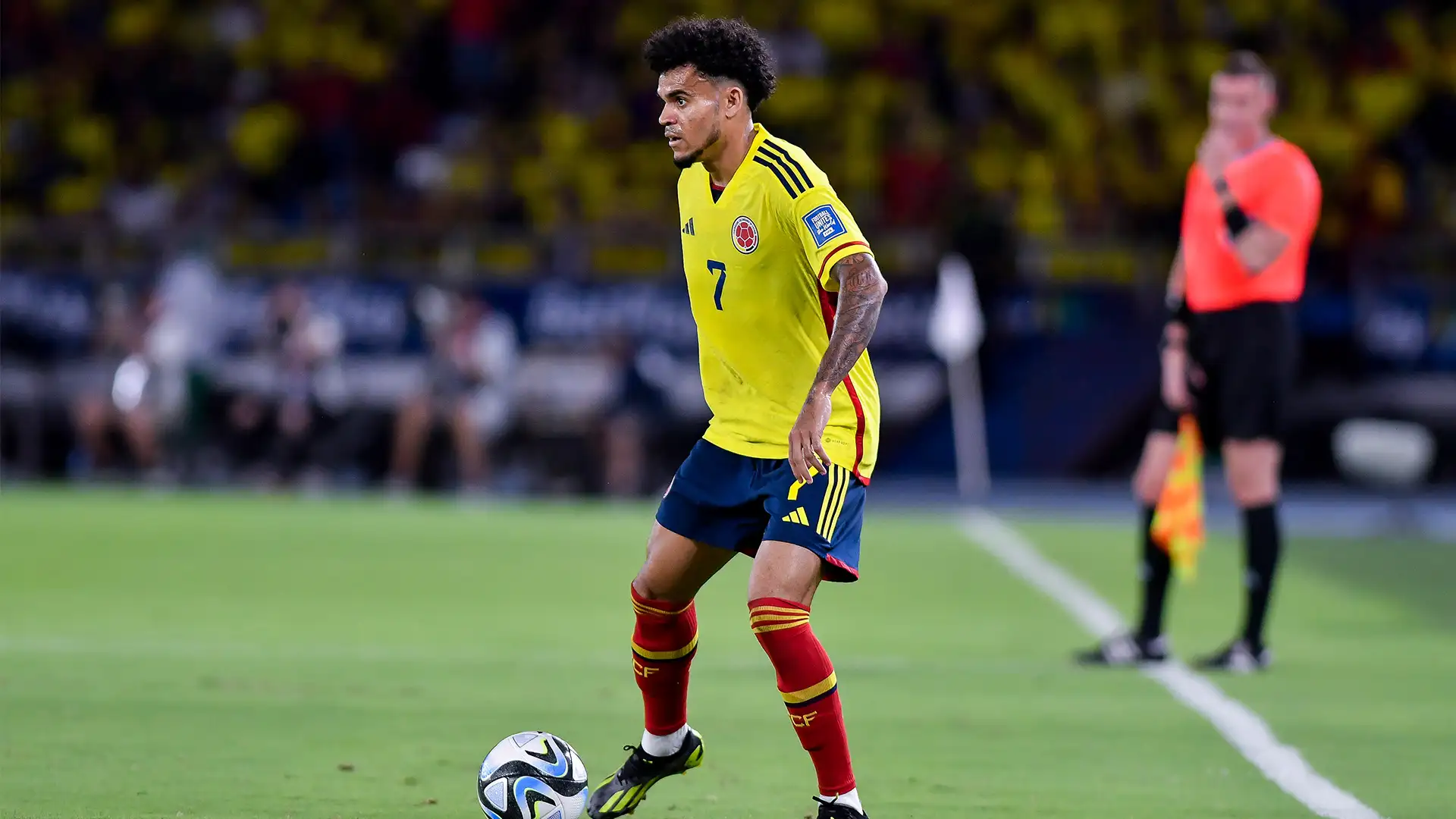
Díaz had an outstanding season at Bayern Munich, operating as one of the most dangerous wide forwards in the Bundesliga. He is 29, in the prime of his career, and arriving at a World Cup — the tournament will be played in the United States, Canada, and Mexico, with Colombian communities across all three countries making up a significant share of the audience. The pressure and the opportunity are equally enormous.
Jhon Durán: The Controversy That Won’t Settle
Durán’s inclusion in the preliminary squad despite his inconsistency — and his path from Aston Villa to Saudi Arabia to Russia via Turkey — reflects the genuine scarcity of reliable centre-forward options behind Díaz. The lesser-trodden path of Saudi Arabia to Russia, via Turkey, has seen him fall down the pecking order, and he hasn’t appeared for his nation since last summer.
His presence in the 55 keeps him in contention for the final 26. Whether Lorenzo takes the gamble on a striker whose club form has been inconsistent but whose ceiling — when he is right — is arguably the highest of any Colombian forward — will be one of the final squad’s defining decisions.
The Election Eight Days Later
Colombia’s World Cup squad announcement on May 29 will be consumed by a country in the final hours of its most consequential presidential campaign in a generation.
As Sociedad Media has reported extensively, the May 31 first round features front-runner Iván Cepeda of the ruling Pacto Histórico against conservatives Paloma Valencia and Abelardo De la Espriella competing for the single runoff slot. The campaign has been marked by a FARC dissident offensive that killed a soldier with a drone, ambushed a senator's convoy, and left 35 massacres recorded in the first quarter of 2026 — the highest in a decade.
The players who will wear the yellow jersey in Group K this summer include men from Cauca, Nariño, Valle del Cauca — the departments most affected by the violence that has defined this campaign. Luis Díaz grew up in the shadow of armed conflict in La Guajira. Colombia’s national team has always carried the weight of its country’s pain. In 2026 that weight is heavier than it has been in years.
Colombia returns with a dangerous mix of experience, rhythm and attacking talent, and have enough quality to be one of the strongest South American sides in the tournament. The football case for Colombia going deep is real — they qualified with 28 points, beat Mexico 4-0 in a friendly at AT&T Stadium, and defeated Venezuela 6-3 on the road. This is not a squad that expects to simply participate.
But no Colombian player, when they pull on the jersey in Kansas City or Dallas or Miami this summer, will be entirely separate from the country they represent — a country that, on the day their final squad is confirmed, will be 48 hours from voting on who governs it next.
Colombia’s Group Path
Colombia are in Group K. They open June 18 against Uzbekistan. Their group opponents are manageable — this is a squad built to advance deep into the knockout rounds. Whether the political turbulence at home creates distraction, motivation, or both is a question no one can answer from the outside.
Colombian football has a history of rising in moments of national crisis. The generation of the early 1990s — Valderrama, Asprilla, Higuita — played in a country convulsed by cartel violence and produced the most beloved football in the nation’s history. The generation of 2024 reached the Copa América final. This generation will play its World Cup in a country electing a president and counting its dead.
That is Colombia in 2026. The squad announcement comes May 29. The election is May 31. The first match is June 18.
Sociedad Media will continue to cover Colombia’s presidential election and World Cup campaign through the summer. Tips, sources, and feedback welcome at info@sociedadmedia.com


