


SANTIAGO — Thousands of students, workers and residents marched through central Santiago on Wednesday against the 2027 budget cuts, in a mobilization called by the Frente Común, which brings together the Confederation of Chilean Students (Confech), the CUT labor federation and neighborhood groups.
Organizers say it is the latest in a series of protests, and more are planned this week and next, covering education, housing, pensions and violence against women.
The protests are aimed at the first budget of President José Antonio Kast, who took office in March on an austerity platform similarly modeled on that which has been carried out by Javier Milei in Argentina.
Wednesday’s March
CUT president José Manuel Díaz said the day included demonstrations at 24 points across the country. The marchers walked along the Alameda, Santiago’s main avenue.
Speakers focused on education. Laura Mlynarz, the Confech spokesperson and president of the University of Chile student federation, said the students feel left on their own, saying “today there is no education minister in this country.”
Organizers estimate the cuts could mean the departure of more than 1,800 teachers and more than 1,000 early childhood educators. Housing groups used the march to renew a call for Housing Minister Iván Poduje to resign.
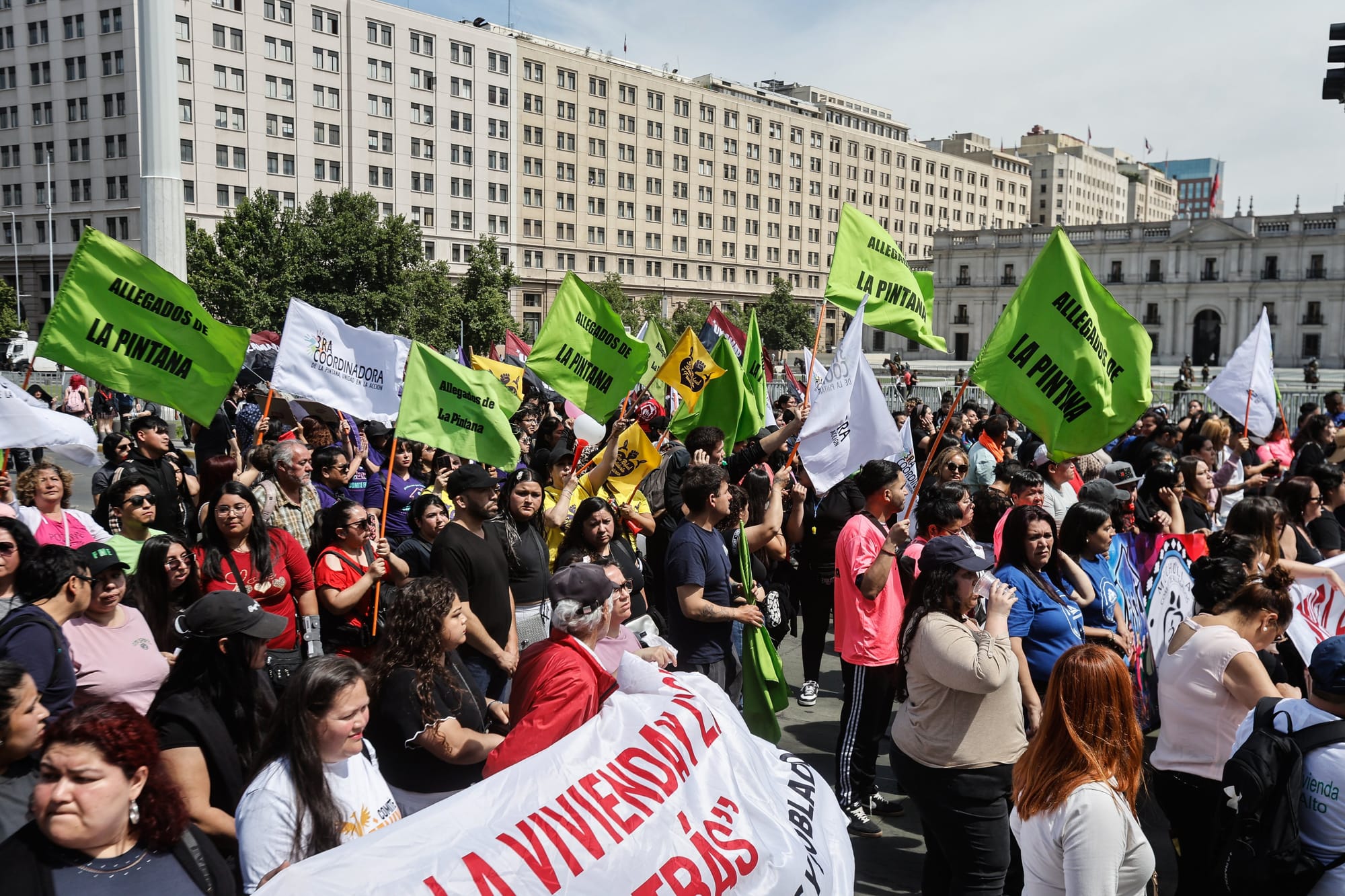
The march however, ended with incidents. Carabineros entered a GAM cafeteria to detain two young people. Police said the arrests were related to damage to public furniture, while GAM workers called the operation disproportionate and said pepper spray affected bystanders, including children and older adults. Student groups denounced what they call police repression.
The reports reviewed do not give arrest totals, and they did not include a government statement on the march.
Budget Proposals
The bill is not a spending cut overall. The 2027 budget, the government’s first, projects spending growth of 1.5%. The criticism is about specific lines. Critics point to cuts of 55.2% to the education recovery fund and 46.7% to merit-based high school funding, and the end of a laptop grant that benefited 96,100 students in 2026. Finance Minister Jorge Quiroz has argued that the adjustment makes spending more efficient without touching social benefits.
The government is seeking a roughly $6 billion fiscal adjustment, including a 3% cut across ministries.
France 24 reported that some polls show discontent with the Kast government above 70%. The bill is being debated in Congress, and the reports reviewed give no vote dates.
Wednesday’s march followed others. Confech held a national protest day on November 11 over education funding and said it had sent a letter to the Education Ministry that day without a reply. Students and police clashed in Santiago on October 1, a day after Kast presented the budget, with riot police using water cannons and tear gas. Large student marches also took place in June against Kast’s education cuts.
Planned Demonstrations
Organizers have announced a calendar running through the first week of December. On Monday, November 23, at 3:00 p.m., the public employees’ union ANEF plans a demonstration outside the Finance Ministry, with a second action Thursday, November 26.
On Tuesday, November 24, at 10:30 a.m., the teachers’ union (Colegio de Profesoras y Profesores) is calling a national strike and a march from Plaza Baquedano to Plaza Los Héroes, with contingents in all regions. The CUT, Confech and secondary students’ groups are joining. Union president Mario Aguilar says public education is “threatened in the budget.”
On Wednesday, November 25, at 6:30 p.m., the feminist coalition Coordinadora Feminista 8M will also march against violence against women, again from Plaza Baquedano. The student movement says it too will join. Among its demands is the exit of Justice Minister Fernando Rabat.
On Friday, November 27, at 11:00 a.m., the Movimiento de Pobladores plans to gather at the Housing Ministry to demand Poduje’s resignation over cuts to subsidy slots under the DS49 program.
On Saturday, November 28, at 11 a.m., the NO+AFP coordinator will march from Plaza Italia to demand an end to the private pension system. The CUT says the Frente Común calendar ends in the first week of December, with no date set for the final day.
The protests come as the economy weakens. Chile’s Central Bank reported that GDP fell 1.1% in the third quarter of 2026, with fixed investment down 6.7%.
Separately, Quiroz announced Wednesday that $160 million would be added to the 2027 budget for a pension protection fund after opposition criticism and a Contraloría ruling.
Reports saw no evidence that the march prompted the reversal.