

MIAMI — The Trump administration used two moments this month — a high-profile international ministerial and a newly published, 100-page State Department report — to formalize a claim it has been building toward for months: that Cuba is not merely an adversarial government 90 miles from Florida, but the ideological architect behind decades of far-left political activity and violence inside the United States itself.
Rubio’s Speech at the State Department
On July 16, Secretary of State Marco Rubio opened the Ministerial on the Resurgence of Political Terrorism at the State Department in Washington, D.C., an event that drew representatives from more than 60 countries across Europe, Asia, and several delegates fromLatin America (where recent elections, i.e. Peru, Chile, Colombia, and Ecuador, have overturned the left-wing tilt of the Pink Tide in the early 2000s).
The department framed the gathering as an effort to reorient Western counterterrorism strategy toward a resurgent, transnational threat from the far-left, which officials argue has been “underestimated” for decades in favor of a near-exclusive focus on jihadist extremism and far-right nationalist groups.
Rubio told delegates that an “extraordinary ideological prejudice” has caused authorities to dismiss left-wing violence as legitimate political expression rather than terrorism, citing a figure that 93% of terrorist attacks in the West between 1970 and 1980 originated from the extreme left.
Deputy Secretary of State Christopher Landau, addressing the same audience, traced a lineage from Europe’s Red Brigades and Baader-Meinhof Group through the Weather Underground in the United States to the Tupamaros and Montoneros, the FARC in Colombia, and the Maoist-motivated Shining Path movement in South America’s Peru.
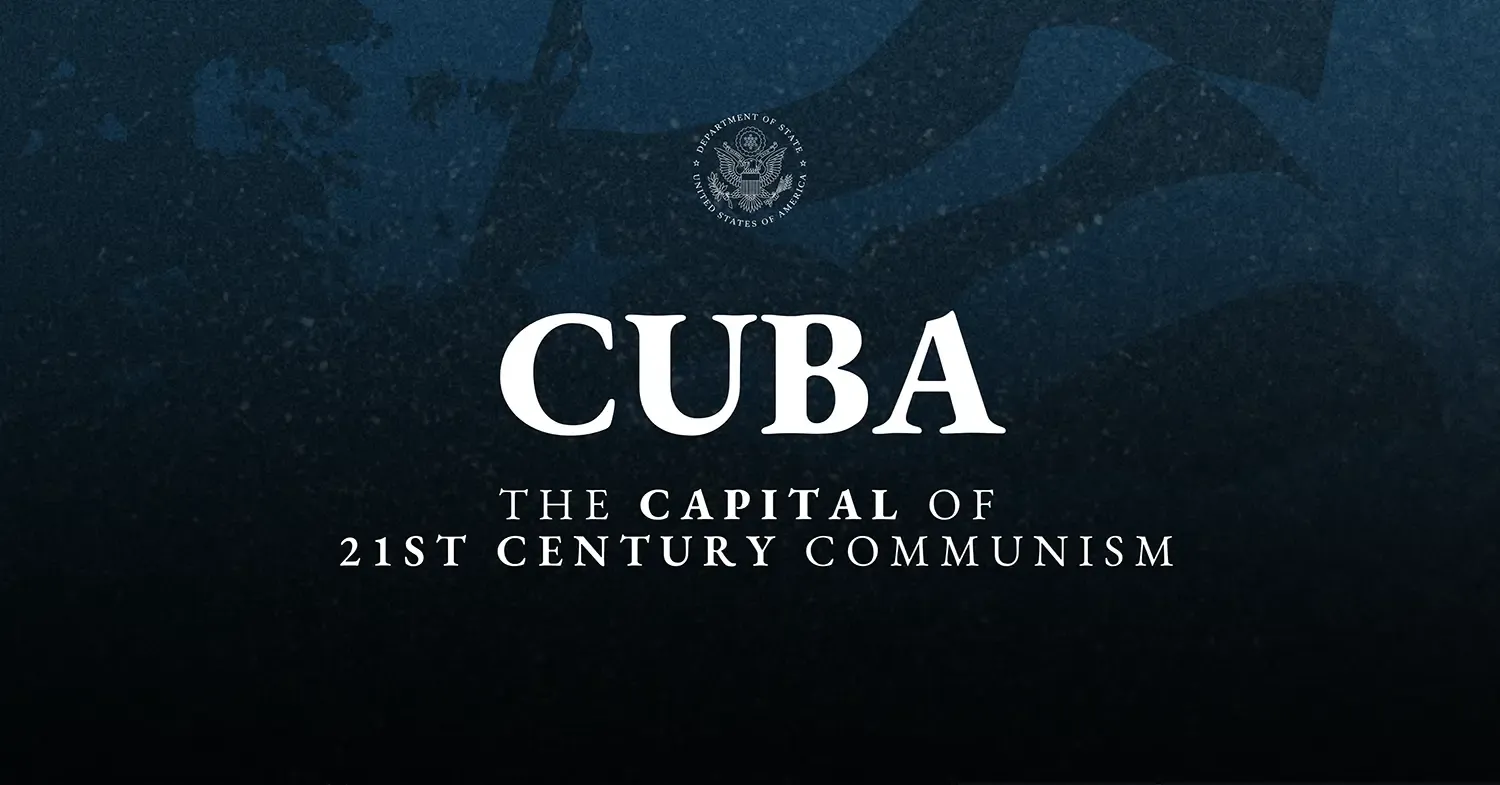
Click below for link to State Departments report:
The administration tied the event to NSPM-7, a National Security Presidential Memorandum directing federal law enforcement and intelligence agencies to jointly disrupt, defund, and prosecute what it terms domestic “political terrorists.”
Cuba featured centrally in Rubio’s remarks: “The Cuban regime’s sprawling intelligence and ideological networks helped build the far-left in our country and in our hemisphere,” he said, “and it remains inextricably linked to far-left groups and movements across and beyond the West.”
The American Civil Liberties Union contends the administration’s approach is targeting peaceful political opponents and donors under the banner of addressing political violence.
The Cuba Report
The report released alongside the ministerial, “Cuba: The Capital of 21st Century Communism,” runs 100 pages and lays out its thesis in explicitly ideological terms. Because Cuba never had the military capacity to defeat the United States conventionally, the report argues, the regime built what it calls a distinct model of asymmetric conflict — one organized around espionage, infiltration, sabotage, proxy networks, and what it terms “a revolutionary infrastructure designed to turn America against itself.”
The report’s central claim is that Cuba’s most consequential and lasting achievement has come not through spycraft but ideology. It traces a direct line from Havana’s post-1959 outreach to the American left through the Black Panthers and the Weather Underground to what it describes as present-day ties with Antifa, immigration-enforcement protest networks, socialist organizations, and Marxist militant groups. The report argues that Cuban Marxism diverged from Soviet communism early on, built less around class-based economic conflict than around “racial, social and even civilizational grievances,” a framing it credits with making Cuban-style leftism the dominant strain of global radical politics after the Soviet collapse.
On the espionage side, the report leans on two marquee cases. Victor Manuel Rocha, a Colombian-born naturalized U.S. citizen who served as a State Department official, National Security Council staffer, and U.S. ambassador to Bolivia, was revealed in December 2023 to have worked as a Cuban agent for roughly 50 years before his arrest — a case federal prosecutors have called one of the most damaging in U.S. history.
Ana Montes, a longtime Defense Intelligence Agency analyst, is presented as a parallel case of decades-long, undetected penetration. The report also revisits the 1998 collapse of the Wasp Network (La Red Avispa), the Cuban spy ring whose prosecution produced the “Cuban Five” — agents later championed by American solidarity campaigns as political prisoners.
The Code Pink Case Study
The report devotes a detailed section to Code Pink: Women for Peace, tracing the group from its 2002 founding through its embrace of the “Free the Cuban Five” campaign in the 2000s and co-founder Medea Benjamin’s history living in Cuba from 1979 to 1983. It places particular emphasis on co-founder Jodie Evans’s 2017 marriage to tech financier Neville Roy Singham, after which — the report states, citing New York Times reporting on the wedding’s guest list — roughly a quarter of Code Pink’s funding has come from Singham-connected groups, and the organization’s public messaging shifted toward defending Chinese state policy alongside its longstanding Cuba advocacy.
The report notes that several U.S. senators have called for a Foreign Agents Registration Act investigation into the group’s funding and foreign travel, including trips to Cuba, Venezuela, Iran, and China.
A Broader Coalition
The report’s final section argues that Cuba’s domestic influence network is compounded by its role as a hub for other American adversaries. It states that Cuba currently hosts eighteen known signals-intelligence facilities, two of them Russian-operated, and that both Russia and China have reportedly tripled their intelligence presence on the island over the past three years.
Havana, the report argues, now functions less as a Soviet-style client state than as a connective staging ground linking Russian, Chinese, and Iranian interests with American domestic movements — citing, among other examples, a 2022 cooperation agreement between a Cuban-aligned international network and an Iranian-linked activist group.
Drawing the Line
The report’s conclusion makes the administration’s underlying argument explicit, tracing the throughline from Fidel Castro’s 1958 vow — that a “much wider and bigger war” against the United States would follow his revolution’s victory — to what it describes as the present day, linking Cuban influence to episodes including the George Floyd protests and the growth of Antifa.
“Cuba’s assault on the United States was never, at root, a quarrel over economic policy or sovereignty,” the report states, framing the campaign instead as a decades-long effort to turn “the children of the West” against their own cultural and socio-political inheritance.
Taken together, the ministerial and the report represent the clearest articulation yet of how the administration interprets the U.S.-Cuba relationship: not as a Cold War holdover to be managed through incremental and perpetual sanctions efforts, but as an active security threat requiring the same institutional response as international terrorism the world over. That framing helps explain much of what has defined U.S.-Cuba policy this year, from the Treasury Department’s designation of Cuba’s Rapid Response Brigades to sanctions against Cuban officials and entities and rising rhetoric around Iranian military assets allegedly stored on the island.
Havana has not issued a formal response to either the ministerial or the report. For Washington, pairing a global diplomatic summit with a documentary case against Cuba’s role in American political life signals that the administration intends its Cuba policy to be read domestically as much as internationally — as evidence, in its own telling, of a threat that originated abroad but has, in the report’s words, taken root within America’s own institutions.
Sociedad Media is a Miami-based digital news publication covering U.S. political developments that impact Latin America. For questions, insights, or tips, contact the outlet at info@sociedadmedia.com
For more than six decades, the Cuban regime has been the leading sponsor of radical leftism and Third Worldism in the United States.
— Secretary Marco Rubio (@SecRubio) July 20, 2026
The State Department is exposing the full history of Cuban espionage and subversion in our country.
The American people deserve to know.…


