


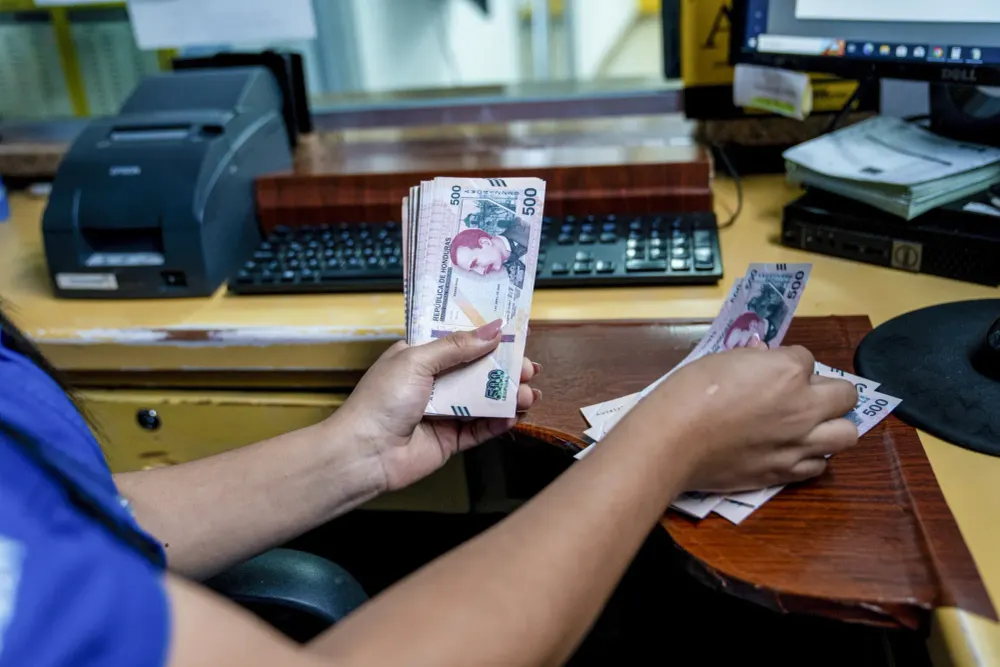
MIAMI — In a modest house in the Honduran department of Yoro, a mother of three pays rent, buys groceries, and keeps her children in school on money that arrives by phone transfer from Houston. She has not seen her husband in four years. What she receives each month — typically between $300 and $500 — is more than she could earn in two months of formal employment in Honduras. It is, by any practical measure, her family’s lifeline.
Multiply that household by millions, and you have one of the most significant financial flows in the Western Hemisphere — one that does not appear in most discussions of Latin American economic policy but one that quietly underpins the stability of three of the region’s most fragile states.
The Numbers
Remittances to Honduras, Guatemala, and El Salvador reached record levels in 2025, according to data from the Inter-American Development Bank and individual central banks. Honduras received $10.2 billion — equivalent to approximately 27% of its GDP. Guatemala received $21.2 billion, representing roughly 19% of GDP. El Salvador received $8.2 billion, or approximately 24% of GDP.
To put those figures in context: remittances to Honduras exceeded the country’s total export earnings. In Guatemala, they exceeded foreign direct investment by a factor of six. In El Salvador, which adopted the U.S. dollar as its official currency in 2001, remittances are the single largest source of dollar inflows into the economy — more significant than tourism, exports, or international aid combined.
These are not marginal contributions to national economies. They are structural pillars. Governments in all three countries have built social stability assumptions around the continued flow of remittance income. When those flows slow, the effects are felt immediately at the household level and, within months, at the macroeconomic level.
Who Sends the Money
The remittances flowing to Central America come overwhelmingly from Honduran, Guatemalan, and Salvadoran migrants working in the United States — the majority in construction, agriculture, food processing, landscaping, and domestic services. The Pew Research Center estimated the combined Central American-origin population in the United States at approximately 4.2 million before the current period of immigration enforcement intensification.
These workers occupy a specific and largely irreplaceable role in sectors of the U.S. economy that have historically struggled to attract domestic labor at prevailing wage rates. Their remittance behavior is consistent and countercyclical — migrants tend to increase transfers home during periods of family hardship, absorbing economic shocks in their countries of origin that would otherwise fall on governments with limited fiscal capacity.
The average remittance transaction from the United States to Central America is approximately $350, sent roughly once per month. Transfer costs have declined significantly over the past decade as mobile money platforms and fintech companies have entered the market, with average fees now below 5% for most corridors.
The Current Uncertainty
The record flows of 2025 were in part a product of anticipatory behavior. Researchers at the IDB and several Central American central banks noted a pattern in late 2024 and early 2025 of elevated transfer volumes that appeared to reflect migrants sending larger amounts home before expected changes in their ability to do so — building reserves for families in anticipation of income disruption.
That anticipatory behavior reflects the uncertainty that has entered the remittance equation. The Trump administration’s immigration enforcement operations — which have accelerated significantly since January 2026, with deportation flights to all three Northern Triangle countries operating at volumes not seen in previous administrations — have introduced new variables into the calculation of how many Central American workers will remain in the United States, and in what legal status, over the coming months and years.
The IDB’s 2026 regional remittances report, published in April, projects a moderation in flows to the Northern Triangle of between 8% and 15% over the next 18 months, contingent on the scale and duration of enforcement operations. That projection carries significant uncertainty in both directions — enforcement operations may slow, or they may intensify further.
An 8% to 15% decline in remittance flows to Honduras would represent a reduction of between $816 million and $1.5 billion annually — a shock of sufficient magnitude to affect household consumption, small business activity, and government tax revenues across the country.
What It Means at the Household Level
The macroeconomic projections describe an aggregate. The reality is experienced by individual families making decisions about school fees, medical care, and whether to eat protein this week.
In communities across the Guatemalan highlands, the Honduran interior, and El Salvador’s eastern departments, remittance income has financed a generation of incremental improvement — concrete floors instead of dirt, zinc roofs instead of thatch, children completing secondary school instead of entering the workforce at fourteen. That improvement is real and documented. It is also contingent on the continued presence and employment of family members in the United States.
Families that have become dependent on remittances over one or two decades have in many cases lost the subsistence farming capacity and informal economic networks that preceded migration.
The asset base that existed before the remittance economy took hold has not been preserved in parallel. For those households, a sustained reduction in transfers would not simply mean less discretionary spending — it would mean a return to conditions of poverty that the remittance income had lifted them out of.
The Governments’ Position
The governments of Honduras, Guatemala, and El Salvador have each, in different ways, sought to manage their relationships with Washington in a manner that protects the remittance flows their populations depend on.
Honduras under President Asfura has positioned itself as a cooperative security partner, accepting deportation flights and participating in regional anti-trafficking frameworks. Guatemala under President Arévalo has maintained a similar posture, with the government publicly accepting deportees while privately raising concerns about absorption capacity through diplomatic channels. El Salvador under Bukele — whose government has received significant U.S. praise for its security model — is in the strongest diplomatic position of the three, with the Bukele-Trump relationship providing a degree of political insulation that Honduras and Guatemala do not have.
None of the three governments has a domestic economic alternative to remittances at the scale that would be required to compensate for a significant reduction.
Structural reforms that would generate formal employment at sufficient wages to retain workers domestically — improvements in rule of law, infrastructure investment, reduction of corruption, agricultural modernization — are generational projects, not near-term solutions.
What Comes Next
The remittance economy of Central America was built over decades and cannot be rebuilt quickly if disrupted. The families who depend on it are making their calculations now — some migrants seeking to regularize their status through available legal channels, some accelerating their savings and transfer behavior, some making decisions about whether to remain in the United States under current conditions or return to countries where economic opportunities remain limited.
What the record flows of 2025 demonstrated is that the system, when functioning, delivers more economic support to Central American households than any aid program or development initiative the region has received.
What the uncertainty of 2026 is testing is how resilient that system is to sustained external pressure — and what the consequences are for millions of families if the answer turns out to be: not resilient enough.
Sociedad Media will continue to cover the economics of migration and remittances across Latin America & the Caribbean. Tips, sources, and feedback welcome at info@sociedadmedia.com