

Argentina will arrive at the 2026 FIFA World Cup as defending champions, with Lionel Messi playing what is almost certainly his final tournament, in a group that should take them comfortably to the knockout rounds. The Argentines will arrive, however, without one of their most promising young players for the first two matches — and the reason why speaks to something larger than a disciplinary case.
Gianluca Prestianni, a 20-year-old winger for SL Benfica, will miss Argentina’s opening fixtures against Algeria on June 17 in Kansas City and Austria on June 22 in Arlington, Texas, after FIFA’s Disciplinary Committee extended his six-game UEFA suspension to have worldwide effect. The extension was requested by UEFA and applied under Article 70 of the FIFA Disciplinary Code — a mechanism designed to ensure that punishments for serious misconduct are not limited to the competition in which they were handed down.
The misconduct that triggered the ban occurred in February, during the Champions League playoff between Benfica and Real Madrid. Vinicius Junior, one of Brazil’s best players on the pitch, alleged that Prestianni directed a racial slur at him during the match. Kylian Mbappé, who witnessed the exchange, supported the allegation. UEFA investigated. What it could prove was a homophobic slur — which Prestianni admitted.
What it could not definitively prove beyond the admitted offense was the racial component that Vinicius and Mbappé alleged.
Prestianni delivered the insult with his red jersey pulled up over his mouth — a gesture of deliberate concealment that the disciplinary committee noted in its findings. UEFA handed him a six-game ban, with three games deferred on probation. FIFA has now extended the active portion of that ban to the world’s biggest stage to be played in the North America during the summer.
Who Prestianni Is — and What He Represents for Argentina
Prestianni is not a peripheral figure in Argentine football. He is one of the most discussed young players to emerge from Argentina’s youth system in recent years — a left-footed winger with pace, technical quality, and the kind of profile that Scaloni’s Argentina needs as it navigates the transition that inevitably follows a generation defined by Messi.
He made his first and only appearance for the senior national team in a friendly in November 2025. He was an unused substitute in Argentina’s most recent warmup match against Zambia on March 31. When Scaloni called him up in March, he did not address the ongoing UEFA investigation — noting only that he needed Prestianni because Paulo Dybala was unavailable.
Whether Prestianni will even be in Scaloni’s final 26-man squad — due to FIFA on June 2, with provisional lists submitted by May 11 — is now genuinely uncertain.
Argentina has significant depth in attacking positions. Messi, Lautaro Martínez, Julián Álvarez, and Alejandro Garnacho are the nucleus of the attacking group. Adding a player who cannot play in the first two matches of a tournament where every point matters — and whose presence in the squad would guarantee that the story of what he said follows Argentina to Kansas City and Arlington — is a calculation Scaloni must make in the next three weeks.
If Prestianni is not selected, he will serve the remainder of his ban in European competition next season. The World Cup chapter of the story would close before the tournament begins.
Vinicius Jr. & the Racism That Has Followed Him
The Prestianni incident is the latest in a long sequence of documented racist and discriminatory abuse that Vinicius Junior has endured since arriving in Europe as an 18-year-old from Flamengo in 2018.
In Spain, fans at multiple La Liga stadiums directed monkey chants at Vinicius. In Valencia in May 2023, three fans were convicted — the first criminal convictions for racist abuse of a football player in Spanish legal history. Vinicius missed matches and appeared in videos expressing pain, frustration, and determination in equal measure. “Brazil was a country of racists,” he said after one particularly violent episode of abuse. “Brazil was never a country of racists. I am one of the best players in the world, and I will not stop smiling.”
UEFA’s response to those incidents was criticized as insufficient. FIFA and UEFA’s eventual criminal referrals were seen as more significant. The Prestianni ban — extended globally at UEFA’s explicit request — is, in one sense, an institutional acknowledgment that the racism Vinicius has faced requires a response that crosses borders.
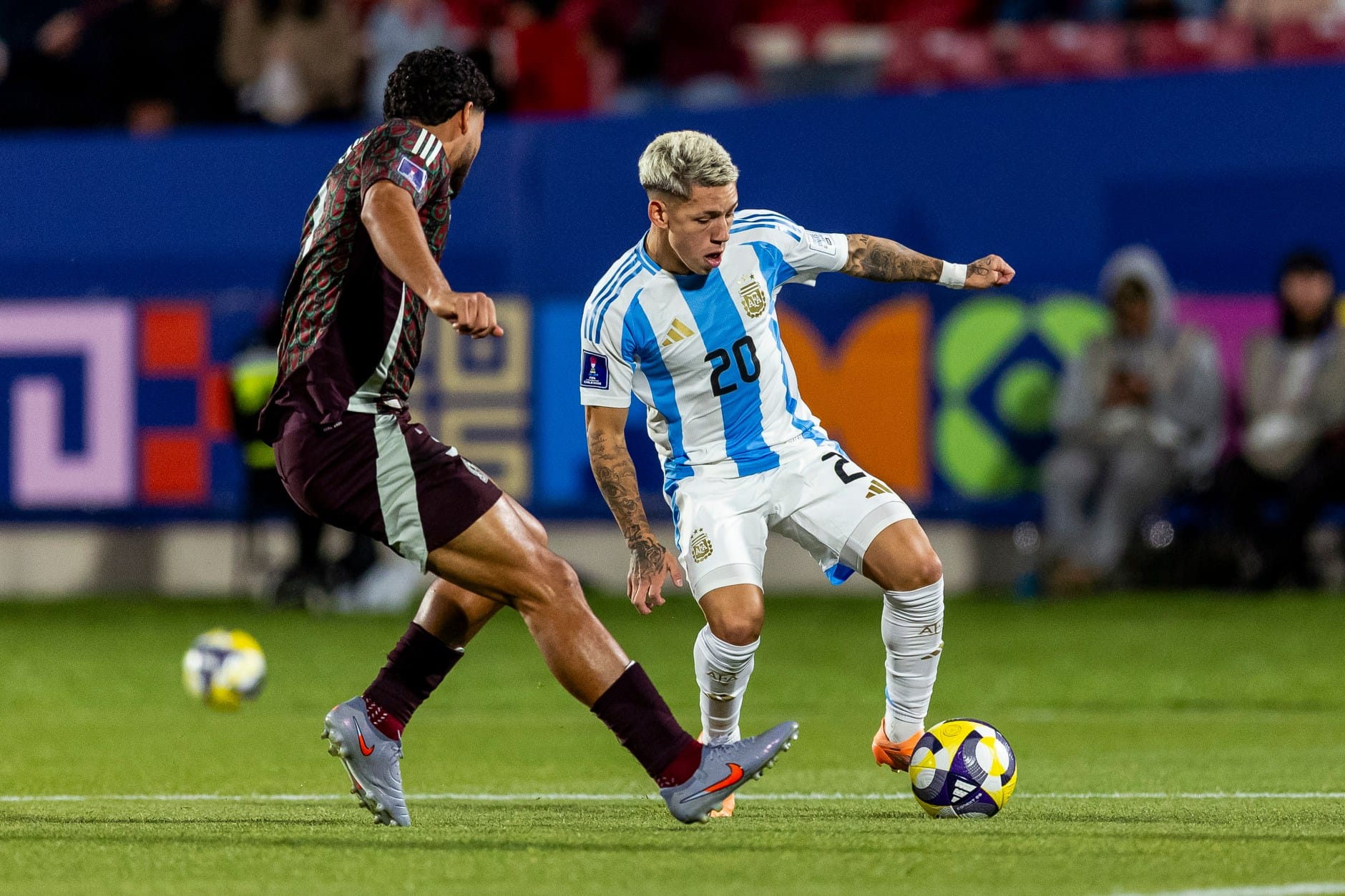
The irony embedded in the World Cup timing is specific. Vinicius Jr. will arrive in the United States as the standard-bearer for Brazil’s campaign to win its first World Cup since 2002 — carrying a squad that has lost Rodrygo and Eder Militão to injury, and that will need its best player to perform at his best across potentially seven matches. The man banned for what he said to him will be in the same tournament — sitting out the first two games of Argentina’s campaign, watching from the stands as defending champions begin their defense.
Whether the two men end up on the same pitch in the knockout rounds depends on how both teams perform in the group stage. Argentina is in Group J with Algeria, Austria, and Jordan. Brazil is in Group B with Morocco, Scotland, and Haiti. If both teams advance — which is the expectation for both — their potential meeting would arrive in the later rounds of a tournament that runs until July 19.
What FIFA’s Extension Signals
The extension of Prestianni’s ban to World Cup effect is significant beyond the individual case. It represents FIFA using its Article 70 mechanism assertively — applying a domestic competition punishment to the global stage in a case involving racist and homophobic abuse of one of the world’s most prominent Black players.
FIFA has faced consistent criticism for being slow and inconsistent in its response to racist abuse of players at the international level. The Prestianni extension, combined with FIFA’s push to make covering one’s mouth when insulting an opponent a red card offense at the World Cup, signals an institutional posture that is more aggressive than its critics have given it credit for.
Whether that posture is applied consistently — whether incidents involving players from less commercially significant nations receive the same treatment, whether fan behavior at the tournament is policed with the same rigor — will be visible across 104 matches played in 16 cities over 39 days beginning June 11.
The tournament that begins in Mexico City on June 11 is the first to include 48 teams, the first co-hosted by three nations, and the largest sporting event in human history by attendance projection. It will also be the first World Cup where a player was banned from its opening matches specifically because of what he said to Vinicius Jr.
Prestianni will watch Argentina’s first two games from somewhere that is not the pitch. Vinicius Jr. will be in Philadelphia on June 19, playing for Brazil against Haiti. The tournament has not yet begun. The story it is inheriting has been running for years.


