

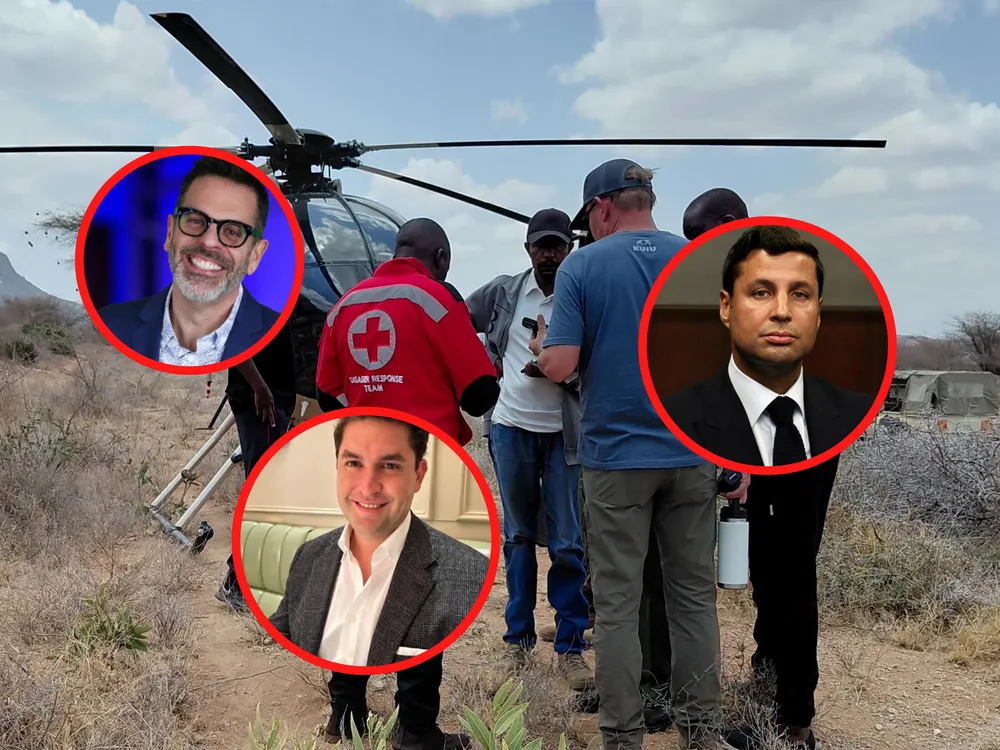
MIAMI — A safari helicopter crash in a remote stretch of northern Kenya killed all seven people aboard on Wednesday, August 19, including two men with deep ties to Miami — a well-known restaurateur and a longtime Telemundo television executive — turning a tragedy thousands of miles away into a loss felt directly across the city’s business and media communities.
The helicopter went down at 9:13 a.m. local time while flying from the Loisaba Conservancy to the Ewaso Nyiro area in Samburu County, according to Kenya’s Civil Aviation Authority, which said an investigation into the cause was underway.
The aircraft crashed in the foothills of Mount Ololokwe. David Nkoroi, the police commander for Samburu, confirmed all seven people aboard — six passengers and the pilot — had died, though authorities did not immediately release their identities.
The U.S. State Department later confirmed five of the seven victims were American citizens. “We extend our deepest condolences to the families and loved ones on their loss,” a State Department spokesperson said, adding that the U.S. Embassy remained in contact with Kenyan authorities and was providing consular assistance to the victims’ families.
The Miami Restaurateur
Roger Edward Duarte, 39, founder and owner of George Stone Crab, a Miami-based stone crab home-delivery business, was among those killed. His family confirmed his death in a statement describing themselves as “devastated and heartbroken.”
“The magnitude of this tragedy is impossible to comprehend, and there are no words to express the depth of our pain,” the Duarte family said. “We ask that you keep them all and everyone who loved them in your prayers.”
The family’s statement also named the other passengers and the pilot who died alongside him.
The Telemundo Executive
José Alberto Suárez, president and general manager of the Telemundo-owned stations serving Orlando, Tampa, and Fort Myers-Naples — Telemundo 31, Telemundo 49, and Telemundo Fort Myers-Naples — also died in the crash.
Suárez had deep roots in South Florida television, having worked at CBS Miami in the 1990s before building a long career at NBCUniversal’s Telemundo stations.
In a memo sent to staff and obtained by multiple news outlets, Telemundo and NBCUniversal executives remembered him as a deeply respected leader.
“José was an exceptional colleague and mentor to many,” the memo read. “He cared deeply about his teams, the communities they served and the essential role our stations play in people’s lives. He brought energy, humor, warmth and a strong sense of purpose to his work, and his impact was felt far beyond the stations he led.”
The Ecuadorian Connection
The crash’s international reach extended further still. Michele Sensi-Contugi, who directed Ecuador’s National Intelligence Center, also died, along with his wife, fashion designer Stephany Hollihan.
Ecuador’s government of Daniel Noboa issued its own statement of condolence following news of his death, extending sympathy to his family during what officials called a moment of deep sorrow.
Two Other South Florida Victims
The crash claimed two more lives with direct South Florida ties. Henry Parra and Adam Hlavaty, a married couple from South Florida, were also among the seven killed while on safari. The pair, who married in 2017, were remembered by friends as passionate travelers who loved exploring the world and giving back to the communities they visited, according to accounts shared with NBC News.
A Region-Spanning Tragedy
Taken together, the crash’s victims formed an unusually interconnected group for a single accident: a Miami food entrepreneur, a Spanish-language broadcast executive who had shaped television coverage across three major Florida media markets, Ecuador’s top intelligence official and his wife, and a married South Florida couple.
That the disaster claimed so many lives with direct ties to Miami and its broader Latino business, media, and diaspora communities has made the story resonate locally in a way few international accidents do — less a distant headline than a loss that touches restaurant tables, newsroom floors, and diplomatic circles across the city at once.
For Miami specifically, the crash lands with a weight that extends beyond any single victim. George Stone Crab, the company Duarte built, had carved out a niche in South Florida’s competitive seafood delivery market, built on the kind of entrepreneurial, food-centered ambition that defines much of the city’s small-business culture.
Telemundo’s South Florida-adjacent stations, meanwhile, are central to how millions of Spanish-speaking Floridians across the Orlando, Tampa, and Fort Myers-Naples markets receive their news and entertainment, making Suárez’s sudden death a loss felt throughout the broader Spanish-language media ecosystem Miami itself anchors nationally.
And with Ecuador’s own intelligence chief among the dead, the crash briefly pulled a Miami-adjacent tragedy into the realm of international diplomacy, a reminder of how frequently Latin American political and security figures pass through, or maintain ties to, South Florida's networks.
Kenyan aviation authorities have not yet released findings on what caused the crash, and an investigation remains ongoing. In the meantime, tributes have continued arriving from the victims’ respective communities: from NBCUniversal and Telemundo colleagues remembering Suárez’s decades of leadership, from customers and industry peers honoring Duarte’s stone crab business, and from Ecuadorian officials marking the loss of Sensi-Contugi’s intelligence leadership and his wife’s design work.
Friends of Parra and Hlavaty have likewise continued sharing memories of the couple’s shared love of travel and community involvement.
For a city as internationally interconnected as Miami, the crash stands as a stark reminder of how far its business, media, and diplomatic networks now reach — and how directly a tragedy on the other side of the world can still land close to home.